Saturday, February 22, 2014
Power Shift
This is interesting:
There was a time that I wanted to get into this field. I knew exactly what data the author had to be citing in the first chart--which I did not use here (the Correlates of War Project). I used it back in the day when I thought of going into quantitative analysis of war.
Those measures are valuable for long wars in the industrial age and earlier, but I'm not sure how it transitions to the modern era. By this measure China is more powerful than we are now, and has been since 1995. Which seems ridiculous on the face of it.
The four-measure (GDP, population size, military spending, and technology) power ranking puts off the day of a power shift but China still passes us by around 2030, or so.
Although if you assume our alliances hold and that power of numerous states is equivalent to the same unit of power wielded by a single state, China will take many more decades to surpass all of us in power.
Still, the noted power rankings reproduced above seems odd.
One, the rising Indian relative power ranking in the 4-measure calculation seems incredible and surely rests on population for a major component of power. I'm not sure how valid that is.
And while the multi-component power supposedly updates power for health, education, and governance not in the traditional measure, anything that ranks the European Union so highly in 2050 relative to other powers is suspect to me. Unless power is truly measured by the number of officially recognized cheeses, an EU power rank that high is laughable.
I suspect that the EU is just primed to be the most healthy, educated, and well-governed non-factor in global power consideration the world has ever seen.
Third, don't show this chart to Putin. I believe he'd be put on suicide watch given the apparent absence of Russian power surging back, which does not shock me. Russia is not "back" and they aren't coming back.
Fourth, even if our power sinks beneath India's to third place, much of China's and India's power will have to be focused on each other, absent a shocking alliance between the two. And don't speak of the Nazi-Soviet pact. That alliance between Hitler's national socialists and Stalin's bastion of socialism in one country was simply a ceasefire that each side thought would allow them to better position themselves for the ultimate showdown between them.
Regardless of our rank, America will remain the power with the most free power capable of being deployed to influence events around the globe.
Anyway, if China is a rising power relative to America (whether one includes our allies or not) and we even know how to measure national power, does a power shift indicate war?
That is, would we go to war with China fearing the loss of primacy? Would China go to war with America in anticipation of primacy? Or after gaining primacy?
One advantage we have in avoiding general war is that we lack a land frontier to have really tense face offs, the way we had with the Soviet Union at the Fulda Gap in West Germany during the Cold War. The vast Pacific gives us a bit of buffer to think clearly.
We are not in the position of Europe during its long history of warfare, whose powers had to figure shifting power when strong powers crowded each other on a small continent.
Unless China gains the ability to invade and occupy Japan, any Chinese gain such as South Korea, the Philippines, Taiwan, or Vietnam, will not give China a decisive advantage, but will give us notice that we are at war with China and allows us to wage a long war to disrupt China's trade and to seek an opportunity to counterattack around their periphery. The ability of China to really inflict a killing blow if they choose war doesn't seem terribly high to me, the way the USSR had the ability to inflict a major blow against NATO if the Red Army could advance to the Rhine River.
The reverse is true, too. We are not going to invade the Han heartland and try to occupy it.
So a power shift between America and China doesn't seem nearly as dangerous as it was in the past, which we define as Europe-based.
Note too that the scale stops at 2050. I suspect that the trend lines will reverse after 2050 through 2100, given Chinese demographic problems compared to US projections.
So maybe there will be another power shift back in our favor should China actually pass us in power by 2050.
Friday, April 20, 2012
2050? Ponder 2100
According to the UN’s population division, [China's] nationwide fertility rate will continue to decline, reaching 1.51 in 2015-20. In contrast, America’s fertility rate is 2.08 and rising.
The difference between 1.56 and 2.08 does not sound large. But over the long term it has a huge impact on society. Between now and 2050 China’s population will fall slightly, from 1.34 billion in 2010 to just under 1.3 billion in 2050. This assumes that fertility starts to recover. If it stays low, the population will dip below 1 billion by 2060. In contrast, America’s population is set to rise by 30% in the next 40 years. China will hit its peak population in 2026. No one knows when America will hit its population peak.
I wrote about population projections to the year 2100 (with all due caution about projecting that far ahead):
With all the caveats about projecting that far into the future, we could have from 60% of China's population to more people than China! Will China have twice the GDP per-capita as America then? With a population older than our population? Because if not, China's lead in gross GDP will not last and we will regain that title well before 2100 rolls around (unless India is the one to surpass us in gross GDP).
Don't write us off. Of course, if power transitions are dangerous periods, let's prepare for a couple as we might lose the number one slot before regaining it.
NOTE: Blogger still hasn't responded to my scheduled posting plight.
Sunday, February 01, 2015
Peak China
China has visible problems already:
Time is not on China’s side. There are numerous examples of this. One of the more obvious is the shrinking Chinese work force. While overall population increased 7.1 million in 2014 (to 1.37 billion) but the working age population declined 3.7 million (to 915 million). The number of Chinese over 60 increased 10 million to 212 million. All this began in 2014 and will continue for decades. The biggest problem, though, is the growing shortage of workers. As the population ages, all those one child families means there will be more elderly than the economy (and the shrinking workforce) can effectively support. Currently there are 11 working age Chinese for every retiree. By 2050, there will only be two for each retiree. At that point, retirees will comprise 30 percent of the population (versus 13 percent now.) Traditionally, children cared for their parents in multi-generation households. That model is dying out, and China is faced with huge pension cost increases at the same time they expect their economy to be the mightiest on the planet. But at that point, the largest single government expense will be the care of the elderly, and this will impose crushing taxes on those of working age. Many working age Chinese are worried about this, for there is no easy solution in sight. China tried (in 2013) to relax the one-child policy but the newly affluent Chinese are less eager than earlier generations to have a lot of kids. To make matters worse there is not much in the way of pensions or health care for most of the elderly to begin with. The government recognizes this is a real problem but does not, and will not have the cash to deal with it.
I've noted that even if China continues to gain ground on us, even passing us by, by 2050 we may reach peak China and see fifty years of America clawing back lost ground.
We have problems. But I wouldn't trade our cards for any other nation's hand.
Friday, April 22, 2022
Peaked China and Significant Shrinkage
For a long time I was probably on the more extreme end of the China Bear side even as there were so many China Bulls talking about China's future dominance. I was way too optimistic about China.
China reached peak population 16 years ago (tip to Instapundit):
They were going shrink in half by 2100. “Then they realized that they had been overcounting people for some time.” Then new data moved the date moved up to 2070. And now they’re saying it will be 2050. “For that to be true, the Chinese would have overcounted the population by 100 million.” And all of those missing people are of childbearing age.
In 2011, when unknown to any of us China had already peaked in population, looking at predictions of Chinese economic dominance by 2050, I wasn't sure China could do it. And if China did, I speculated America could reclaim dominance by 2100:
Let's imagine China and America in the year 2100, 89 years from now.
China's population is estimated to peak in about 2030 at 1.393 billion. By 2100, China will decline to 0.941 billion people. America, at a Census Bureau middle projection will tip the scales at 0.571 billion. At the high end projection, we'll have 1.182 billion people. Note that the projection made 11 years ago for today's population was 302,300,000 and the high end was given as 314,846,00. We are actually at 311,308,000, so we are closer to the high end prediction than the middle projection.
With all the caveats about projecting that far into the future, we could have from 60% of China's population to more people than China! Will China have twice the GDP per-capita as America then? With a population older than our population? Because if not, China's lead in gross GDP will not last and we will regain that title well before 2100 rolls around (unless India is the one to surpass us in gross GDP).
Mind you, America isn't going to reach the high end of population projections given recent demographic trends. But we'll still grow even as China shrinks faster. So we won't have to wait until 2100 to reclaim lost ground to China.
And what of the Chinese demographic problem? No big deal, eh? China got what it wished with a one-child policy, right? Turns out, no:
“China isn’t getting rich, it’s getting old.” They’re facing demographic collapse within a decade.
And to preserve Chinese Communist Party control of China, the author says war might seem like the least bad answer to get the people to rally around the CCP in the absence of prosperity.
First, the CCP doesn't even need to win a war it starts however nice that would be. Perpetuating CCP rule is the primary objective above all else, and losing a war to keep the CCP in power is a price the CCP is willing to have China pay.
I do not buy that it is all about the economy. When has history ever been about a rational calculation of how decisions affect the economy or even whether the economy is the focus of decisions?
Even if this logic is true, what if China faces an economic depression? Might not an invasion of Taiwan rally nationalistic support in the face of lack of economic progress? China's rulers wouldn't be the first to seek foreign conquest to still domestic unrest.
Worse, a China that thought it had until 2049 to show its strength openly may find it doesn't have nearly that much time if it wants to use war to lock in some gains while it can.
But the CCP rulers may still underestimate their danger. The existence of China as a political term rather than a geographic term may be the big question and not whether the CCP is in charge.
NOTE: War updates continue at this post.
Saturday, October 22, 2005
Look Forward
Russia's population has shrunk by more than half a million people this year, dipping to 143 million, the federal statistics agency said Friday.
Russia's population — the largest in Europe — has been declining steadily since the 1991 breakup of the Soviet Union, with increased poverty, alcoholism, emigration and degradation of the health care system blamed for reducing birth rates and life expectancy.
Since the beginning of the year, the population went down by 506,400, the agency said on its Web site.
Why is Russia's population declining? Increased poverty? Well, Soviets were pretty poor and Russia's economy has been growing so I'd want to see stats on this claim. Alcoholism? Again, hardly a new thing compared to Soviet times. Emigration? Ok, that holds true since the state no longer holds the people hostage. Degradation of health care? You have to pretend that Soviet care was good but I'll concede that universal access to crappy care is gone so even that has made the situation worse. HIV may be a bigger factor here.
And when you consider Russia's population decline you must remember that the Moslem portions are increasing so the extent of the Russian decline is masked by the fast producing Moslem population. And since all the factors the article lists affect the Moslem population just like the Russians, how can they be the cause of the decline?
The UN has the predictable solution:
United Nations experts have urged Russian authorities to boost social spending to improve health care and prevent the population decline.
I don't think this is the key. I think the ethnic Russians are just demoralized. Once the rulers of a superpower empire, now they are virually a petro state like Saudi Arabia that happens to have the legacy of a superpower's weapons programs whose momentum is still giving Russia some military power. They pine for past glory and Putin does not do them any good by forging a foreign policy that reflexively tries to relive the glory days when all they can do is associate with the scum of the earth and only remind themselves that the Hot Line is getting a little dusty. Russia is an annoyance and not a threat.
Russia's leaders need to stop trying to hang on to a past they cannot reclaim and look forward to a future within their grasp. As part of the West they can achieve much and regain a vision of prosperity and influence.
If the Russian leaders continue to pretend they are a superpower, what can they look forward to?
In a United Nations Development Program report released this week, demographers predicted that Russia's population will fall to 100 million by 2050, and could even drop to 80 million.
If Iran, due to Russia's support, is still a mullahcracy in 2050, Tehran will have the nukes and numbers to invade the Caucasus and take over Russia's Moslem regions between the Caspian and Black Seas. Only Turkey will stand in Iran's way.
Sunday, July 31, 2011
Window of Opportunity
Let's imagine China and America in the year 2100, 89 years from now.
China's population is estimated to peak in about 2030 at 1.393 billion. By 2100, China will decline to 0.941 billion people. America, at a Census Bureau middle projection will tip the scales at 0.571 billion. At the high end projection, we'll have 1.182 billion people. Note that the projection made 11 years ago for today's population was 302,300,000 and the high end was given as 314,846,00. We are actually at 311,308,000, so we are closer to the high end prediction than the middle projection.
With all the caveats about projecting that far into the future, we could have from 60% of China's population to more people than China! Will China have twice the GDP per-capita as America then? With a population older than our population? Because if not, China's lead in gross GDP will not last and we will regain that title well before 2100 rolls around (unless India is the one to surpass us in gross GDP).
In part, I've relied on a concept that--while I didn't know it--is called the "Lewis turning point."
AND now a RAND study should stifle some of the hyper-ventilating amongst the Commie fan boys in the West who dream of China's rise. Says the RAND monograph:
China is likely to become the most important contender over the next 40 years in terms of national resource base, but its relative GDP has everything to do with how high its per capita productivity gets vis-a-vis the Untied States. If it achieves Japan-like levels of productivity by 2050, its GDP will be double America's. If, however, it begins to level off as it approaches productivity levels characteristic of South Korea today, then China's economy will be somewhat larger than the American economy. Finally, if the many challenges that China has --pollution, corruption, and financing the elderly--are not met, China may reach an economic inflection point earlier rather than later and fail to surpass U.S. GDP levels. Demographics suggest that if China's economy cannot surpass the United States' by 2050, it might never do so.
Oh, and a sincere "eff you very much" to RAND for disabling copy functions in their PDF. That was thoughtful for something that they presumably want disseminated widely. No, really, I didn't mind freaking retyping something from the freaking web in the freaking 21st century. I'm fine with that. Really.
But I digress.
China wants to pass us by. They could do it. We shouldn't want them to, however. And unless we shoot ourselves in the foot and cripple our own economy to essentially throw the race (and God help me, I go to sleep every night trying to convince myself that our leaders aren't doing just that), there is no reason we have to give up our lead. Or if we do drop to the number two spot, no reason we can't regain the lead.
And never forget that when our relative power is in the balance, our geography gives us one heck of an advantage over China. In the future, when people speak of the "American century," we should be able to respond, "be more specific."
Saturday, April 08, 2023
When You Look So Hard for Defeat, It's No Shock You Find It
You'd think Iraq defeated America the way this article about the Iraq War was written. A war examined too closely is indistinguishable from defeat.
The article authors conveniently list the problems that supposedly make the invasion of Iraq a problem akin to Germany's invasion of the USSR in 1941:
Invasion led to diminished US influence in Mideast
Toppling of Saddam emboldened Iran, unnerved Gulf Arabs
Limit on US troop numbers enabled communal strife
Islamic State filled vacuum left by 2011 US pullout
'Strategic error' akin to Hitler’s Russia invasion - Armitage
US price tag for wars in Iraq, Syria $1.79 trillion - study
550,000-584,000 deaths in both countries, including 4,599 US military - study
That looks bad if you don't read farther and if you don't remember the war.
Let's take a look, shall we?
One problem for the entire examination is that the article complicates the question of Iraq by throwing Syria into the mix. And why is Syria in the mix. Because of ISIL, which spanned Syria and Iraq. And why is ISIL in the mix? Because America prematurely left Iraq in 2011, allowing it to rise up in Iraq with the Syrian east beyond Assad's control its extension. So it's kind of like adding in the costs of World War II to the First World War ledger, after America walked away from Europe in 1918 and ignored the growing threats of war there.
Let me go through the cliff notes charges and the article explanations.
What about that diminished American regional influence?
I think the claims about reduced American influence are misleading. One, without the Saddam threat, the need for American military power to oppose a now-defeated threat declined. That's good. Further, I think there is conflating of America's military presence--no longer needed at high levels (because we defeated Saddam and the Iraq insurgencies)--and influence. As the only game in town given our military power, of course we maintained influence.
What about emboldening Iran?
Gulf Arabs were worried about Iran. But it is nonsense to say that Iran "won" the Iraq War in our wake. The defeat of Saddam's Iraq didn't solve all problems in the Middle East. It solved the Saddam problem.
And the Iran problem pre-dated 2003. Indeed, Iraq under Saddam invaded Iran in 1980 in part because Iran's mullah-led government was stoking Shia Arab anger at the Sunni Arab minority government. Gulf Arab allies--ruled by Sunnis--did indeed see Iraq under Saddam as their shield against Iran. And their shield against the Shia majority of Iraq.
And note that while the Iraq War helped Iran penetrate Iraq, before we left we battled the pro-Iran militias and helped the Iraqi government break their hold.
But then the 2014 collapse of Iraqi forces helped Iran regain its armed militia foothold. Fortunately, Iraqi Shias increasingly resent and reject Iran's influence that destabilizes Iraq.
In this article, the basic problem is stated:
Iraqis would never have been liberated from the former regime, but the job is unfinished.
The job is helping democracy gain ground with rule of law to defend their freedom. I recognized that job before the war and continued to call for helping Iraq achieve that. Iran works to undermine rule of law to keep their hand in Iraqi politics through corrupt Iraqi politicians.
And really, raise your hand if you really want to argue that Saddam should have been allowed to continue oppressing and terrorizing the Shia Arabs.
After dealing with Iraq under Saddam, Iran was the next problem and we did not turn to face it. Instead we befriended and funded Iran with the awful 2015 nuclear deal. That emboldened Iran.
And as long as we're bringing up the Nazi invasion of the USSR, America joining the war against Nazi Germany and Allied arms and supplies for the Soviets just emboldened and strengthened the USSR. The Soviet empire was advanced all the way to the Elbe River in the divided Germany by 1945. And it might have been much worse but for American nuclear weapons.
Yet nobody says fighting the Nazis emboldened the Soviets, so we shouldn't have defeated the Nazis.
Still, at least the article doesn't make the most idiotic argument of all--that Iran actually won the Iraq War.
If so, Iran is pretty damned ungrateful to America. But it is not actually true. This argument is shallow strategic thinking in action.
Far from being a gift to Iran, the overthrow of Saddam eliminated the major reason Shia Arabs under Saddam's boot looked to non-Arab Shia Iran for help. Once in charge, the Shias increasingly lost their appetite for Iran and began to see Iran has a threat.
Further, by eliminating Saddam as a major anti-American state, the chance that Iran and Iraq might create a new Nazi-Soviet pact to focus on America was ended. That was a recognized problem of our pre-2001 "dual containment" policy.
Getting rid of Saddam also made it easier for Arab states to reach out to Israel to oppose Iran. Saddam was always ready to stand with the Palestinian terrorists and condemn Arabs who might want to focus on Iran, instead.
And by making Iraq an ally--less than perfect, but far better than an enemy--we could focus on opposing Iran.
And as to the unnerved Gulf Arab allies?
Well, Gulf Arabs were actually very concerned about Iraq, which had invaded Kuwait in 1990.
The article even notes the source of Gulf Arab unnerving was not the 2003 invasion of Iraq, but the 2011 total departure from Iraq:
The 2011 withdrawal of the U.S. troops from Iraq left a vacuum that Islamic State (ISIS) militants filled, seizing roughly a third of Iraq and Syria and fanning fears among Gulf Arab states that they could not rely on the United States.
Did the limit on U.S. troops enable communal strife?
Ah, troop strength. Except for two periods just after the conventional war phase of the war and mid-2004 during the dual Sadrist and Sunni jihadi uprisings, there were enough troops. The problem is that Western analysts only considered American troops the measure of troop sufficiency. America had enough troops under its command, including coalition and local forces, to win. And we did. So by definition we had enough troops.
Further, communal strife was strong already as Saddam's minority Sunni Arab government slaughtered and abused the Shias and slaughtered, abused, and even gassed the Sunni Kurds.
Go ahead, you explain to the Shias with centuries of oppression behind them that it was all a mistake.
And in another callback to World War II, do you even know what the chaotic aftermath of World War II in Europe looked like? Did that invalidate the defeat of Nazism, too?
Did the vacuum of American withdrawal allow the rise of ISIL?
Ding! Ding! Ding! You are correct, sir! But this actually undermines the claims that the Iraq War caused the rise of ISIL.
Remember, when American troops withdrew in 2011, Iraq was largely at peace. Both Obama and Biden praised the victory they were leaving behind.
Even Obama saw that we needed to defend what we achieved by initiating Iraq War 2.0 to defeat the revived Sunni Arab jihadis and their old Saddam partners who now controlled a proto-state across Iraqi and Syrian territory.
And again, the destruction of Nazi Germany created a vacuum in central Europe that the USSR filled. Any regrets about that?
Was invading Iraq and overthrowing Saddam a 'Strategic error' akin to Hitler’s Russia invasion?
Let's be clear. Germany's invasion of the USSR just led to the Soviets blasting their way into Berlin fewer than four years later, supplied by the Allies. And that was followed by the partition of Germany by the USSR and the Western Allies, whose armies met inside Germany.
So. What? You see anything even remotely like a parallel with America's experience?
Please note that this judgment is based on one man's opinion reported in the article.
Did American credibility suffer from failing to find WMD in Iraq? Perhaps. But every ally believed what our intelligence agencies believed. That it was a "slam dunk" that Iraq had chemical weapons.
And every grown up understood that Saddam was poised to quickly restart chemical weapons production once freed of our scrutiny.
Further, we were not required to prove Saddam had WMD. The 1991 ceasefire required Saddam to prove he had no chemical weapons and no material to produce chemical weapons. He refused to do that.
And today, allies from Europe, to the Middle East, to Africa, to Asia see the value of our security assistance.
Wow. What an epic disaster. I still remain in awe of how the original Iraq War went from "fiasco" to a "gamble" that worked so quickly.
But America had many reasons to destroy Saddam's regime, which we fought in 1990-1991, and through the rest of the decade and into the aughts, until destroying Saddam and enabling his trial and execution for his many crimes.
And at the end of the Iraq War and Iraq War 2.0, we had a training-wheel democracy struggling with rule of law that at least doesn't slaughter its own people. And it helps us kill jihadis every day. Iraq today isn't perfect. But it is much better. If you expected perfect, that's on you.
How is this not recognized as victory?
Was the US price tag for wars in Iraq, Syria $1.79 trillion?
One, I see we've lumped in Syria to this. And Iraq War 2.0.
Two, studies like that rely on taking a lot of costs not directly related to the war and then projecting them into the future. In some senses that is valuable to know. But now do social spending and interest on the debt. You'll get huge numbers for those categories with that method, too.
Three, since when is adding the interest on our debt the fault of the war? Isn't defense spending kind of a basic government function? Why do we count defense spending as borrowed money rather than paid for with tax money?
Four, we are wealthy enough to spend money instead of blood.
And five, let's look at American spending since 2003.
Going to 2011 when we totally withdrew from Iraq--but before Syria's civil war or Iraq War 2.0, our entire government spent $25.7 trillion. So the $1.79 trillion cost that counts those other wars with the Iraq War was less than 7% of our total spending.
And if you add in those other two wars and go up to 2022 spending, we find the federal government spent since 2003 $76.08 trillion. War spending to last year was under 2.4% of government spending.
And if you extend the spending to 2050 to compare the higher war spending number, what would that show? Let's charitably assume the next 28 years will only spend a per-year average of the 2003-2022 spending. That means total spending will be $182.59 trillion. So how does that compare to the $2.89 cost if we count veterans spending out to 2050?
Under 1.6% of spending. Optimistically.
Why didn't the article clearly note the parameters and definition of that "war" spending?
Also note that the war has been over for a while. American spending continues to shoot up.
Finally, the casualties.
American losses are beyond dispute. If you count the war as lasting until 2009, when we transitioned to a primarily training mission, you can round to 6 years of combat. Losing 4,599 troops is tragic but is a historically low casualty rate. That actually scared our potential enemies. Just ask the Russians how their invasion is treating their troops to see a real blood bath. In a country with less than half our population. In a little more than a single year.
Did a lot of Iraqis die? Yes. But contrary to the implication, America is not responsible for that high toll. The vast majority were the victims of the terrorists and death squads of our enemies. Had they not decided to fight and kill civilians after the rapid and low-casualty invasion, we would not have the death toll. Had they not decided to hide behind civilians, we would not have the death toll.
And to get the high total you have to add in Iraq War 2.0 that only erupted because we mistakenly withdrew all our remaining troops in 2011 and our jihadi enemies resumed slaughtering civilians in Iraq on a large scale in 2014.
Finally, adding Syria into this figure really bulks up the losses. Those losses were mostly caused by Assad's forces with a strong assist from ISIL--not from America's narrrowly focused efforts in the east supporting the Kurds and local Syrians who fought ISIL. Not really our fault, all things considered. Especially when we did not intervene against Assad to "avoid further militarizing" that civil war, as our genius diplomat put it.
Twenty Years.
So there you go. Today Iraq fights at our side against terrorists rather than threatening, invading, and undermining neighbors and creating regional instability. More Iraqis reject Iran. And Iraq has an imperfect democracy that desperately needs rule of law to make it real and enduring. But the democracy is far better than the 99.9% pro-Saddam elections that once took place under Saddam's brutal minority regime that slaughtered, terrorized, and tortured the majority.
Twenty years after the war started, the media is no better than it was at ten years in assessing the war. Their efforts demonstrate Sartre's observation that a victory examined in detail is indistinguishable from a defeat.
I must say, what really gets me annoyed and ranty are the authors who claim that the Iraq War upset the kite-flying stability of the Middle East.
Don't buy that "stability" BS.
One day there will be big-name authors and historians who will challenge the entrenched and incorrect conventional wisdom that America erred in fighting the Iraq War and that America lost the war.
But so far--even twenty year after we launched the war--that conclusion eludes most people.
We won the Iraq War. Get over it. And stop expanding the original war to include more wars in order to judge it a defeat or waste.
UPDATE: Oh, and let me link an old post that rejected a claim the war destabilized the Middle East. To be fair, the regional unrest was new to the documentary makers. So it must be new, right?
NOTE: TDR Winter War of 2022 continues here.
Sunday, May 26, 2024
Weekend Data Dump
Two more good jihadi leaders: "Iranian President Ebrahim Raisi
and the country’s foreign minister were found dead Monday hours after
their helicopter crashed in fog, leaving the Islamic Republic without
two key leaders as extraordinary tensions grip the wider Middle East." Don't rule out killer tomato attack.
Interesting: "The Navy is on track to homeport four Independence-class littoral combat ships in Bahrain next year as part of a new mine countermeasures force in the Middle East, service officials said."
China builds its first super carrier and American carriers prepare to meet them. I worry that the Chinese carriers are bait.
Why the panic over Kharkiv? And yeah, predictions of Ukraine's doom assume current trends accelerate. But Russia pays a price. That's a problem of analysis: You see your side's problems much more clearly than you see the enemy's. Still, trends must be reversed or Russia keeps its conquests. Via Instapundit.
As Ukraine expands its drone and sabotage attacks into Russia, I have to admit that my fear that strikes inside Russia would rally Russians to Putin's side was wrong. Of course, a portion may have rallied. But there is no obvious upsurge in determination to pay any price to defeat Ukraine.
Attention is needed. Alone this doesn't repel China: "After more than four years of negotiation, economic-assistance funding has been approved under the Compacts of Association, the agreements that govern U.S. relations with Marshall Islands, Palau and the Federated States of Micronesia." Kudos to Biden.
It's certainly another flashpoint: "If war breaks out in the Indo-Pacific, it will not be over Taiwan but over the atolls and shoals dotting the South China Sea. [The Philippines ambassador to Washington called] these sovereignty disputes, particularly between China and the Philippines, the region’s “real flashpoint.”
Smart Diplomacy®: "The United States expresses its official condolences for the death
of Iranian President Ebrahim Raisi, Foreign Minister Amir-Abdollahian,
and other members of their delegation in a helicopter crash in northwest
Iran." He's a thug. But Democrats loove mullah-run Iran. They're confused.
Optics? "The Biden administration was close to transferring 11 detainees out of the detention facility at Guantanamo Bay, Cuba, to a country in the Middle East in October 2023, but abruptly halted the move amid concerns about political optics after Hamas’ attack on Israel[.]" They should age and die there.
Drawing a line in the sea: "The U.S. Army is exporting its Joint Pacific Multinational Combat Training Center to the Philippines as the Southeast Asia country seeks to enhance and modernize its defense strategy."
Good to show we care: "Washington could sign off on a sweeping package of economic and security support for Georgia if its government abandons its increasingly anti-Western rhetoric and stops backsliding on human rights." I hope this isn't just a drive-by to pretend we care.
Progressing--but with hiccups: "The Czech-led initiative to fund and procure urgently artillery ammo for Ukraine is progressing steadily – the first 180,000 shells have been contracted and should arrive by June[.]"
The West was surprised that Russia speedily rebuilt its army. I was not. That's why since fall 2022 I desperately wanted a counteroffensive before Russia could recover. Russia bounced back from their 1939 debacle invading Finland and could do it again, I feared. The rebuilt army isn't good. But it's an army.
Kadyrov is bargaining with Putin to send more Chechen fighters to fight Ukraine.
The strangely vulnerable Finnish Aland Islands: "The self-governing archipelago stretching across the middle of the Baltic Sea officially belongs to Finland, its residents speak Swedish, and Russia is tasked with enforcing an accord that has banned any military presence on its shores for over a century."
Interesting: "Egypt is now building a 13.5 kilometer wall from the Mediterranean inland to the Israeli border town of Kerem Shalom to keep the Palestinian refugees fleeing the Hamas-Israel violence in Gaza."
France built a jet-powered anti-tank suicide drone: "Veloce 330 is expensive for a UAV, costing over $200,000 each." Speed and jamming defenses increase the costs, I imagine. And other drone stuff plus a digression--because they can--into firing rifles.
It would be nice if Iranians decided Allah gave them a good start on overthrowing the mullahs: "Funeral ceremonies have begun in Iran for president Ebrahim Raisi, foreign minister Hossein Amirabdollahian and other victims of Sundays helicopter crash." But Iran could get away with shooting and hanging Iranians.
No! Way! "[From the U.S.-built pier] on Saturday, only five truckloads made it to the warehouse after 11 others were cleaned out by Palestinians during the journey through an area that a U.N. official said has been hard to access with humanitarian aid."
It's mainly for testing: "The Navy on Friday took another step toward creating a surface fleet seamlessly integrated with uncrewed vessels by formally establishing its second unmanned surface drone unit."
The Army will upgrade and overhaul its M270 armored, tracked MRLS vehicles for future rockets.
I weirdly get a bunch of hits from Hong Kong lately. I assume this is a VPN disguising the point of origin. But I really don't know what is going on.
I wish more government officials would vow to stay in their lanes as I did. Sure reinforces my determination to keep doing this. Tip to Instapundit.
Welcome mat: "Top Finnish defense officials are moving closer to finalizing proposals aimed at filling the country’s NATO membership with life. One key consideration, which may require amendments to Finland’s constitution, relates to the hosting of alliance forces on Finnish soil."
It's perfectly appropriate to mourn a murdering, anti-American thug. Ah, Smart Diplomacy.® Tip to Instapundit.
FFS, this is for a supply emergency--is it really? Tip to Instapundit.
China struggles to keep their Burma vassal.
That seems dark [LINK FIXED]: "U.S. military forces training and deploying from their bases and
stations for a future conflict or crisis will likely face a growing
variety of threats close to home." Should I worry about more than what I do?
Jihadis seem so nice: "Hundreds of hostages, mostly children and women, who were held captive for months or years by Boko Haram extremists in northeastern Nigeria have been rescued from a forest enclave and handed over to authorities, the army said."
As night follows day, and as flying spittle follows rage, Putin waves about his nuclear missiles. Yawn.
Huh: "Norway, Ireland and Spain said Wednesday they would recognize a Palestinian state, a historic but largely symbolic move[.]" How did Hamas earn that? The October 7, 2023 murder, rape, and kidnapping invasion? Or Israel's decision to fight so such a mass atrocity can't happen again? The rewards escalate.
The harassment is probably more valuable than the damage: "The 'Code 9.2' drone unit, from the 92nd assault brigade, are moving into a new launch position from where they are about to conduct a rare and potent mission: flying drones into Russia and dropping mines onto key roads inside enemy territory."
This seems like a hyper-velocity shot in their own foot: "Russian physicist Anatoly Maslov was convicted of treason and sentenced to 14 years in a penal colony on Tuesday in the latest of several cases against experts working on the science underpinning Russia's development of hypersonic missiles." Ah, paranoia.
I'm calling BS on this: "Broadly using 'China' as a threat can strengthen CCP narratives and alienate non-CCP Chinese communities." Everyone knows "China" means the CCP-controlled state. Let's not descend into paralyzed drooling idiocy.
Useful for static positions--if it it works: "After receiving four high-power microwave prototypes designed to stop drone swarms, the US Army is preparing to send them on to the Middle East to see how they perform[.]"
The China-Pakistan axis. I don't think that Pakistan is enough to enable a Chinese wartime presence in the Indian Ocean. But China has A2/AD options there. At least America isn't paying to sustain Pakistan. Good luck to China on that.
I've been informed by strategists that this means Russia forfeits its right to independence: "A deputy chief of the Russian military general staff has been arrested on charges of large-scale bribery, Russian news reports said Thursday, the latest in a series of bribery arrests of high-ranking military officials."
True love: "Whistleblowers’ emails reveal John Kerry blocked the FBI and DOJ from arresting Iranian terrorists and agents on U.S. soil in order to protect his Iran deal." Because of course he did. Tip to Instapundit.
Fear of what we would do to Iran would be better protection: "American army engineers in the Middle East are building reinforced above-ground bunkers to protect soldiers from the impact of larger and more powerful ballistic missiles being used against them." But ...
But they're such polite budding fascists. Tip to Instapundit.
F**k the ICC: "Hamas' use of so-called human shields -- that is, human hostages positioned between Hamas terrorist murderers and Israeli weapons -- is a crime." Israel is fighting as clean as it can--under the rules of war. Hamas fights dirty. Spent shell casings and dead Palestinians are just the detritus of their war.
Hamas rapists and murderers thanks their supporters in the West. Tip to Instapundit.
I'd rather have a U.S.-Saudi security deal--but details are important--than focus on preventing Israel from entering Rafah to finish off Hamas battalions able to function in Gaza. While the author isn't interested in the Middle East, the Middle East is very interested in us. Also, U.S. ships and planes oppose China, too.
This author says Israel is defeating Hamas. I disagree with the author's dismissal of COIN in Iraq and Afghanistan, but it's true you can't win the hearts and minds of an enemy that hates you. Israel wants to smash and contain Hamas within Gaza so October 7, 2023 can't happen again. That's the "day after" plan.
But could China sustain a blockade? "China on Thursday encircled Taiwan with naval vessels and military aircraft in war games aimed at punishing the self-ruled island after its new president vowed to defend democracy."
Loafers on the ground in New Caledonia: "Arriving in Nouméa after a 24-hour flight from Paris, President Macron said he wanted the return of peace, calm and security 'as quickly as possible'."
Sweden should definitely hold Gotland: "Russian President Vladimir Putin is targeting a strategic Swedish island that offers mastery over the Baltic Sea, the commander-in-chief of Sweden's army warned this week." But Russia is doomed there, surrounded by NATO states all around the sea.
A provider and not just a consumer of security: "Swedish Prime Minister Ulf Kristersson on Wednesday announced that his country would give Ukraine a further €6.5 billion ($7 billion) in military aid spread over three years to ward off Russia's invasion."
Some Israeli ministers want a "day after" plan for Gaza. Don't get distracted from the need to crush Hamas on the battlefield. Israel needs a rebuilt hate-free Gaza with a coexisting counter-example. Could a virtual Pal-E-stine state be part of a plan?
This example of a "prominent role" is a particularly bad idea: "The Biden administration is considering appointing a U.S. official to serve as the top civilian adviser to a mostly Palestinian force when the Israel-Hamas conflict ends[.]" The advisor will be a shield to protect Hamas. Even if it doesn't start that way.
So a LCS, a dry cargo ship, and a Dutch frigate walk into a sea: "A pair of U.S. Navy ships took advantage of a rare chance to train alongside a Dutch vessel this week in the South China Sea, according to U.S. 7th Fleet."
A disturbing lack of a sense of urgency: "The first batch of Ukrainian pilots have graduated from U.S. F-16 training, a National Guard official told Air & Space Forces Magazine on May 23." This is taking way too long.
Sure, Assad wants to reduce Iran's influence in Syria after Iran helped Assad slaughter his opposition. And Russia would like to shiv its Iran rival. But now Russia needs Iran's weapons to invade Ukraine. So Assad looks to America. But the monster Assad only wants to leverage our aid. And Biden won't harm Iran.
China is used to bullying Manila: "The Philippines will continue to build security alliances and stage joint combat drills in disputed waters to defend its territorial interests, Defense Secretary Gilberto Teodoro said Friday, dismissing China’s criticisms of such moves as paranoia."
We now know Kenya's price for sending troops to pacify Haiti is: "President Biden on Thursday announced his intent to designate Kenya as a major non-NATO U.S. ally, the first such designation for a sub-Saharan African country."
How the "our" democracy form of elections works: "In May Iran held national elections and hardline pro-Islam candidates
obtained 233 of the 290 parliament seats. The candidates for election
must be approved by the government, which is dominated by conservative
religious leaders." I object to "conservative".
Robot pilots: "What is novel about ROBOPilot is not that it can replace a human pilot, but that the ROBOPilot equipment is flexible enough to be quickly installed in any manned aircraft. ROBOPilot software has to have an electronic profile of each aircraft it can be installed in and has to be tested [.]"
Hearing the International Court of Justice complain that Gazans are being "displaced" from Rafah is a complaint against Israel evacuating civilians from a looming combat zone to protect them. Huh.
Stay away: "Taiwan scrambled jets and put missile, naval and land units on alert Thursday over Chinese military exercises being conducted around the self-governing island democracy where a new president took office this week."
On Memorial Day, I will repeat that rules of war are really more about protecting our soldiers from what they must do in war: "'It ain’t the dying that’s scary, boy, it’s the killing.' [And] when they come home from war, they must learn to live again as a civilian." Although Veterans Day is for remembering that.
Marines are getting an upgraded LAW disposable rocket launcher that can be fired from inside buildings or bunkers. Also, the trigger is no longer on top where firing can disrupt aiming.
The new high ground: "The National Reconnaissance Office said it launched the first satellites in its proliferated constellation, which will provide rapid data collection and delivery across multiple orbits."
Decline: "The U.N. forecasts China's population, now the world's third largest [Huh?] after India, will shrink from 1.4 billion to 1.31 billion by 2050. Yi argues that the prediction is too optimistic[.]" He sees one billion in 2050--if its fertility rate doesn't drop below 0.8. The decline has been evident for some time.
I'd like to believe it's that easy: "Two of the world's most important chip companies can flip a 'kill switch' remotely on their most advanced chipmaking machines should China invade Taiwan, Bloomberg reported on Tuesday, citing people familiar with the matter." The chips made will work, of course. Via Instapundit.
Huh: "Russian border guards have removed navigation buoys from the Estonian side of a river separating the two countries, the Baltic nation said on Thursday, adding that it would seek an explanation as well as a return of the equipment." My "Kargil scenario" for Narva post was timely.
New Caledonia unrest: "Macron’s supreme arrogance is now tearing apart the French empire[.]" Macron took his eye off the ball of keeping his remnant of empire together to pursue his real imperial objective.
The U.S. announced another batch of assistance to Ukraine, apparently mostly ammunition. Plus some protective gear for chemical weapons, which is good because Russia has been routinely using banned tear gas grenades on Ukrainian troops.
What he said: "It is one thing to say that protecting America’s borders is of equal or greater importance than protecting Ukraine’s. It makes no sense to argue, however, that if money is not allocated to protect America’s borders, Ukraine’s should be left molested." We must help Ukraine defeat Russia in Ukraine.
Does this mean Xi and Putin think only nukes can stop them? "General Secretary Xi Jinping and Russian Federation President Vladimir Putin issued an odd one-sentence communique: 'There can be no winners in a nuclear war and it should never be fought.'" Or Xi laid down the law to his vassal who had to agree.
Our special forces have a new recon/strike drone. With this ability: "Beak is equipped with anti-jamming technology and will return to its launch site if the jamming overwhelms the GPS navigation system." Why can't the enemy jam the drone, watch it return to the launch site, and drop rounds on the location?
As American military aid resumes, the Kremlin spreads rumors that Putin wants to negotiate. But he won't give up his conquests. All he wants talks to do is slow Western aid to Ukraine and buy time to repair his ground forces.
We are not going to "transition" from fossil fuels to "Green": "The world will need all forms of energy production imaginable. An 'energy transition' would only restrict energy supplies—and that’s not going to happen." Middle East energy exports remain crucial, even if America buys nothing. Via Instapundit.
Ukraine is installing anti-suicide "cope cages" plus explosive reactive armor panels on its Abrams tanks. Good. Tanks die. They do.
Russia is running out of armored vehicles: "Recently, the Ukrainian army has recorded an increase in the number of assault operations by enemy units on motorcycles, buggies and golf carts or unarmored Ural trucks encased in anti-drone cages." And "turtle tanks." Ukraine can beat Putin's Potemkin-ish army.
The B-21 is extremely stealthy. I assume the fleet size means they will be used in the Pacific for long-range conventional strikes against PLA ships and ground targets, and not just nuclear roles. But stealthy isn't invisible. How long before air defenses use AI-equipped optical sensors to find and track them?
Japan is joining a significant biennial American exercise: "About 4,000 Japanese troops, eight vessels and 60 aircraft will join Valiant Shield from June 7 to 18, the Japanese spokesman said."
Ukraine plans to cut 2/3 of bloated senior staff officers: "'With the released personnel, it is planned to replenish units at the operational and tactical levels, as well as military combat units,' said Brig Gen Yevhen Ostryansky, head of Ukrainian military defence planning." Lower ranks will be empowered, too.
Communism is as evil as Nazism (tip to Instapundit). I don't know how much of the evil has been infused in Russian society after many generations of Marxist poison. Or maybe there is a reason Russian society embraced it. Either way, I don't want Russia any farther west than it is now. And I worry about that.
Does this mean that Russia considers the former Wagner fighters included in the force are loyal enough--or better off dead on the battlefield? "Russia has deployed Africa Corps units to aid its offensive in Ukraine's Kharkiv region, UK Intel says."
"Unrest" is almost always bad for tourism: "France has begun evacuating tourists from its overseas territory of New Caledonia after days of unrest in the Pacific archipelago."
Thankfully we have allies: "Currently the actual Chinese defense budget is $700 billion a year, nearly as much as the United States spends. China claims it is spending less but does so by ignoring spending that the Americans include and the Chinese are now matching what the United States spends."
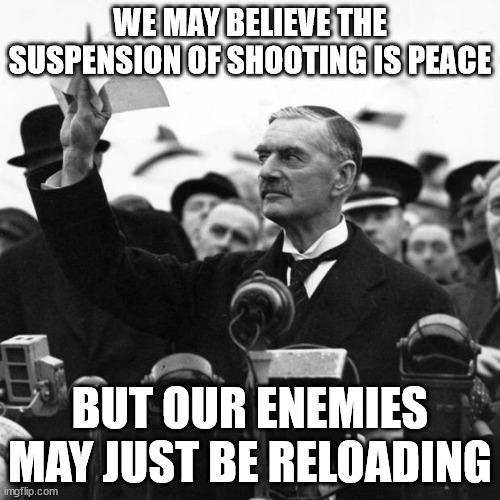
Remember that when America left South Vietnam, the "peace" treaty allowed North Vietnam to keep their troops in place inside South Vietnam. North Vietnam reloaded and from those positions, invaded South Vietnam and conquered it in 1975. Don't pressure Ukraine to do that, too.
Hmmm: "Himars rocket launchers supplied to Ukraine by the US have been left “completely ineffective” because of Russian electronic jamming systems." And other GPS-guided ammunition, too. No doubt there is at least some truth to this report. Is this over-stating the effects to mislead Russia?
In more news for those emerging from a decade-long coma: "An exiled Iranian resistance group has uncovered damning evidence
showing top regime officials' direct involvement in supporting the
Houthis in their attacks against ships in the Red Sea." File this away in the "Well, Duh" folder.
Friday, November 27, 2020
Peak a Boo
Has China peaked? It would be good if it has. But a China at this level will be a scary threat to its neighbors for a long time to come.
The Chinese Academy of Science predicts that China’s population will peak at 1.4 billion in 2029, drop to 1.36 billion by 2050, and shrink to as few as 1.17 billion people by 2065. Ominously, if fertility continues to drop from its current rate of 1.6 children per woman to a realistic 1.3, China’s population would be reduced by about 50% by the turn of the next century. And the composition of that population will also change in significant ways. Most significantly, the population will continue to get older. ...
Second, and despite the night terrors of some and the fever dreams of others, the reality is that China’s meteoric economic rise is stalling. Rather than displacing the United States and becoming the next economic superpower, China is instead entering into a period of economic entropy and relative decline—with all that that implies for internal disaffection and unrest.
The reason for this is that China now finds itself ensnared in a classic “middle income trap.” This term refers to a situation in which rapid growth and the equally rapid attainment of the status of middle-income country is followed by a period of stalled growth and failure to achieve the status of high-income country. A country falls into this trap when it loses its competitive edge in the export of manufactured goods because of rising wages.
But I haven't been panicked about the rise of China. Concerned, of course, but not convinced that China would pass America by. Or if they did, whether the Chinese could hold their lead.
Five years ago I wrote that China's peak was in sight. Two years ago I wondered if China's meteoric rise was over. Last year I looked ahead to the relative decline of China and asked if the China Century was over already (before it could begin). And in the summer it seemed like peak China might be here. I asked if the next century would be another American Century.
And never forget what I warned fifteen years ago. Even dominance within their own region can have global impact. Even if China is peaking right now, the danger a communist regime poses to the world is not over.
Friday, January 25, 2019
The Great Fall of China
This worsening slowdown, which is the new normal for China, may have major effects on Beijing’s foreign and security policy. On the one hand, it will become increasingly unaffordable for China to build the type of military it has been aiming at for decades now; indeed, Chinese defense spending has already dropped from years of double-digit increases. It is still the world’s second-largest military budget, and the People’s Liberation Army is modernizing, but projecting out slowing growth rates into the future means that Beijing will have to make hard trade-offs between domestic spending on an aging population and fielding the world’s most powerful armed forces. Thus, in a few decades, we may look back at today as the high-tide of China’s global power.
Well, the current time is certainly the age of China's peak toil, but I think 2050 might be the Chinese power high tide. But yeah, the China century might be fading before it can get started.
The author is right that peak China doesn't mean the danger has passed. I've worried that China might decide that striking before their situation worsens is their best course to lock in any transient advantages they can get now.
That's more of a worry than thinking America might strike first to avoid China taking the lead. I just don't think the Thucydides Trap is applicable to the US-China competition.
And remember, saying we are entering an "Asia century" is not the same as saying we are entering a "China century," thus denying the problems that could derail China's rise. America is in the Pacific, too, and is part of an Asia century. So Asia can rise without China leading it.
Honestly, Russia has more to worry about than America if China wants a signal victory.
Wednesday, August 15, 2018
The Communist Party Stamp of Approval
An op-ed in a state-run newspaper titled "Giving birth is a family matter and a national issue too" is the latest to encourage couples to have more children, and call for official action to enable young people to start families.
The full-page column was published in the overseas edition of the People's Daily, mouthpiece of the Chinese Communist Party. It warned that "the impact of low birth rates on the economy and society has begun to show."
The piece has attracted millions of comments online, and comes as the government revealed a new official postage stamp, which seems to hint that it may drop the remaining restrictions on the number of children people can have.
The stamp shows two happy pig parents with 3 happy piglets.
The 2015 change hasn't had the effect China's rulers hoped it would have, and a shortage of workers as the still-poor China faces an aging population without the means to support it.
Interesting enough, the relaxation hasn't had much of a birth impact, but it has led to companies being more reluctant to hire women lest they get pregnant more than once.
I've written that China has population problems that could well mean that if China doesn't surpass America by 2050 it might never do that, and even if it does America could regain the lead by 2100.
UPDATE: I didn't think the 2015 change (or the relaxation in 2013) would lead to a baby boom. I find it hard to believe this change will have any effect--except perhaps to encourage poorer ethnic minority communities to have more children. Which isn't exactly what China's rulers want.
Wednesday, February 06, 2013
Be Careful What You Wish For
China's working-age cohort just dropped:
On January 18th, the National Bureau of Statistics (NBS) announced that China’s working age population (ages 15-59) had declined in 2012 by 3.45 million, or 0.6 percent, marking the first decline in working population “in a considerable period of time.”
The head of NBS, Ma Jiantang, admitted: "I can't deny that I'm worried about this problem.” Indeed, the problem is perhaps more serious than originally thought. HSBC co-head of economics Frederic Neumann commented in the Financial Times, “Most projections . . . estimated that the decline in the working age population would start around the middle of this decade…but [the numbers] show it has already happened, which suggests the decline over the next few decades will be faster than expected.” UN figures showed that China’s total population would start declining after 2030, a number that senior Communist Party officials are now revising to 2020, by which point the China Development Research Foundation estimates that the working age population will decrease by another 29 million.
Eliminating the one-child policy would not cause a dramatic rise in population growth, although it would help out fifteen years down the line. Societal changes would keep the birth rate from shooting up. Worldwide birth rates are dropping dramatically without one-child policies, after all.
As the article notes, this problem is cropping up earlier than expected even a year ago when I discussed the implications of the imminent peak labor force:
Until now, much of China's growth has been based on the "Lewis turning point" that reflects direct inputs of new workers rather than more efficient use of existing workers. Once the direct input slows, wages rise and the comparative production advantage erodes. As I liked to say, take the most efficient peasant and take him from a farm and put him in the most inefficient factory and the GDP he produces goes up.
The years 2050 and 2100 may look very different from today where anybody who is anybody tries to predict when China takes over our top spot on the globe.
China has a lot more people than we do. Yet they may not have enough workers to complete their rise even though they've made tremendous progress.
China got their wish. Now they have to figure out how to cope with it.
And the coping may not be going well, if other statistics are being fudged (either as state policy or as a general hope of underlings that everyone else is being accurate and they don't want to be the only ones reporting disappointing economic strength up the chain of command) in China (tip to Instapundit):
When China announced better-than-expected trade numbers last month, the statistics were met with outright suspicion from international powerhouses such as Goldman Sachs, Swiss financial firm UBS and Australian bank ANZ. The disbelieving scoffing only mounted days later, when the government unveiled numbers showing yet another positive trend — a narrowing income gap between China’s rich and poor.
Numbers in China have long faced suspicion, from optimistic recordings of visibly hazy air to the age of its Olympic gymnasts. But the credibility of its economic data is now coming under particular scrutiny, at a time when China’s growing global role weighs on investors, analysts and governments worldwide, even as the country’s economy is slowing after years of unbridled growth.
China's rulers have replaced communist purity with economic growth as a reason to justify their control of the country. If economic growth falters, the Chinese may want to ramp up the nationalism that they've kept bubbling on the back burner just in case they need that rallying cry.
China's rulers may wish for that as better than the alternative of losing the Mandate of Heaven. But there is danger that they could be driven by those passions rather than controlling them for their own benefit.
If China has to rely on stoking nationalism rather than economic growth to legitimize the Communist Party's monopoly of power, we might want to speed up that pivot to Asia, eh?
Saturday, November 18, 2023
Navy Strategery Guidance is Silent on Phase Two
Controlling the seas runs through controlling the climate?
The Navy's updated "strategic" guidance
"includes combatting climate change as one of four actions required to
strengthen the Navy’s maritime dominance." Phase 2 remains murky:
Citing climate change as “one of the most destabilizing forces of our time”, Del Toro curiously claims that achieving the Biden Administration’s commitment to net-zero greenhouse gas emissions by 2050 will enable the Navy to become a more agile, capable, and lethal fighting force. Including the questionable connection between emissions reductions and combat capability is enough to undermine his guidance, but there is an even greater deficiency – nowhere in the guidance is there a direct mention of China and our urgent need to outcompete that country in the race for maritime superiority.
WTAF?
Ah, one more substitute for victory from our top defense people who can't seem to focus on real military problems.
I was right to worry about del Toro. One day our ships will be designed so that when they are sunk they won't release dangerous pollutants into the sea and air. Because woke lips sink ships.
NOTE: TDR Winter War of 2022 coverage continues here.
NOTE: I'm adding updates on the Last Hamas War in this post.
Sunday, May 30, 2010
The Glass Ceiling
But does this mean that China will become the dominant nation? Probably not:
But in any case one flawed assumption Jacques entertains is the idea that the rest of Asia will simply acquiesce to China’s emerging hegemony. While all the region seems to sense that they have little choice but to work with China and accept to some degree its growing economic and strategic footprint, there is something else afoot. Looking around China’s periphery, Japan, India, Indonesia, Vietnam, and Australia are all hedging against a Sino-centric future, bolstering ties to the U.S. and strongly encouraging U.S. deeper engagement in Asia. This is not any sort of “containment” but perhaps a sort of balancing. If China pursues a pattern of blatently aggressive, imperious behavior, these nations along China’s periphery could form the nucleus of a counter-weight.Yes, China has inspired neighbors to arm up and reach out to us to help them balance China. As China gains offensive capabilities against their neighbors, their neighbors respond by developing capabilities that can be turned against China. Our power becomes more relevant to each under these circumstances.
Will China Rule the World? A bit of an overstatement. But looking out to 2050, viewing China as a dominant player in a multipolar world would not seem unrealistic.
And even if China matches us in power or even surpasses us, we will continue to have more free power to project far from our shores than China can ever muster given all the hostile or potentially hostile neighbors that pin China's power in place.
And this is worst case, as near as I can figure. Don't count us out in retaining the number one spot absolutely.