Sunday, July 22, 2012

A Disturbing 1930s Vibe

Europe's long peace is threatened by the massive debt accumulated and the temptation to blame others for the problems this borrowing has caused. One major refusal to pay debts and rein in further borrowing could cause chaos:

Europe is one demagogue away from causing an earthquake in global finance such that the current problems seem a tremor in comparison. If Silvio Berlusconi – the only truly populist politician the continent has produced in the last half a century – were 20 years younger, I fancy it would have been him. As it is, a great deal now depends on whether a man will emerge somewhere in Europe capable of pushing nervous and resentful electorates over the precipice to outright default.

Is a man on a white horse really so far fetched?

And if Western Europe--the forward line of NATO--falters for even a bit, would Russia--which has dangerously promoted the idea that NATO expansion was a stab in the back--take advantage of the disorder to engineer an anschluss with Belorus and Ukraine?

Do you really wonder why I keep beating the dead horse of keeping a robust American Army presence in Europe?

Good for the Gander

With Greece battling the EU to change their financial policies; Greece working with Israel as the Turks turn away from Israel; Russia setting up a naval base in Syria; Turkey taking the lead in opposing Russia's ally, Assad; and Russia working more closely with Israel over energy resources, could we see a major Russian play for the loyalty of Greece?

Would Greece default on their debts to the world, and pull out of NATO as well as the EU, if Russia offered to back Greece's economy and finance (and shield from Turkey) projects to exploit off-shore Greek (and Greek Cypriot) oil resources? Could this flip in foreign policy be seen in Athens as the solution to Greece's financial and diplomatic problems?

Would Russia like to get our bases on Crete to support their eastern Mediterranean goals--and stick it to us in the process with a little payback for America winning the Cold War and poaching the former Soviet empire for NATO expansion? (OK, asked and answered.)

Could the Truman Doctrine be rendered null and void?

Saturday, July 21, 2012

Getting Shakespeare

It always cracks me up when a supporter of Obamacare will rattle off 3 or 4 provisions of the act that are popular with voters. No doubt, some of that massive act are popular. How inept would they have to be to fail to put anything good in it?

But even if you assume 4 provisions that take 10 pages each to define, what about the other 2,660 pages of Obamacare statutes?--and I have no idea how you count the reams of administrative rules that follow in the wake of that massive piece of legislation.

The defense is simply astounding to me. If you had enough monkeys typing away for long enough, how could you not get a provision letting you keep your 26-year-old "child" on your health insurance?

Damascus Dan

Syria's media is insisting that all is well and that people should remain calm:

EVEN by the standards of Syrian state television, the gap between fact and fiction yawned unusually wide on July 15th. With street battles rattling Damascus, the capital, for the first time in Syria’s 17-month uprising, a roaming camera crew struggled to find a picture of reassurance. “Nothing’s happening! Its completely quiet!” a trio of veiled women shouted at the microphone poked through their car window, as gunfire crackled in the background. They seemed anxious to speed off, as did a lone pedestrian waylaid on an eerily deserted boulevard, who briskly agreed that things were “normal—very, very normal”.

Syrian security forces are fighting at Aleppo at the northern end of the Jordan-to-Turkey road, but if Assad wants to retreat to Core Syria, I think Aleppo is a bridge too far. Friendly populations need to be evacuated from there.

Assad has to cut his losses at some line, and Aleppo is too far forward of that line, I think.

As long noted, most of the Syrian army is too shaky to fight and is confined to barracks. The rest is doing a fair job of ethnic cleansing along that road corridor.

And the story says that Assad has two brigades in reserve, still.

Seriously, Assad's army has to be tired. They're taking way heavier casualties than we did fighting in Iraq, and Syria is up against more meager opposition. The troops just can't keep up this pace. Two reserve brigades is enough for an emergency but not enough to relieve troops in battle to allow a fight that drags on years.

But two brigades could be fire brigades to rescue retreating units and people as they withdraw to Core Syria.

Tuareg Awakening

Northern Mali is in bad shape. The Tuaregs had hoped for independence and instead got jihadis who are intolerant of pretty much anything but praying and killing Infidels. The Tuaregs chose their allies poorly.

The ECOWAS and southern Mali forces training for operations in the vast north number only 4,500. Without a regiment of French Foreign Legion to spearhead the assault, I don't think that force is capable of scattering the jihadis and their still-allied Tuareg forces.

But the Tuaregs seem to be having second thoughts about independence under the conditions they have. I've read Tuaregs may be willing to turn on the jihadis if the Tuaregs get more autonomy within Mali.

That would satisfy a lot of concerns about the status quo. No African state wants secession to set a precedent. No regional states want jihadis to set up shop and spread unrest. No Western state wants a jihadi haven. Southern Mali wants to restore the country. And northern Mali wants a better deal but doesn't want jihadis to run their lives.

Could there be a Tuareg Awakening?

The Last Resort

Even more on Assad wanting to run an Alawite regime rather than all of Syria, which increasingly looks impossible to achieve:

Many Middle East analysts view Syria through one lens: a troubled state in need of regime change. But recent events indicate that a new paradigm is needed—one that accepts that the Alawite drive for communal survival may preclude survival of the present Syrian state.

I've thought this was an option for quite a while now.

If Kofi Annan can't save Syria under Assad's rule with talks and if Russia and Iran can't save Syria under Assad's rule with violence, either Assad has to go or Syria does. I know what Assad would choose.

Friday, July 20, 2012

Defending Core Syria

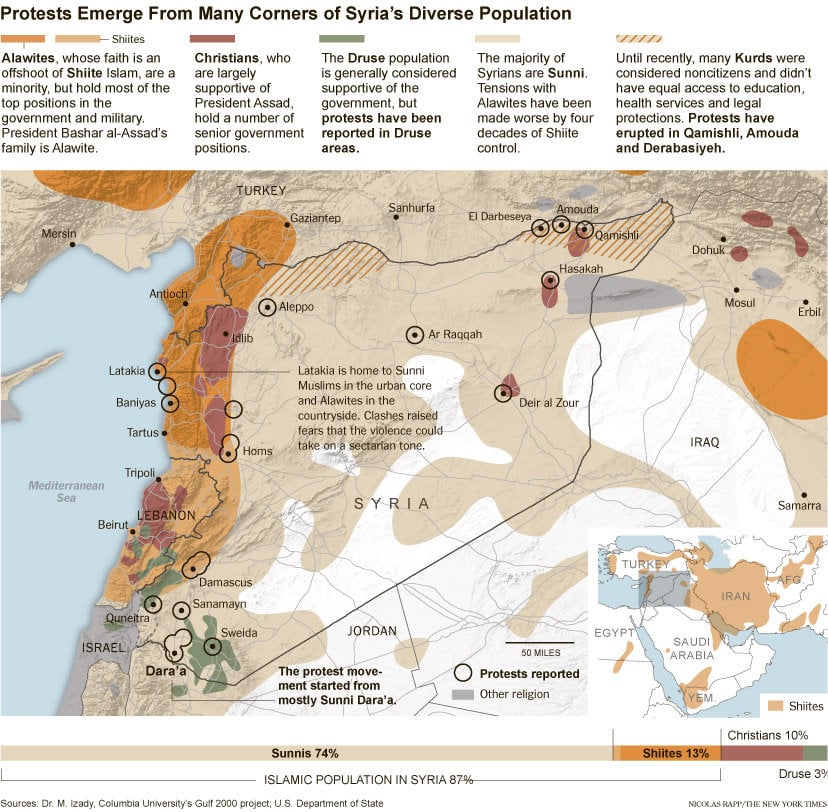
With others also wondering if Assad will retreat to the Allawite core of Syria, perhaps along the coast with perhaps inland buffer zones, I supposed I should look at my more expansive idea of what I will call a Core Syria with a higher proportion of Allawites and other supporters. Could Syria hold that territory and pacify/control that population?

To recap, I think Assad needs an arc from the Turkish border, around Lebanon to the Israeli and Jordanian border, including Damascus.

This preserves Syrian claims to Turkish territory, centers the country on the Allawite homeland, keeps the UN seat by continuing to be the recognized Syria, retains the option of being hostile to both Israel and Jordan, and controls the land borders of Lebanon.

Everything else to the east is abandoned to whoever wants to govern it. Let's look at the map:


I figure Assad needs to control the provinces of Idlib, al Ladhiqiyah, Tartus, Al Qunayurah, and Daria; the city of Damascus; plus the western parts of Hamah, Hims, and Dimashq provinces, arcing from the eastern border of Idlib down to the eastern border of Daria.

A 2004 census gives those provinces a total of  10.1 million people. I'll call it even by assuming populations increased but that the eastern portions of Hamah, Hims, and Damascus will reduce the population to control--but not by much since a lot is fairly barren.

With 75% of Syria's population Sunni, in theory Assad could gather the entire 25% Allawi, Shia, Christian, and Druze in the Core Syria and increase their share of the population in Core Syria to about half the population. With the guns, money, and secret police, I have to believe that's a base of support capable of suppressing resistance to his rule in this Core Syria.

It is commonly reported that Assad has 200,000 loyal ground forces (army, secret police, and loyal militias/gangs). Standard counter-insurgency states that you need troops equaling 2% of the population to control/protect them. 200,000 is almost exactly 2%. I have to conclude that Assad would have the horses to control a Core Syria.

If those troops can keep fighting for the duration without a rotation base to relieve them.

What I also don't know is what the logistics for this move would entail. Is it possible to move supporters from outside the core? Can strategic assets be relocated (chemical weapons, ballistic missiles)? Would Assad need to ethnically cleanse areas of Sunnis to make room for incoming supporters? Would Assad want to destroy the abandoned areas as much as possible to deny easy use by whoever takes over? And how would a Core Syria's economy function? Would it become even more reliant on Iranians and possibly Russian support? Could China be enticed to provide diplomatic support and money?

Retreating to a Core Syria would be a major decision with a lot of difficulties to overcome. But it might have the advantage over trying to hold everything in that it doesn't end with the Assad family hanging from lamp posts in the Damascus public square.

The option is better from the Assad clan's perspective, no?

Drugs and Dregs

Wow, that sure is a lot of effort:

Two drug-smuggling tunnels outfitted with lighting and ventilation systems were discovered along the U.S.-Mexico border, the latest signs that cartels are building sophisticated passages to escape heightened surveillance on land.

Both tunnels were at least 150 yards long. One began under a bathroom sink inside a warehouse in Tijuana but was unfinished and didn't cross the border into San Diego. The Mexican army found the tunnel Wednesday.

It's kind of impressive.

Then you remember the tunnels into Hamas that smuggle goods and weapons.

And you remember that insurgents and terrorists in Afghanistan and Colombia joined forces.

And you remember that Mexico doesn't exactly have a handle on their northern provinces overrun with drug gangs.

And you also remember that PRI is back in power in Mexico, whose determination to battle the drug gangs wasn't very high the last time they held power. Heck, they figured, the drug trade was our problem--not their problem. If gringos wanted to send dollars south into the Mexican economy, who were they to complain?

Then it became their problem big time. But the problem is perhaps too difficult for the PRI to fight with any enthusiasm.

Now it may be our problem again. If some of the drug gangs team up with jihadis to make use of tunnels like that for things worse than drugs.

Thursday, July 19, 2012

War is an Option

Don't assume we can only briefly delay Iran's nuclear programs if we really hit Iran hard in a multi-week campaign.

Remember, when we hit Iraq's WMD infrastructure in 1998's Operation Desert Fox, we assumed we could only delay Saddam for a year, if memory serves me. We seem to have done far more harm in the four-day assault.

But I'm on record as believing that buying even a year of time is worth the risks.

Bigger Than Two Men and a Truck

While I've not been shy in speculating that Assad might try to retreat to a Core Syria to lower his security needs to match his security assets, I remain very aware that this is a map-reading exercise that doesn't go into the complexity of shrinking your country.

I remain aware because I still remember the effort by South Vietnam in the waning days of the war, when they lost our support and North Vietnam was invading, to "strategically withdraw" from the border areas of South Vietnam to defend a core South Vietnam in the southern part of the country.

Once the retreat began, troops became further demoralized and worried about family. And the whole thing collapsed.

Which is why I thought that Russian troops on the ground in Syria could be a morale booster for the Alawites and allies if they try to retreat to a Core Syria.

Yet despite the difficulties and uncertainties of pulling it off, Assad has to make a choice soon about doing something different or seeing his tired troops just collapse from the effort at playing whack-a-mole.

UPDATE: And remember that Syria can't rotate troops they way we did even when our rotation base was stressed. Syria's armed forces have already exceeded our maximum 15-month Army deployments during the surge.

Why Summer in Ann Arbor is Great

The weekly lunch hour musical performances in Ann Arbor are taking a break for the Art Fair.

Last week, Scars on 45 played.


Amusingly, the female member of the band wasn't on hand at start time and fellow band member (and husband) asked the crowd to yell out, "Aimee, where are you?"

She was shopping.

But got to the counter where she realized she'd forgotten to bring money. Shopping fail.

Before too long she ran to the stage to applause. At some point, some man (not me) asked her how single she was. Her husband, with the guirar, answered, "zero."

I saw them last year, too, and liked them. So it was a musical success, anyway.

And I like art fair, too. Summer in Ann Arbor is pretty good.

She's Got Some 'Splainin' To Do

The Iraq War was supposed to inflame the Moslem world against us.

Yet we won and Moslem states seem to work with us just fine.

But any minute it will get bad:

A senior adviser to the US military has warned that the West has yet to see the repercussions of the war on terror in Iraq and fears some Islamists may still be set on seeking revenge.

Huh. The Iraq War should have gotten the Easily Excitable lathered up to kill us.

We beat the jihadis in Iraq and the Moslem world doesn't seem inclined to sign up for the jihad.

Note too that the "good war" in Afghanistan is now part of the complaint against us.

But any minute, Moslems will realize they need to seek vengeance for Iraq and Afghanistan, join the jihad, and try to kill us.

Could be. After all, before both Iraq and Afghanistan, jihadis hit us on 9/11. And the Cole bombing. And the Saudi housing bombing. And another earlier try to take down the Twin Towers. And the Beirut Marine barracks bombing.

Funny how Moslems got worked up to kill us before Iraq. Huh.

Besides, our president delivered an outreach speech in Cairo and cleared up that anger management issue back in '09. We're good to go.

Although bombing oil-rich Libya into submission last year might rekindle memories of Iraq. So you never know.

God help us. She was a senior freaking adviser to us. But we won anyway.

Maybe Moslems are starting to realize there are repercussions for following hopped-up jihadi nutcases who want to slaughter innocents for their god.

Wednesday, July 18, 2012

An Inconvenient Conviction

A man was convicted of threatening to kill our president. Which is good. President Obama is our president, and you just don't do that. Stay vigilant, Secret Service.

Our feds have tools to identify these threats, of course. Department of Homeland Security understands that white male--probably from one of those southern states, you know--veterans of fighting our nation's wars are an identifiable threat. So--wait. What?

Oh. The man convicted wasn't a white southern male veteran who was radicalized into hate thoughts and motivated to kill? He was a Moslem who was radicalized into a Islamo-fascist killer? And an illegal immigrant, to boot?

Fancy that.

So ... Never mind. Sometimes you just can't generalize about an individual's beliefs and motivations.

UPDATE: Thanks to Stones Cry Out for the link.

Wheel of Misfortune

As China's power grows, those on their border worry that increased Chinese power projection abilities will be directed at them.

India, Vietnam, the Philippines, and Taiwan are the most obvious worriers.

Now Japan can worry as Chinese military capabilities allow China to contest islands in the East China Sea:

Although the sovereignty dispute between China, Japan and Taiwan over the Senkaku/Diaoyutai Islands in the East China Sea has always had its military component, from the 1970s onwards the three sides generally refrained from engaging in behavior that risked exacerbating tensions to the point where armed clashes could occur.

Recent developments, however, indicate that this self-restraint might be over, and that the conflict may be about to enter a new — and possibly far more perilous — phase.

Once safely distant from all but Chinese nukes, Japan now must face a Chinese navy and air force capable of reaching Japan. So Japan now worries and pivots south away from their Cold War orientation toward Russia.

Russia is growing more wary of China. And they have historic fears of being swamped in their Far East. If Russia manages to rejuvenate their conventional forces, they can act on their worries to be more forceful against China.

Shoot, the way China is going, North Korea will turn on Peking.

Spin the wheel in Peking and no matter where it points you find worried neighbors--or neighbors who should be worried.

Faust and Furious

More and more, it really looks like our government tried to make a deal with the Devil in order to make American gun dealers look like the heart of Mexico's drug war problem. Fast and Furious as executed under this administration makes little sense otherwise, unless you accept levels of ineptitude that I am not prepared to believe is possible.

We shall see if the victory of PRI in Mexico's presidential election is where the real deals will be made.

Yet however much it may be understandable that Mexicans might be furious with this program and hope to just make the drug war problem go away by bringing back PRI, pretending that the violence is really our fault and making new deals with the drug cartels will just make new Hells possible.

That Ship Has Sailed

In one sense, I don't understand the debate over risking war with Iran over their nuclear programs.

After all, Iran has been at war with us since 1979. Capturing our embassy, supporting enemies who killed us in Lebanon, attacking us in the Persian Gulf, attacking us in Iraq, attempting to bomb targets in our nation's capital, and supporting enemies who kill us in Afghanistan.

In what sense would we be starting a war with Iran?

Tuesday, July 17, 2012

Damned and Damner

The Syrian people are being blessed by the combined compassion of Kofi Annan and Vladimir Putin:

Syria peace mediator Kofi Annan was due in Moscow on Monday for talks with President Vladimir Putin amid growing pressure on Russia to finally back the ouster of President Bashar al-Assad.

Syrians are so screwed.

Rally 'Round the Dinner Table

I've read that the new Iran sanctions are so full of holes and exemptions that Iran can cope with them.

But then Strategypage writes this:

The new sanctions, meant mainly to cut Iranian oil sales and smuggling efforts (in response to earlier sanctions) are hurting. Inflation and shortages of imported goods are both getting worse. This hurts most Iranians and has turned public opinion against the nuclear weapons program.

Interesting. I was always skeptical of the claims that Iranians would support a nuclear program no matter what.

And just when Syria's Assad needs all the financial help he can get from Iran.

Mine Warfare

French Foreign Legion troops are in a battle with illegal gold miners who have armed up to protect their operations:

The Legion is spoiling for a fight. In the weeks ahead, their jungle warfare skills will be tested in an escalating battle between illegal gold miners and French authorities. Last week a gang of these miners (garimpeiros) killed two French military noncommissioned officers during a raid near the isolated jungle town of Dorlin. The operation to disband the miners was met with violence from the start. First, a helicopter was peppered with bullets from below as it flew over the camp. The subsequent raid on the ground was met with a well-coordinated attack; in addition to the two soliders killed, another two were seriously wounded. The attackers fled toward nearby Suriname as French forces sought to seal off the border. As of this writing they have not been found.

Tip to Instapundit.

Private warfare, huh?

Confusing Apples With Oranges

Good grief, is this silly analysis of Afghanistan getting more attention? Part of it asserts we blew a chance at a negotiated settlement with the Taliban:

"We squandered the troop surge," says Rajiv Chandrasekaran, author of Little America: The War Within the War for Afghanistan, "because of this nasty bickering in Washington."

Much of the tension centered around Richard Holbrooke, the veteran diplomat appointed by Secretary of State Hillary Clinton in early 2009 to be the point man for Afghanistan policy. Holbrooke was brought in to try to forge a path toward peace talks with the Taliban, essentially ending a decade-long war. But he was undermined, says Chandrasekaran, by the White House and even members of his own team.

But what does negotiating with the Taliban have to do with this problem cited in the article?

"What we fail to understand was that the Afghan people largely wanted to be left alone and they hate their government, in many cases, as much as they hate the insurgents. And when we went to them and said, 'Ah, we're coming here to help bring your government to you.' They said, 'Whoa we don't want out government!' "

I agree that trying to create a centralized Afghan government is a mistake. I said so before the surge:

The end result in Afghanistan, if all goes well, will be a nominal national government that controls the capital region and reigns but does not rule local tribes and which actually helps the locals a bit rather than sucking resources from the locals, who in turn do not make trouble for the central government or allow their areas to be used by jihadis to plan attacks on the West. We press for reasonable economic opportunities, with bribes all around (I mean, foreign aid), to keep a fragile peace.

Truth be told, if this is all that Chandrasekaran highlighted, I'd have no problem with the criticism. I'm still not sure if we are trying to base victory on a stronger central government or working with locals for security and governance.

This issue of governance structure is completely separate from the issue of negotiating a peace deal with the Taliban. If talking is meant to pry away the less fanatical Taliban supporters by getting them to agree to live under he new order in order to isolate and defeat the hard core Taliban, that's fine. We did that in Iraq with the Awakening.

But if talking is for the purpose of letting the Taliban win in some areas in exchange for not shooting at us while we withdraw, that's actually a defeat no matter how much it is disguised as a triumph of diplomacy.

And basing a book advocating talks with the Taliban on the vaunted talents of Holbrooke to deliver a diplomatic coup is nonsense.

Good Enough?

Iraq has not collapsed 7 months after our departure. We have several thousand ex-military there for training and security, but it has not been enough to keep the Iraqi security forces in top form:

The security forces, under attack by gangsters and terrorists using bribes and threats (of murder or kidnaping) are becoming less effective. This has made it possible for Sunni terrorists (al Qaeda and several local groups) to keep operating.

Luckily, we weakened the enemy enough to make this flaw less than fatal--so far.

And I hope that there is enough accountability in the Iraqi system for voters to pressure or punish leaders for failing to provide security and economic growth.

I'm still cautiously optimistic that Iraq will turn out well.

Monday, July 16, 2012

The Last Resort

I don't know if this is just security theater, but we are working to keep options open:

The Pentagon is sending the aircraft carrier USS John C. Stennis to sea four months ahead of schedule to ensure that there are at least two carriers in the Middle East.

Even if Iran doesn't think we will stop them, they can't discount the possibility completely when we have the assets nearby.

Divide and Conquer

Eschewing charm, China played power politics in ASEAN to divide and conquer opposition to China's expansive claims to the South China Sea:

Southeast Asian nations have failed to reach agreement on a maritime dispute involving China, ending a foreign ministers' summit in disarray after Beijing appeared to split the 10 countries over the contentious issue.

The Philippines said in a statement on Friday that it "deplores" the failure of the Association of Southeast Asian Nations (ASEAN) summit to address the worsening row, and criticized Cambodia in unusually strong language for its handling of the issue.

We responded by bolstering the notion that all the smaller nations should approach China in a united front rather than being picked off one by one by China:

Secretary of State Hillary Clinton warned on Thursday of more confrontations in the South China Sea without a region-wide solution as China rebuffed calls to expedite talks on rules for operating in disputed waters.

Never forget that we have an important role in bolstering the many and varied countries around China that would prefer not to be bossed around by China. Divide and conquer would be a lot easier if we weren't nearby and strong.

The Philippines needs to arm up. This isn't Obamacare--they can't just restart the American alliance after being out of it for two decades at their choice, and now assume their preexisting condition qualifies for unconditional insurance for their claims against China.

Obviously, the Philippines can't cope with China on their own. They don't have the resources.

But Manila can make sure that China has to make a major effort over a longer period of time to defeat the Philippines and assert control over disputed islands. That will raise alarms in the region over China's ambitions and increase the risk that China has to run that America will intervene in some way.

Too Dumb to Believe

Sometimes people simply get what they deserve:

A multistate identity theft scam that claims President Barack Obama will pay your utility bills appears to have widened. ...

The scheme was first reported in May, when Dallas-based Atmos Energy warned its 3 million customers in 12 states that scammers had been asking for Social Security numbers to enroll in the faux federal program. According to the pitch—distributed via email, Facebook, text message, phone and, in some cases, door-to-door sales—the government would pay a month of energy costs through credits offered by the Obama administration.

In the end, that scam will cost the country less than the scam that lies behind it.


That's why the scam worked, eh?

One Glue Failure Away

Once again, after licking the Sprint ecoEnvelope in the vain hope of triggering its supposed adhesive qualities--after performing the monthly ecoPunishment of disengaging the return envelope for daring to pay by mail, I had to use glue to seal the envelope.

I'm thinking of firing up my gasoline-powered ecoDestroyer car and running the oil-based ecoTires back and forth across the ecoEnvelope to see if a ton of Detroit's best can somehow unleash the adhesive qualities of the ecoGlue with pressure beyond even my capacity to pound my ecoFist over and over into the stupid thing on my dining table.

And I'm reasonably certain that cursing the company isn't the key.

Seriously, this is pissing me off so much that I'm this close (imagine me holding my finger and thumb about a centimeter apart) to switching carriers. I'm due for a new phone from Sprint since my two-year period is long over. Maybe I need to exoSkedaddle to a phone company that doesn't hate me for destroying the planet.

Let's see how that next ecoEnvelope goes, shall we?

Rationality Fails--Or Changes

Iran has threatened to close the Strait of Hormuz to block all oil exports from there:

Iran could prevent even "a single drop of oil" passing through the Strait of Hormuz if its security is threatened, a naval chief said on Saturday, as tensions simmer over Tehran's nuclear program.

We have reacted by moving assets to the Gulf to deal with various levels of threat.

Besides, would Iran really be foolish enough to react to our restrictions on their oil exports by doing something that completely cuts off their oil exports and mobilizes even skittish Europeans to fight Iran to keep their oil imports coming?

Military analysts have cast doubt on Iran's willingness to block the slender waterway, given the massive U.S.-led retaliation it would likely incur.

This is excellent reasoning with only one problem--it could become wrong at any moment.

That reasoning, after all, kept Iran from trying to close the strait despite years of Iraqi efforts to shut off Iranian oil exports during the Iran-Iraq War (which I prefer to call the First Gulf War) through an air campaign that targeted Iranian tankers and Kharg Island.

The Iranians even followed that reasoning as American efforts to "tilt" to Iraq to keep them from losing the war made it look like we were co-belligerents with Iraq.

The Iranians followed that reasoning right up until 1987 and 1988 when the didn't follow that reasoning, and challenged the American-led naval flotilla guarding the Persian Gulf:

Iran did in fact attack the United States Navy during the Tanker War during the Iran-Iraq War, and suffered losses in clashes with our forces during 1987 and 1988. For years, the Iranians endured Arab and American efforts to support Iraq in the war that Saddam launched in September 1980, knowing that the Persian Gulf was the source of income and supplies for Iraq. Yet Iran endured rather than striking out, knowing that they needed the Gulf, too, and perhaps understanding that the alternative to Iraq using the Gulf was not Iran only having use of the Gulf. But the pressure of war led the mullahs to abandon their caution and sail into battle that they lost.

As I noted in the post, the Iranians seem to believe that the chance of war this year is pretty high, so they'd best prepare for it. Striking us first if they believe we will strike anyway will seem quite reasonable to them.

Sunday, July 15, 2012

The New Old Front

Hamas believes Egypt will support them in Gaza against Israel.

And the Israelis moved Iron Dome anti-rocket defenses to the southern border with Egypt.

At this rate, Israel will need to update their war plans to advance across Sinai to the Suez Canal.

So who expels the MFO which watches everyone and makes sure Egypt doesn't reinforce Sinai unnoticed?

In Need of Money, Guns, and Lawyers

Here is an interesting overview of the Syrian revolt, as of last month.

Their estimate of 40,000 insurgents in the field is fairly fascinating given that in Iraq the estimate of enemy full-time fighters in the field never exceeded 25,000. Which gives you a sense of how narrow the Iraqi insurgencies were. With all the money and weapons available to them, our enemies didn't have the popular support to really challenge us despite widespread impressions in the West that the Iraqi insurgencies were a national resistance to our occupation.

If the Syrian insurgents had more money and weapons, I have to think that they could put more in the field.

The figure of 40,000 probably isn't comparable to the 25,000 figure for Iraq. In Iraq, that represented the full-time fighters, who were probably 10% of the total dominated by part-timers who occasionally fought. That's typical, as I understand it.

Given that Iraq's insurgents during the height of the fighting there managed daily attack numbers that Syrian insurgents manage in a month (over 150 lately), the 40,000 "active fighters" in the Syrian resistance, as the foot note for that figure calls them, cannot mean full-time fighters. If it was, the Syrian opposition would be doing a lot better than their Iraqi counterparts did given that the Syrian opposition faces far fewer and lower quality counter-insurgency forces than the Iraqi insurgents and terrorists faced. The security force quality issue is clear from the far greater casualties that the Syrian security forces are suffering compared to Coalition casualties. Even in the worst months of the insurgencies, far more numerous Iraqi forces did not endure the recent levels of Syrian casualties (404 in May).

It seems to me, from my pajama-clad view, that it makes more sense to think of the Syrian opposition army as having 4,000 full-timers with the rest part-time help. With a sixth of the Iraqi insurgencies' numbers and far lower material support, the far lower attack numbers of the Syrian resistance compared to the Iraqi insurgents make more sense.

Already, the insurgency's ability to hold out-of-the-way terrain exceeds the capacity of the Syrian security forces to clear and hold. With more arms, the large number of potential recruits from the 75% Sunni population could exceed the activity of the Iraqi insurgents quite easily. Arms are clearly the limiting factor for the Syrian insurgents. Maybe we should get our BATF on this problem.

Ready for Low-Level War

We have plenty of big stuff in the Central Command region to fight Iran if Iran goes big and tries a Viking funeral ride with their military.

If Iran tries to fight a low-level fight, we are ready, too:

One of the Navy’s oldest transport ships, now converted into one of its newest platforms for warfare, arrived in waters off Bahrain late last week, a major addition to the enlarged presence of American forces in the Persian Gulf designed as a counter to Iran.

I've mentioned the Ponce development. Click through for a link about the last time we were involved in a low-level duel with the Iranians over freedom of navigation in the Persian Gulf.

I wouldn't discount Iran's ability to hurt us. Respect them in that regard.

But don't discount our ability to take whatever Iran tries to dish out and pound them into the ground in return.

Saturday, July 14, 2012

Color Me Unpersuaded

I need to confess something. I'm a white American.

Yeah. I know. And me commenting on world events.

I recently received a lovely piece of email from a devoted reader:

under all your idiotic talk of freedom and democracy, only a hypocrite white american male like you would be so cowardly to disable comments on their blog. what are you afraid of, pinky bottom , is it because you know that you are full of [redacted] and it will be only a matter of minutes until someone mops the floor with your latest nonsensical post if you just gave them the chance?

get a life, loser. i challenge you to allow comments to your drivels, if you have any confidence in their truth value. i promise to be there to rip your idiotic ramblings to pieces.

He's a Turkish reader (or at least somebody in Turkey) who didn't seem to like some of my posts related to Syria. My "pinky" bottom (Good God, I hope that is a color reference) could not stand up to his brilliance, he believes. Or someone's brilliance.

Who knows? A lot of writers out there are idiots. I guess I could be one of them. Or one of them on a bad day. At over a thousand posts a year, I'm bound to have a bad moment or two. Or maybe it was just a bad week to give up sniffing glue. Stuff happens. Give a guy a break.

I don't allow comments, it is true. For my readers, this is why (from my 9-year anniversary post):

I still don't allow comments. I don't want to police them--have you seen the Yahoo News comments? There are lots of idiots out there. I have an email available if you really want to comment. And if you really, really want to comment, you can set up your own blog (it is free to do so), link to my post, and blast away (or heartily agree). But mostly, rather than not wanting to deal with hostile or idiotic comments, I don't want to get ensnared by comments. I think that there can be long-term pressure to conform posts to what your fans like. I want to offer my thoughts--for what they're worth--and not your thoughts.

Yeah, what am I thinking to disable comments? I'm sure my Turkey-based reader's instant comment would have been more intellectually focused than the email he sent.

Yet there is that email address I make available that he managed to re-type into his email service. It's funny. I read books all the time and no matter how many times I look through the pages, I can never find an email link to click.

And journal articles, too. Sometimes they have emails noted. Sometimes--online--they even have comment capabilities. That's their problem if they want to deal with that.

But you know what I do? I blog about the things I read. It's an amazing free thing. My reader should check it out. Consider it a challenge. Why do I owe him the convenience of insulting me with a single click? Work for it, dude.

I'll review the email later for the aforementioned floor mopping that I was promised. I'm sure he'll make Plato look like a moron. The drivel-ripping wasn't obvious at first glance. But what do I know?


Thank you for reading. I'll save the email for my scrap book. That's all I really have to say on this subject.

Paper Air Force

Syria's air force has deteriorated a great deal and the risk of further defections by letting pilots go up in a personal cross-border escape device is greater than the possible gains of using the rotting air force to kill civilians. Strategypage explains the situation.

Artillery and tanks will have to do for bombarding civilians.

The Historyless Reading the Historyless

I already commented on a new book out that claims we are doomed in Afghanistan (and it isn't President Obama's fault!).

Now we have a review of the book by someone with no business offering his opinion on the Afghanistan War, let alone comparing it to the Vietnam War which he blew when he had the job of covering it.

Basically, the reviewer endorses the idea that our brilliant diplomat on the scene could have given us a negotiated victory with the Taliban if we'd let him. The reviewer, Sheehan, gives this notion credibility based on his triumph of the Dayton Accords that ended the Bosnia War in the former Yugoslavia:


Holbrooke was the most talented and effective diplomat of his generation. His greatest accomplishment came in 1995, when he ended the bloodshed in Bosnia (where inter-communal strife had killed about 100,000 people) by browbeating Yugoslav strongman Slobodan Milosevic and his Croatian and Muslim rivals into accepting the Dayton Peace Agreement.


What a load of hooey. You know what ended that war rather than a glorious diplo-speak browbeating of Milosevic? A Croatian and Bosnian Moslem offensive that broke the backs of the ethnic Serbs and made continued fighting at the risk of further actual beatings on the ground seem rather pointless. Bonus points if you remember that the offensive was designed by an American military contractor company.

Getting the sides to stop further fighting after some minor land swaps with the Dayton Accords was nice, but hardly the diplomatic coup that Sheehan tries to claim. Our limited air attacks, while not decisive in creating new facts on the ground, at least was a threat of more to come if the Serbs didn't agree to ending the war. But claiming that this experience shows that Holbrooke could have gotten a diplomatic victory a few years ago in entirely different circumstances (aside from the questions of whether it would be strategically or morally right to agree to specific terms with those thugs) is simply fantasy thinking.

But wait, there's more.

The real offense is Sheehan's attempt to compare current problems with the Vietnam War, which he "covered." This is pure comedy gold:

Americans are a historyless people. We are constantly being told by wishfully thinking leaders that history does not apply to us, that we are its “exception.” Unfortunately, we are not, which is why it bears repeating that what the Obama administration is attempting to do in Afghanistan bears a striking resemblance to what the United States attempted in Vietnam. Nguyen Van Thieu, our man in Saigon, headed a coterie of fellow generals, politicians and their greedy wives who excelled at thievery and bequeathed us one of the fundamental lessons of the Vietnam War, that one cannot build upon the quicksand of corruption a sound government and army that will stand up to its opponent. When the moment of truth came in 1975, after the United States had pulled out its combat forces and the North Vietnamese army launched another offensive, the Saigon regime simply collapsed, its well-equipped troops abandoning their weapons and fleeing so fast that the opposition had difficulty catching up to them.

One, what leaders tell us history doesn't apply to us? But this is merely an annoying aside.

Two, Sheehan accusing Americans of being historyless is rich.

In fact, when we left South Vietnam, we left a government in control of its land--excepting the North Vietnamese troops holding border terrain, which we decided to ignore--with a military capable of holding off the North Vietnamese army in a conventional fight. Unfortunately for the South Vietnamese, the assumption was that after winning at such a high cost, we'd continue to provide logistics support to the South Vietnamese armed forces and we'd even commit air and naval forces in emergency to help them. In 1972, with our logistics support and air power, South Vietnamese forces withstood a North Vietnamese offensive. Clearly, our plan could work.

But after we left completely, Congress denied South Vietnam both the resources to support the conventional armed forces we'd designed and forbade our direct support from the air and sea. So when North Vietnam invaded South Vietnam, South Vietnamese forces lacked the support to make their military capable of resisting the North Vietnamese who violated the peace treaty to invade and win the war.

The idea that it was the corruption of South Vietnam that led to their defeat is nonsense. Corrupt governments and armies are the norm around the world. They can survive depending on the state of their armed enemies.

The fact is, South Vietnam's government was good enough to defeat the Viet Cong and their North Vietnamese reinforcements before we left; and would have withstood North Vietnam's conventional forces in 1975 if Saigon had received the support they absolutely had to have to operate.

But other than screwing up South Vietnam reporting, misunderstanding the fall of South Vietnam, and failing to recognize cause and effect in Bosnia, Sheehan is the perfect man to review a book that gets Afghanistan wrong, too.

We are not immune to history. But history is made by people making decisions. If we decide not to win in Afghanistan, it will be history all right.

Friday, July 13, 2012

Being There

Krauthammer has a good piece on the dashing of hopes that the Facebook faction would emerge victorious in the Arab Spring. With Islamists of one sort or another gaining power and influence, the Arab world had more unrest ahead until it tries freedom and democracy to solve its many problems.

I still think the Arab Spring is an opportunity even though I didn't expect the Twittering class to emerge victorious in short order. Just being where they are brings hope for a better future as well as peril for a worse future.

We all need time. Spring brings both flowers and weeds. We are dealing with weeds. The Arabs may yet get a garden.

How's That Resurgence Going?

The Taliban are having trouble convincing kids to go along with their suicide-bombing plans:

The Taliban suicide bomber operations have long been fueled largely by brainwashed students from Pakistani religious schools and Afghans convinced, deceived or coerced into carrying out an attack. But in the last few years getting these kids from Pakistan has become more difficult. Finding adult Afghans to fill in, at least competent ones has been very difficult.

A resurgent Taliban wouldn't need to use suicide bombers to fight us.

A resurgent Taliban wouldn't need to recruit children in the absence of adult true believers.

A resurgent Taliban wouldn't screw up the ability to trick little kids into being suicide bombers.

Despite our press corps, one might need to conclude that the Taliban are not "resurgent."

The "Why" Is Important

Assad's forces are moving chemical weapons from storage, and we don't know why:

American officials are divided on the meaning of the moves of the arsenal. Some fear Assad may want to use the weapons against rebels or civilians, while others said perhaps he is trying to safeguard them from his opponents, the Journal reported.

I've mentioned that Assad's forces are in a death spiral of fighting while unable to make progress against the resistance due to insufficient numbers. He has to do something different, I concluded.

Using chemical weapons on his own people is a very different thing. Is Assad desperate enough to do that? He'd have to win quickly if he chooses this path. Egypt got away with this in Yemen and Saddam got away with this in his own Kurdish regions, but today using chemical weapons would likely remove Russian and Chinese abilities to shield Assad from a Turkish-led intervention. The payback if they lose would be horrifying. Assad might still do it. But it would be highly risky.

Or it could simply be to move the chemical weapons to a more secure location.

But even moving them is risky. Why not just increase the guards where the weapons were originally placed?

But then, I'm looking for evidence that Assad might be retreating to a Core Syria. I noted that moving chemical weapons might be too tough (I just honestly didn't know) and so maybe my notion is simply rooted in maps and not the reality of the logistics of contracting your country's borders.

But Assad wouldn't need to take all the chemical weapons with him. If reports of moving chemical weapons are followed by reports of chemical weapons being destroyed to keep them from falling into the hands of the rebels, this could be a sign that the Assad regime wants to live to fight another day in a smaller Syria.

One thing that occurs to me is that Assad might think that if he leaves any chemical weapons he doesn't want in place rather than destroy them that it might keep the West busy in the abandoned parts of Syria trying to secure the chemical weapons to that jihadis don't get them. Maybe. But that might prompt a Western response as bad as one that reacts to Assad's use of chemical weapons. And we might not get them in time, which might mean jihadis opposed to Assad then use them on Assad's Core Syria. It just seems too risky.

But from Assad's point of view, I don't know what "too risky" really means, I suppose.

UPDATE: Here's the Wall Street Journal article. They mention the idea that Assad may truly want to safeguard the weapons. The article also mentions that some analysts think Assad might retreat to a coastal Alawite-dominated region. It doesn't mention linking the two ideas by wondering if Assad is moving chemical weapons within the borders of a future Core Syria. Also, I think Core Syria needs to be bigger than the coastal Alawite areas, as I've described.

UPDATE: Thanks to Stones Cry Out for the link.

Seeking Compromise

 
Yes, I'm sure the Islamists will agree to some limits on how many cultural and historical sites they'll destroy. And I'm sure that the Islamists will limit how many centuries they want to go back in time for the people unfortunate enough to live under their influence.
 
Will the AU consider it a triumph of diplomacy if the jihadis only destroy 85% of the Islamic sites? Or is victory set at half?
 
And what's the acceptable human collateral damage?
 
France really needs to get moving on this.

He Lived to Fight Another Day

At least since that breathing piece of human garbage, Moqtada al Sadr, led pro-Iranian Shia Iraqis in a revolt against Iraq's new security forces and our forces in the spring of 2004, I've worried that his survival is a risk to our objectives in Iraq. Two more major campaigns against his death squads did little to change my mind about the danger he poses. Now he is back and in politics:

With none of the fanfare of his homecoming last year — which was quickly followed by his return to Iran — Mr. Sadr says he is back in Iraq to stay, at least for now. He says he has temporarily put aside his religious studies in Iran, widely considered his patron, to attend to a political crisis here over contests for power among Iraq’s Shiites, Sunnis and Kurds that has brought the government to a standstill, and to position his movement for the next elections.

Notably, Mr. Sadr has joined Sunnis and Kurds in calling for the ouster of Prime Minister Nuri Kamal al-Maliki, a fellow Shiite. He is also testing other cross-sectarian alliances by inviting Sunni and Christian candidates to run in provincial elections, scheduled for next year, under the Sadrist banner. Together, these moves could help position him as a nationalist and help him shed the baggage of the past, when his militias were linked to some of the worst sectarian violence.

I'm sure that Sadr would never consider violence again if his political maneuvering falls flat, eh?

Certainly, the Iraqi government is stronger now than it was in the past when it battled Sadr.

But if Iraq's political process falters and the militias come out again, Sadr could tilt the balance of power--and provide an avenue for Iran to intervene more openly in Iraq's battles for power.

Sadr has had three strikes, yet still he takes swings. If the rules of the game are that he keeps playing his game with no chance of getting out, why won't he keep playing?

Thursday, July 12, 2012

Da Bears

The Russians are rousing themselves to make the biggest naval demonstration in the eastern Mediterranean in over two decades:

Two Russian Navy ships entered the eastern Mediterranean Wednesday, steaming toward a Russian Navy base at Tartus, Syria. The ships are advance units of a flotilla of 11 warships - one destroyer, five amphibious landing ships, two patrol frigates, two rescue tugs, and one tanker. Several ships carry units of Russian Marines.

It is to be the largest display of Russian naval power in the Mediterranean since the collapse of the Soviet Union two decades ago.

Let me just say that if Syria's Assad decides to retreat to a Core Syria, this major show of force for Assad would help ease the shock of such a big retreat by showing a major level of support for Assad.

Or it could be used to protect and evacuate Russian nationals if the whole place goes belly up, I suppose.

What About East Syria?

Stratfor writes about the implications of a Sunni Arab-run Syria if Assad falls. It is an interesting piece.

But I wonder if the discussion shouldn't be whether Assad wins or the Sunni opposition wins. What if Assad retreats to regions he can hold in the west and simply leaves eastern Syria for the resistance to fight over?

I've discussed the option since then, and still wonder about the degree of difficulty in moving critical regime support pieces (loyal people, strategic weapons) into the area to be held. Originally, I wondered if Assad would try to hold outposts in the east in areas too critical to abandon. But that may imply corridors. And holding those outposts would be very expensive and perhaps take too many troops.

In the end, if Assad wants to survive by retreating to a mostly Alawite Core Syria, he'll have to abandon (and destroy) anything in the east that he can't move west. That will be a monumental chore.

Would Russia and China replace what can't be moved? Would Iran help? Would the morale of the Alawites and perhaps their Christian and Druze allies survive such a retreat long enough to make a go of a Core Syria? Would Russian troop presence on the ground provide a bridge for the Alawite leadership to get used to the new situation and become determined to hold their smaller state?

Would Turkey consider lopping off half of Syria's population and a majority of the land a victory enough over Assad? It would be easier to get UN approval for relief efforts in East Syria alone.

Then we'll need to figure out the implications of a Sunni Arab-run East Syria (and wonder how many states emerge and under whose control) as well as what a Core Syria running from the Turkish border to the Jordanian border would do.

One Thirty-second Breed

Elizabeth Warren has decided to take on her faux Cherokee heritage controversy head-dress on with a new campaign commercial:


The university said she was Indian by law, of course.

Sadly, Cher could have avoided the taunts if she'd sought an academic career.

UPDATE: Apparently, the campaign is working.

Being That Guy For a Decade

Fancy that, 10 years ago today I debuted The Dignified Rant on the old Geocities platform. I was inspired by James Lileks.  I migrated to Blogger near the end of 2004. I'll always be grateful that Instapundit's example provides a convenient excuse for defying the "comments" trend of blogs.

I've written, say, 12,000 posts in that time. It would be more if I didn't update posts with new thoughts and instead only added new posts.

What was I thinking when I started this?

Oh yeah, I was frustrated that a letter to the editor that I sent to The New York Times to correct some author's major idiocy on military issues related to the war begun on 9/11 didn't make the cut. And others, I'll say. Not just NYT.

And now, this blog is one of the blogs NYT tracks and links to for their subject index categories for related information. Life is funny that way.

Actually, I've fulfilled a childhood goal on this blog. Remember in pre-Internet and pre-cable TV days when there would be a crisis in the world? The network news would put on some guy who would explain the crisis and what might happen. I'd listen attentively to understand what was going on.

I wanted to be that guy. Or one of the three guys, since each network would have one.

Of course, nobody can be that guy these days. And we're better for that, of course. They had authority but they had one point of view. Now we have lots of those guys--and gals--who must compete to have their ideas heard.

Now I'm that guy--or at least one guy--explaining what I think is going on in the world.

Oh well, they say the first 10,000 posts are the most difficult. Thanks for reading them and letting me be that guy.

Tuesday, July 10, 2012

A Simple Joy

Recently, I took Lamb out to a crafts store to buy felt and cloth for some sewing projects. She spotted YouTube videos on how to make Mario Brothers plush toys, and wants to try them.

So we'll try that. She made her own Yoshi egg, already. We have yet to try the more exacting mushroom things--whatever they are.

But I don't need to understand. The best part is when we are walking around and she reaches out to hold my hand.

Eventually, they don't want to hold your hand any more.

The Battle Continues

President Mursi doesn't want to play by the slanted rules that Egypt's military has set:

Egypt's Islamist-led parliament reconvened on Tuesday in an open challenge to the generals who dissolved the assembly last month, stirring up tensions with the military just 10 days into Mohamed Mursi's presidency.

Let's see if they pass legislation and dare the military to defy it.

Neither side is admirable in this. If rule of law can win and both the Islamists and the military lose, I'll be happy.

Shocked, to be sure. But extremely happy.

UPDATE: Egypt's supreme court said Mursi couldn't convene parliament. This is a rather basic disagreement.

Well, That'll Teach 'Em

New Zealand doesn't let our nuclear warships into their ports. So although we are otherwise good allies, when a New Zealand frigate and support ship came here to participate--for the first time since the 1980s, I believe--in multi-national naval exercises we are hosting, we didn't let the ships dock in Pearl Harbor with other participants. We made them dock in another port in Honolulu.

Which put the Kiwi sailors much closer to the women and liquor:

"I think they are the happiest guys in RIMPAC - they are not stuck in Pearl Harbour," he said.

"They've got Chinatown right here, they've got Waikiki, instead of spending 60 bucks for a round-trip (cab ride)."

Hooters has received many New Zealand sailors.

It is possible that we did this on purpose to welcome the New Zealanders even though technically we have to scowl at them for the nuclear prohibition.

I fear that this is just symbolic of our inability to really figure out how to punish behavior we don't like.

Buffer Zones

North Korea's collapse certainly seems like a matter of when rather than if, on the current trajectory. This could get interesting:

China has told South Korea that it will not allow the unification of Korea under a democratic government. North Korea will remain under Chinese "influence." If worse comes to worse, China will send in troops to set up a North Korean government that will faithfully follow orders from China. In an effort to dampen some of the anger in South Korea (the United States, Japan and so on), China would maintain North Korea as a separate entity (and not a new province of China). China wants no misunderstanding about who "owns" North Korea.

Even aside from all of China's neighbors who will worry that China will suddenly discover that they really own part of that neighbor's territory, this could cause quite the risk of war if China carries through with the threat.

I can understand why China would not want South Korea's border on the Yalu River. China went to war with us once over that. They may not have liked the experience much, but the motivation to fight are still there. China wants a buffer zone.

But so does South Korea. For decades, an effective and large North Korean army loomed over Seoul a short distance north across the DMZ. As North Korea's armed forces have rotted away, the threat of invasion has pretty much vanished. North Korea would have to nuke and gas South Korea and pray that they can manage a road march south against minimal opposition--and then recover from the nukes we'll plant on North Korean military assets and the smart bombs on everything else.

South Korea wants to reduce their army. But they can do this only if North Korea continues to be the de facto buffer zone between Seoul and an effective army in China. If China occupies North Korea, not only will China be on South Korea's border, looming over Seoul; but China will reconstitute North Korea's army into an effective force. It will no doubt be smaller than it is now, but it would be the first wave only. China would follow up with their own army if it comes to war with South Korea. It just doesn't matter that North Korea would be officially independent and not a new province of China. Remember, Belorussia and Ukraine had their own UN seats when they were part of the Soviet Union. Does anyone think they were really sovereign states then?

I just don't think South Korea wants to be in a worse situation after the collapse of North Korea than they were before the Soviet Union fell and slowly took North Korea's military power with them. If China takes over North Korea, South Korea will face the threat of invasion again--and this time by a nuclear power that could possibly nullify our nuclear umbrella. We'd nuke North Korea if they nuked South Korea or if we couldn't handle a conventional invasion since North Korea can't reach us now. Would we nuke China--or even Chinese assets in North Korea--under similar circumstances? Maybe. But it isn't nearly as certain.

So if North Korea collapses, I'd expect South Korea to want to move their buffer zone north. Not all the way to Pyongyang, certainly, let alone to the Yalu. But north. And they could do it faster than China could move south in force. If I was South Korea, I believe I'd think it worth the risk of war with China now well north of Seoul (while America is in South Korea and before China can dig in within North Korea after a few years) rather than risk war later with Seoul on the front line.

I still think the best solution to a collapsing North Korea (or even a non-collapsing North Korea if it looks like it is going to field nuclear-tipped missiles) is partition.

South Korea and China both want to keep the other away from their border. Unless China wants to risk war with America and the disruption to their economy, giving both Seoul and Peking their wish seems the best option.

It can be portrayed as an interim solution. But we can all be vague about what comes next for North Korea's territory and when it comes. Maybe the horse will learn to sing, eh?

Monday, July 09, 2012

Fancy That

Well, this is some good news in the Arab Spring:

A coalition led by a Western-educated political scientist appeared on Sunday to be beating its Islamist rivals in Libya’s first election after Col. Muammar el-Qaddafi, breaking an Islamist wave that swept across neighboring Egypt, Tunisia and Morocco in the aftermath of the Arab Spring uprisings.

Let's not walk away from the place. Help them establish rule of law and work for clean elections to keep this going.

I still wonder if the west and east can come to terms for a unified state (and then tell the south to take what is given).

Worth a Shot

I don't know what else we could do under the circumstances:

A senior U.S. official says President Barack Obama has assured Egypt's Islamist president of America's commitment to a "new partnership" with the Arab nation.

It would be folly to push Egypt away because of the result of their election. We need to use our levers of power to make sure--as much as we can--that structures of democracy are put in place to keep regular elections coming that can actually affect Egypt's policies.

Egypt may end up being an enemy, but why assume it? Better to try and fail than to cut off all economic and military aid now and ensure it.

Sunday, July 08, 2012

Speed Bumps

Syria has started "large-scale exercises" to demonstrate they can hold off a Turkish invasion:

Syria's military began large-scale exercises simulating defense against outside "aggression," the state-run news agency said Sunday — an apparent warning to other countries not to intervene in the country's crisis.

The exercise began Saturday with naval forces in a scenario where they repelled an attack from the sea, and will include air and ground forces over the next few days, SANA agency said.

Large scale? I think not.

Given that their pilots are likely under more scrutiny, that is likely to be limited. If pilots are given enough fuel to take off, circle the air field, fire a burst, and land, I'll be surprised. I suppose you could send some with enough fuel to make it to the coast for pictures without giving them the range to reach foreign soil to bail out.

As for ground forces? Loyal ground forces have more jobs than they have troops to handle. Or does Assad think it can let some of the less loyal troops off their bases if they think they are simply practicing to protect Syria? Even that seems doubtful at this stage.

Perhaps we'll see how inventive Assad's photographers can be with troops on a parade ground safely inside a base. Or file footage and imagination--if the Iranians will help with that deception.

At this point, Assad's forces will be speed bumps if the Turks want to cross the border.

Dismissed

I hope this journal of my basic training was enjoyable--or at least interesting. I have more plans for it.

On July 8, 1988, I woke up in the civilian world again. I would go back in uniform the next summer to complete my training. In the meantime, I'd get married, return to my job, continue to go to my unit weekend drills as a partially trained soldier, complete grad school, have my leg and knees heal, and gain about 10 pounds and lose just about whatever benefits I'd had from basic training.

I'll always be glad that I enlisted. I was getting older and it was do it then or not at all. I never had to go to war (although it was a close call), but I did take my turn in uniform just in case the lamps went out. Not long after I finished training, the Warsaw Pact collapsed. Then the Soviet Union itself collapsed.

By the time my first enlistment period was up, our reserves were being called on to do more in ongoing operations. And I started a career job that I didn't want to screw up by being a part-time soldier. True, just the drills and summer training aren't too bad, but for leadership it takes more work than that. I was going to go to NCO school but I told my unit I couldn't go after it looked like it would interfere with my new job. So if I stayed in, I'd be an E-4 for the rest of my days. And I probably had a higher chance of being sent off somewhere on some minor Balkans operation or something. And I'd already experienced the turmoil of expecting that I'd be pulled away from family to be mobilized and sent overseas.

So when my enlistment was up, I did not re-enlist.

Which in the end kept me out of Iraq, since my old unit was sent there during the counter-insurgency. Not that I would have been in particular danger sitting in the middle of a well-defended base.  But being dragged away from home would not have been enjoyable. That alone gives me a far greater appreciation for what our military personnel do every year. And their families have to cope with that. Every year.

Unexpectedly, simply serving in uniform gave my military writing a little more credibility. My membership in the American Historical Association may have been a general waste, but it did give me a bit of a shock to see a major name in military issues give a short apology for not having served in uniform as a preface to his talk. Not that serving would have affected what he said. But he seemed genuinely abashed at speaking about military matters without having served. I don't have that issue, at least. I do think having served has helped me understand some concepts. Just having served and being a soldier has been a nice foundation. Although I'll never claim I've gotten more than a faint glimpse of what soldiers who serve full time experience--let alone what those sent overseas must sacrifice. And obviously, I have no way to understand what being a combat veteran means. I don't think about what I learned in my limited service when I write of larger issues, but I think it helps nonetheless.

My plan is to go through my letters to spark memories to flesh out the posts; perhaps move some impressions of events to the proper day if I can nail down times better; add some scanned pictures from basic training; and some other odds and ends. Then I'll put it in book form and self-publish it on Amazon for Kindles, and place it in the "Buy The Dignified Rant" tab at the top of the page.

Oh, and I have a journal for signal school at Fort Gordon the next summer. Unless I lost it. I confess I haven't seen it lately ...

Step Two: Joy

The Libyans, with a major NATO assist, took the first step toward freedom by toppling and gunning down their dictator, Khaddafi. Now, they have the joy of voting:

Crowds of joyful Libyans, some with tears in their eyes, parted with the legacy of Muammar Gaddafi on Saturday as they voted in the first free national election in 60 years.

But in the eastern city of Benghazi, cradle of last year's uprising and now seeking more autonomy from the interim government, protesters stormed polling stations and burned hundreds of ballot papers.

Libyans are choosing a 200-member assembly which will elect a prime minister and cabinet before laying the ground for full parliamentary elections next year under a new constitution.

Already, the path to real democracy with rule of law is difficult. But this must be so, as it has in the past. Civic society has endured so much damage that it can't be corrected with a quick Twitter revolution and a fast transition to restrained debates moderated by the League of Women Voters.

Many in the West, caught up with the stirring sight of young proto-democrats marching in the street with their Twitter and Facebook accounts broadcasting it all--thought that the despots had been holding down a majority of people with those feelings and desires.

And now, as the revolutions that took place struggle to move forward to the end state on that long path to liberty and rule of law, many in the West are ready to throw up their hands in defeat:

Still championed by over-excited, ill-informed pundits in the West, and kept alive on the ground by a gaggle of equally naive, out-of-touch and mostly English-speaking local activists, the bitter truth is that the so-called Arab Spring has proved a dismal failure on every level.

Nothing good has come of it at all, if judged by the classic Western values of liberty, freedom of expression and democratic accountability.

Supposedly, we needed a gradual transition to democracy guided by enlightened despots. Hosni Mubarak of Egypt even said so before he died. That settles it, right?

Wrong.

The path to real democracy was always going to be difficult. The yearnings for democracy on the streets of Arab cities is real. But they don't really have any experience with what real democracy means, now do they? That has always been our role in this hopeful drama. Rather than teaching Arabs to elect good men--which they failed to do in Egypt, no doubt--who we approve of, we need to avoid choosing leaders and teach them how to elect good men.

And we need to help them keep having elections until they tire of those pretending to deliver real democracy as an expression of popular will and elect those who will provide rule of law as the basis of real democracy.

It is true that we have failed so far to teach Egyptians to distinguish between bad men out to exploit formal elections to seize power and good men who will take the many steps needed to reach rule of law and real democracy. But it doesn't mean we should give up.

And it doesn't mean that we should believe that the right path was to support the Mubaraks of the world and hope they reform. George W. Bush tried that path for Egypt and he was blocked by "realists" here who preferred the "stability" of Mubarak. And without pressure, Mubarak's deathbed conversion to the need to slowly introduce democracy did not take place.

Don't fool yourself into thinking that reasonable despots are the key to frustrating Islamists. While the despots can call the Islamists their enemy, it doesn't follow that Islamism was the enemy of the despots. No, the despots merely tried to mobilize Islamism for themselves and deny that support to the opposition. This didn't work very well for Pakistan, now did it?

Despite the Westphalian system serving as the basis for its legitimacy, Pakistan has evolved from its secular origins to embrace a pre-Westphalian concept of the primacy of Islam over the state. This transformation has become a source of instability to both the government of Pakistan and its neighbors, particularly India and Afghanistan, and threatens U.S. objectives in Afghanistan. Initially, Pakistan’s government attempted merely to buttress the legitimacy of the state without any sense that its actions would spur the growing inf luence of Islamists in Pakistani society. In 1956, for instance, Pakistan became the first state to use “Islamic" in its title: “the Islamic Republic of Pakistan." However, despite the intention of Pakistan’s founder merely to use Islam to lend legitimacy to the state, the introduction of religion into the political sphere has grown as a force in society beyond the government’s control. From early in the nation’s history the writing has been on the wall. The founder of Pakistan’s Jamaat-e-Islami party (Islamic Society), for example, spoke for many in the middle and lower classes when he advocated establishing “Islamic rule, [organizing] the various aspects of social life on Islamic bases, to adopt such means as will widen the sphere of Islamic influence in the world."

Soon after independence, Pakistan’s government began supporting militant groups both to serve as proxies in the ongoing conf lict with India over Kashmir and as a means of bolstering the state’s legitimacy. Under the presidency of General Zia ul-Haq, these efforts linking the government to Islam became comprehensive, transforming Pakistan’s government and society: “Zia’s decade in power . . . ushered in an era of religious obscurantism that affected every facet of domestic life and foreign policy."15 Zia, with American assistance, famously used Islam as a shield against Communist influence in Afghanistan during the Soviet invasion. Pakistan’s support for the Afghan Mujahideen further caused the country to turn to the Middle East for both financial support and to strengthen its position in the Muslim world. Zia also integrated Islamic principles into schooling, the judiciary, and the military[.]

The Pakistanis could not control the tiger they tried to ride. They bought some time by trying to focus the Islamist violence they unleashed but could not control by directing it abroad, but that just invites foreign war and the anger of jihadis against the government when their ambitions abroad are either limited or if they win and need new targets.

And our deep financial support for the Pakistan that has evolved doesn't even win us friends in Pakistan:

Pakistani politicians and military leaders are obsessed with the idea that Pakistan is being persecuted by American plots and conspiracies. India is still seen as a major conspirator as well but America is the superpower and, therefore, must be the bigger threat. This Pakistani conspiracy culture includes things like the belief that the September 11, 2001, terror attacks in the United States were staged by the CIA, to cause hatred of Moslems. The Islamic terrorism in Pakistan is believed to be somehow caused by the United States. ...

All this is the result of decades of anti-American propaganda. Opinion surveys in Pakistan show 74 percent of Pakistanis see the United States as an enemy and this is up from 64 percent three years ago. Some 40 percent of Pakistanis believe economic and military aid from the United States is not helpful, while only ten percent see such aid as useful. The aid is seen as part of the American conspiracy against Pakistan. The Pakistani military exploits and encourages this paranoia by supporting Islamic radicals.

And this government has nuclear weapons. Isn't foreign policy realism grand?

The problems of the Middle East are deep and can't be quickly solved with 140-character manifestos. The Arab world needs time. We exhausted our supply of miracles coming out of the Middle East a couple thousand years ago, no? Be really realistic. We need to help Arabs get the time to sort out their problems without giving the Islamists the chance to blow up sizable chunks of the world.

Arguing that the Western response to the Arab Spring should have been to back the dictators to the hilt and pressure them to gradually move to democracy is a fantasy strategy. And it is immoral even if it could work. During the Cold War, I accepted the need to bolster Arab dictators willing to help us defeat the Soviet Union. But that higher goal is gone. Arabs deserve freedom no less than anyone else. But they don't know what real freedom is.

Work the problem. No other solution can work. The Arab Spring is an opportunity--not a gift from God that requires no effort.


Saturday, July 07, 2012

A Lean, Mean, Fighting Machine

14:40. Graduation over.
Brief. No sweat. Lots of civilians
around. Plane home. Missed
connection. Standby to Detroit.
Home at 11:30.

Thursday, 7 JUL 88, was my last day of basic training.

I graduated. There were lots of civilians and we marched in formation and we all graduated (minus a desertion and recycles). We were now lean, mean, fighting machines.

That's the fact, Jack!


Coming home after basic training rather than going straight off to my military school was a bit weird. For one thing, it was like "war over!" and I was discharged. But I had to go to the next National Guard drill weekend. And next summer I'd go to Fort Gordon, Georgia, for several more months of training.

Being a part-time soldier made every summer training seem like the big deployment. And when we finished those training periods and went home to be a civilian again, it was a shock to have to come back in a couple weeks for another weekend training period.

As I've often thought, my military experience was not deep--and certainly not dangerous--but I did get hints of military life and reality.

I learned what it is like to be focused on my immediate duties of figuring out how to use a combat fax even as a coup in Moscow a world away could have escalated to nuclear war. Normally I'd have been glued to my TV.

I learned what it is like to know my unit was scheduled to deploy to war and worry about leaving my wife to go off to the Middle East. And I learned that it was tough to see my mom worry about another son going to war long after she thought she'd have to worry about that.

With basic training over and going straight home, I had a small distant glimpse at what troops going directly from South Vietnam, where one day they were in the field, then they got on a plane to go home, where the next day they were back on the block in the world expected to act and react like a civilian.

I was not at war. And after 2 months in basic training, I didn't feel like a soldier who was no longer a civilian. But I was courser. And it took a while for that to wear off. And it was weird to be in a college town environment after being in the Army.

Oh, and one more lesson. Training is something that needs to be done constantly to keep a soldier well trained and ready to fight. I went home to graduate school, marriage, and weekend drills. I gained 10 pounds by the time June 1989 rolled around and I went off the Fort Gordon, Georgia, for signal corps training. I could barely fit in my dress uniform. And I had run perhaps once after coming home.

The first morning I was back in uniform for PT, marching off from a strange barracks in the dark on a strange base to a track somewhere on base, we ran 3 miles. I swear to God, I thought I was going to die. Only the knowledge that I had no idea where my barracks were kept me in formation running since I knew if I dropped out I would be totally lost. I made it. We never ran 3 miles again, as far as I can remember. And I got back in shape in short order--without injury at the lower stress levels.

Like I've often reminded readers, I was a reservist signal corps soldier. I don't know what snakes taste like. But I was a soldier, and I learned a lot being a soldier. I'll always be grateful that I enlisted and served my time in uniform. Though I only have a glimpse of what soldiers can go through, it has made me appreciate much more deeply what our troops endure in defense of our nation under far worse conditions than I went through one summer in Fort Leonard Wood, Missouri.

Becoming a Big Fish in a Smaller Pond

This article raises the possibility of the Allawite regime of Bashar Assad retreating to the coastal enclave where the Allawites are a majority. But the expert quoted doesn't think that is likely because Assad would not want to abandon Damascus:

The most straightforward scenario for a Syrian collapse would be de facto partition, with the coastal regions dominated by the Allawi minority -- the regime's main supporters -- breaking away from the Sunni Arab provinces inland. "That would be fairly clear-cut," said White. But Damascus lies outside the hypothetical "Allawi-stan," and White doubts the regime would be willing to give up the capital and retreat to the coast: "What I think is more likely is the regime will fight for Damascus as long as it can, and when that falls it will be a matter of flight, every man for himself."

Yet the alternative to retreating to the coast for a state on par with Lebanon is not trying to hold everything until collapse.

The alternative to collapse is retreating to a smaller Syria that can be dominated by the core "Allawi-stan." Assad doesn't need a pure Allawite rump Syria (with whatever other minorities want to bet their futures on Assad rather than a Sunni-majority state). Assad just needs to reduce the number of rebellious Sunnis to a manageable level. Assad can do this with a rump Syria that extends from the Turkish border and runs down the coast, into Damascus, and down to the Israeli border. If there are too many Sunni Arabs there, Assad's forces can practice ethnic cleansing to push these suspect populations into the ungoverned spaces to the east of rump Syria.

I don't know what percent of the population of rump Syria has to be composed of Allawites and their allies, but Iran runs a police state with about half non-Persians. I assume that there is a level below half that Assad could work with and suppress the majority. A third Allawite and allies? Forty percent? I guess it depends on how many loyal troops the rump state can generate and whether they can put toops representing 2% of the population (yes, I know the number is in dispute, but it will do for blog work) into the field to control/protect those people.

Russia would likely be happy to support a rump Syria that gives Russia a naval base at Tartus. And Iran would accept a rump Syria that still gives them access to Lebanon to support Hezbollah.

That's the problem with refraining from committing to regime change and assuming Assad will inevitably lose. It assumes that Assad fights to hold it all and simply lets his control of all Syria collapse in a futile effort to hang on to it all.

Then you have to wonder what happens to the parts of Syria outside of the rump Syria. Do Iraq and Turkey annex parts of eastern Syria? Would Syria's Kurds try to establish an independent state or try to join Iraq's Kurdish autonomous region? Would Jordan want any of the desert to their north?

Indeed, would Iraq's Sunni Arabs in Anbar province secede from Iraq if they could extend their hold into Syria's eastern Sunni Arab regions?

How long would Iraq's Kurdish regions remain in Iraq without the additional weight of Iraq's Sunni Arabs to balance the Shia majority?

We fear the consequences of defeating Assad. But there are scary consequences for any outcome--including Assad's ultimate victory in whole or even survival in a part of Syria. After all, Assad is likely to want to keep his WMD and ballistic missiles within his rump regime in order to reduce the appetite for foreign intervention to sweep up loose chemical weapons. Will Assad feel kindly to the West and the Arab world after surviving our clear desire to see him go? That quiet Israel-Syria border might not be so quiet in the future.

PRE-SCHEDULED POSTING UPDATE: After I wrote this but before its scheduled posting, I ran across another article on Assad retreating to the Allawite core. This one adds that Assad needs more than the coastal enclaves. Assad needs inland positions as a buffer. The article also notes that Iran and Russia could learn to accept a rump Syria.

I still think rump Syria needs to be a bit bigger than the coast and even inland blocking positions, and must include Damascus to retain the UN seat. And once you retain Damascus, you might as well keep going down to the Israeli and Jordanian borders.

Also, the article doesn't mention what happens to the areas outside the rump Syria that Assad retreats to.

But what I first wrote about in January is getting a lot more attention as an option.