Sunday, April 21, 2019

Rule of Law

While this article is about Slovakia's long road to building rule of law as a vital partner of voting to enjoying democracy, this excerpt on rule of law is excellent:

If institutional economics is little known to the general public, it is because the building of progress-enhancing institutions is a difficult task. Any economist can show that free trade leads to cheaper and more varied goods, but there is no blueprint for “building” a society that respects the rule of law. That vital ingredient, including an impartial judiciary and respect for property rights, does not emerge from edicts promulgated by democratically elected parliaments and enforced by politicians, policemen and judges. It emerges slowly and incrementally from shifts in cultural norms and popular expectations.

Recovering from Soviet communism was hard enough for Slovakia and other former Soviet vassals--even with the active help from Western democracies since 1991 tp provide physical security and assistance in building the governmental and societal institutions for rule of law.

Imagine how much harder it is for Iraq--continually under assault by jihadis and Iran since the overthrow of Saddam--and why an Arab Spring is a long-term project that will span many generations even with outside help.

Saturday, April 20, 2019

Is India Doomed?

For a long time, India's leaders (with some reason) feared coups more than they feared foreign invasion. As long as Pakistan was the main threat, size mattered. Times change.

India hasn't had a coup in the modern era. India's government enabled a corrupt military and society. And then equally large China rose in power far beyond India and can now make good on Chinese claims against large portions of India's territory.

Suddenly an unprepared military with a corrupt procurement system backed by a corrupt education system and the caste system's effects that will not die matter an awful lot to the defense of India:

The rapidly modernizing Chinese military and increasingly aggressive Chinese demands to settle old border disputes has forced India to take a realistic look at its defense spending and the current state of its armed forces. For the first time in its history the modern state of India faces a very real military threat. That’s because China considers colonial era border agreement illegal and wants 90,000 square kilometers back. India has refused, especially since compliance would mean losing much of the state of Arunachal Pradesh in northeastern India and some bits elsewhere in the area.

There is one glaring problem with this Indian situation. The more Indians examine the state of their own military, especially compared to what China is doing with its military, there is growing alarm. China not only spends more than three times as much as India each year on defense but gets better value for what it spends. China not only spends much more on modernization (and has the equipment to show for it) the Chinese procurement bureaucracy is far less corrupt and inept. While both nations have problems with corruption China has made a more determined effort to curb the corrupt practices in the military. India is only starting to uncover hidden corrupt practices that generations of politicians and bureaucrats have deliberately ignored (and profited from). But with the growing Chinese threat there have been a more investigations and honest audits of the Indian military.

Do read it all.

This is not to say that the Indian military is inept. It has not just relied on mass to defeat Pakistan in wars. And India does have combat-experienced leaders. But size was the ultimate safety net.

But China is now the primary threat to India. What was once good enough to provide a solid margin of error against smaller Pakistan (which is why Pakistan uses nukes to deter and terrorists to fight India) is now clearly insufficient to prevail against China if China makes a serious effort to humble India in war.

The bad terrain in the north may limit China's capacity to take more than the disputed border region--although Chinese infrastructure construction is eroding that shield. But the loss of that territory would be a large blow to India. But would it be a large enough blow to make any Indian nuclear threats to deter China from attacking credible? When China has nukes, too?

I think that in the long run India's democracy will give them the edge over autocratic China. But rule of law is the source of that edge, and India has yet to come to grips with defeating corruption to provide that edge. So India has to survive the short and medium runs and set the conditions to prevail in the long run. Will they? On the bright side, China will no doubt falter in their rise. So India has a chance. In the long run.

While I think it is appropriate for America to consider how an expeditionary Army could assist India against China, as part of a general move to see how the Army can contribute its core capabilities to a war against China as I discussed in Military Review, we have to be wary of the risk of exposing our force to defeat if the Indian armed forces can't hold the line against the now-obviously superior Chinese military.

We have to consider that simply increasing military-to-military cooperation between America and India isn't nearly enough. We need to help India develop rule of law (but don't let any of our Chicago officials participate).

The Plundering of Venezuela

Although everything remains great within the walls of the palace and while the core supporters get enough (and get a view of what they would face if they weren't in the core of supporters), the rest of Venezuela is falling apart:

Maduro and his government had refused humanitarian aid because they deny a humanitarian crisis exists. Maduro blames Venezuela's problems on "sabotage." Who are the saboteurs? Neighboring Colombia, the U.S., oil companies, capitalism, etcetera.

The real blame lies with Maduro and his predecessor, former army paratrooper Hugo Chavez, founder of the so-called socialist Bolivarian Revolution. Chavista authoritarianism and the corruption and repression socialism inevitably creates crippled and impoverished what was once one of Latin America's richest nations. The country's daily oil production is a third of what it was in 1999. According to the International Monetary Fund, Venezuela's inflation rate in January was 2.6 million percent.

Maduro uses food as a weapon against his own people, just like the Soviet Union did. In July 2016, Venezuela's food shortages were so severe the military took charge of food distribution. In January 2017, the army took control of food imports.

Maduro's supporters immediately benefitted from this militarized system. They had and still have access to food. They can also demand bribes from starving citizens in exchange for food.

Unless Brazil, as the largest state in South America, can be convinced to lead a coalition of the willing to topple Maduro (with America providing logistics help for the operation and for the humanitarian aid surge needed), I don't know how this ends well before a lot of people starve and flee to neighboring countries to spread disease and destabilize the host countries.

Russia and China (and Iran and Cuba, too) of course feel no shame for backing that scumbag Maduro and his socialist tyranny plundering the wreckage of Venezuela.

UPDATE: Guaido exhorted opponents of Maduro to make May 1st a massive rally to pressure Maduro do leave.

Friday, April 19, 2019

The Marines Cannot Build the Wonder ARV

Wow, the Marines really want it all for the LAV recon replacement being called the armored reconnaissance vehicle (ARV):

The ARV will be highly mobile, networked, transportable, protected and lethal. The capability will provide, sensors, communication systems and lethality options to overmatch threats that have historically been addressed with more heavily armored systems.

That would be effing fantastic!

But can we get it? Being highly mobile and transportable while also being protected and lethal is certainly the Holy Grail of armored vehicles.

But as I argued in Military Review (pp. 28-35) when the Army wanted the Future Combat System (FCS) replacement for the Abrams and Bradley to be strategically mobile, lethal, and well protected:

The Army should not spend whatever it takes attempting to meld multiple revolutionary technologies into one vehicle for all missions. The FCS should be different from the Abrams and Bradley but must be designed with near-term technology that incorporates modular improvements if the Army is to turn “gee whiz” ideas into actual hardware. Separated missiles and a sensor grid; active defenses; EGTs; and exotic engines, fuels, and weapons can be retrofitted to defeat more capable enemies. Barring successfully fielding exotic technologies to make the FCS work, the Army must consider how it will defeat future heavy systems if fighting actual enemies and not merely suppressing disorder becomes its mission once again. The tentative assumptions of 2001 will change by 2025. When they do, the Army will rue its failure today to accept that the wonder tank will not be built.

In practice, recon vehicles must be heavy if the opponent is a tank-based modern army. "Agile" recon vehicles just sit there in a spreading slag of their own too-light armor melting around the dead crew. That's not agile in practice.

The Marines cannot build the wonder ARV. Ask the Army.

It isn't Pretty But it is a Gathering Victory

Iran and their Shia Houthi allies are even willing to allow humanitarian aid to Yemen's people if it buys time to reverse their losing war effort.

Relying on our media, you'd think the humanitarian crisis was Saudi Arabia's fault. But no:

The Shia rebels now say they will finally implement the December peace deal that was supposed to reopen the Red Sea port of Hodeida, which is essential for delivering emergency food and other aid to northern Yemen. Iran had persuaded the Shia rebels to stall but that advice lost its appeal as the rebel situation worsened everywhere, not just at Hodeida. Iran had problems of its own at home and elsewhere and as not been able to help much.

While the rebels have stolen and stockpiled a lot of food and other aid their coalition continues to unravel and lack of aid coming through Hodeida is one reason.

The Saudis have started alternate supply routes for humanitarian aid. If the Houthis wreck Hodeida and burn supplies they will obviously be the bad guys even to the media and Congress which have fallen for Iranian propaganda hook, line, and sinker by demanding America abandon the Saudi-led coalition.

But the Saudis are slowly defeating the Houthi, inflicting a looming defeat on Iran, too (back to the Strategypage post):

The Shia rebels demonstrated that they have fewer and fewer options. The rebels have lost the ability to launch more ballistic missiles at key targets in Saudi Arabia and the UAE. Apparently the rebels have few, if any, ballistic missiles left. Moreover the Saudis and UAE have been able to shoot down all of the missiles that were going to hit an important area (and not land in an unpopulated area, as many of the missiles have done). Another threat that the rebels pose, but will not admit openly, that they will try to destroy the port facilities and food storage sites before they leave the city. Recently the rebels decided that destroying Hodeida port facilities and related food storage sites was not a practical option. Damaging the port like that could reduce aid supplies to rebel held areas and it would obviously be the fault of the rebels. Food would be available from the government, bringing it in via Gulf of Oman ports. Finally the rebels need the forces concentrated around Hodeida elsewhere. The government and Arab coalition forces are advancing on several fronts and if the rebels don’t send reinforcements there will be major losses of territory.[emphasis added]

With a ceasefire the Houthi will attempt to move their troops out of Hodeida to the areas under pressure by their growing list of enemies.

And of course, al Qaeda and ISIL are trying to survive the fighting, providing America with plenty of reason to back the Saudis and hunt Sunni jihadis on our own. As of the beginning of the month, we've launched 8 UAV strikes this year on such targets.

So yeah, this is good:

President Donald Trump has vetoed a resolution to stop U.S. military assistance to the Saudi- and Emirati-led campaign in Yemen.

In issuing the veto, Trump said, "This resolution is an unnecessary, dangerous attempt to weaken my constitutional authorities."

And an attempt to hand Iran a victory, don't forget.

Thursday, April 18, 2019

The Problem With Turkey is Not the S-400 System

I really dislike the fact that our diplomatic problems with Turkey are being framed as a problem of Turkey choosing the Russian S-400 air defense system or the American F-35.

This is not a good way to look at the problem with our supposed ally Turkey:

Is Turkey’s acquisition of the Russian S-400 air defense system a done deal?

“Yes and no,” according to a member of a senior Turkish delegation visiting Washington this week, suggesting there was still room for negotiation, and Ankara was trying to find a way to avoid a collision course with Washington.

“Politically speaking, we believe we can find a way to address this without having a collision course on this issue,” the senior Turkish official, speaking on condition of anonymity, said Monday. “Solving this would be the biggest part of a positive agenda.”

With Congress threatening sanctions if Turkey acquires the Russian air defense system, and the Pentagon and State Department warning that Turkey could lock itself out of the F-35 Joint Strike Fighter aircraft program and will not receive the fighter jets if it doesn’t scrap the S-400 deal, Turkey is taking its case directly to President Donald Trump.

I hope Trump realizes that our problem with Turkey isn't that they want to buy the S-400 which would compromise the secrets of the F-35's capabilities:

Turkey under Caliph Erdogan has stopped being a NATO ally despite being a member of NATO. The Russian S-400 air defense system purchase by Turkey is just an identifiable symptom. ...

Our EUCOM commander thinks that Turkey should not get the F-35 if it buys the S-400. I don't think Turkey should get the plane even if it doesn't buy the S-400--unless we send Turkey stripped down "monkey versions" that are not networked and don't even have the best stealth features, sensors, and weapons. 

As I've said before on TDR, we should wall off Turkey from NATO information to protect NATO from Erdogan, while not expelling Turkey in the hope that Turkish friends of the West will one day regain dominance. ...

Honestly, I'm worried Erdogan will back down and buy the Patriot instead of S-400. We should not trust Erdogan with the F-35 even if Turkey rejects the S-400.

If we frame the issue as forcing Turkey to choose between the S-400 and the F-35, we could "resolve" the issue and simply leave us with Erdogan controlling F-35s.

Makes Sense. Wait. What?

I'm all on board the idea that China may pass us by in overall economic power in the near term but begin a decline soon after that.

I've noted much the same.

But this makes me wonder about the model that concludes the same thing (broadly speaking) that I did:

Indeed, forecasts of the Global Power Index, a measure developed in coordination with our own Frederick S. Pardee Center for International Futures and used in one of the National Intelligence Council’s Global Trends reports, suggest Chinese general capabilities will peak and immediately begin to decline near the year 2050 — just two decades after its material power surpasses the United States in approximately 2030. This decline is forecast to continue through the end of the century, and, while China is likely to remain the single-most powerful country during this time (with a forecasted 19.2 percent of the world’s power in 2100 relative to India’s 14 percent and the United States’ 13.2 percent), its material power is never forecast to exceed the likes of NATO (with a forecasted collective share of world power at 29 percent in 2100).

One, I'm not so sure China will be number one in relative power in 2100, as I noted in the first link. Heck, I'm not sure "China" will be a political term rather than a geographic term.

Butif the model also says that non-America NATO will have 15.8% of global power potential compared to America's share at 13.2%, I have to wonder if nuance and pacifism are expected to be the raw material of power as the 22nd century is about to begin.

Wednesday, April 17, 2019

The More the Merrier

One of the advantages that China has in fighting a naval war with America and our allies in the western Pacific is that China is a giant air base and missile-launching site out there. Of course we should want land-based anti-ship bombers!

Well yeah (tip to Instapundit):

It was in this spirit of disruptive thinking that, at a CNAS-hosted panel discussion titled “A New American Way of War,” former Deputy Secretary of Defense Robert Work casually offered up a fascinating bit of heresy:

“If the Air Force is getting rid of the B-1 bomber, I’d say ‘You are out of maritime strike.’ We’re going to give the B-1 to the Navy, we’re going to load up with 3,000 LRASMs, and we’re going to base them in Guam and all over the place, and in the first 72 hours [of a conflict] they are going to go out and hunt down and kill every ship in sight.”

Amateurs gush disruptive ideas all the time, but when an industry heavyweight like Robert Work speaks out, it’s prudent to explore his opinions. Work’s conjecture was nested in a broader discussion, beginning around the 53-minute mark, lamenting the self-imposed limitations of “jointness” in driving procurement decisions. Rather than treating land-based strike as a proprietary mission of the Air Force, Work suggests that the Navy revive its concept of the Patrol Bombing (VPB) Squadron, which employed land-based aircraft to sink enemy ships in WWII. A force of LRASM-equipped naval patrol bombers, Work contends, could destroy an adversary’s fleet from the air without tangling with its anti-ship missile systems.

I've frequently raised the idea of B-1 bombers armed with anti-ship missiles to help sink ships. B-52s could do this, too, of course.

Indeed, I've mentioned the idea of using B-1 bombers as missile trucks with anti-aircraft missiles to help defeat China's land-based fighter aircraft in the western Pacific.

Further, I'm puzzled that the Navy doesn't consider putting carrier air wings on land bases to fight ships.

Land-based planes can fire long-range anti-ship missiles, long-range guided bombs, and drop naval mines. There is no reason China should get a monopoly on land-based ship-killing weapons.

Thinking About Fighting a Land War in Asia

The Army in the Pacific is finally lifting its eyes from its narrow focus on defending South Korea:

The U.S. Army’s major Pacific-area exercise in 2020 will focus on China-based scenarios in the South and possibly East China Seas.

The Commander of U.S. Army forces in the Pacific, General Robert Brown, explained the outlines of the 2020 Defender Pacific exercise at a conference in March. While the army focuses on partner-building throughout the Pacific, the high-end combat scenarios it prioritized have generally focused on a conflict on the Korean peninsula.

The exercise will deploy a division-sized force to the South China Sea to augment army forces already stationed forward in the Western Pacific and operate in traditional U.S. partner-nations like the Philippines and Thailand, but also may go to Malaysia, Indonesia, and Brunei.

I mentioned the exercise recently and noted that this move to help the Navy with anti-ship missions is a start to thinking about using the Army for its core capability of large-scale combat operations on the Asian continent.

I lamented the narrow focus on South Korea that limited the Army's thinking about its role in INDOPACOM as just a supporting force for the Navy in this Military Review article.

Eventually I assume the Army will practice how it could move a corps to those allied and friendly nations--and beyond. And after that, a multi-corps force?

Tuesday, April 16, 2019

The Long Spring

The Arab Spring is not over. These seasons don't run their course on a yearly calendar.

The urges for something other that autocrats or mullahs to run their lives inspired the largely failed Arab Spring of 2011. Those longings for democracy failed, in part, because we failed to teach them how democracy works.

Voting alone is not democracy. Democracy requires rule of law so democracy isn't just the means to legitimize the tyranny of the majority over the minority.

Despite the earlier failures, in Algeria and Sudan, the longings for something better than they have for governance are reappearing in an echo of the Arab Spring. That's good.

Will Sudanese soldiers help the people and will Algerian officers really tackle corruption?

These efforts may fail or remain isolated. And Sudan in particular seems like poor ground to sow democracy. With war and genocide such a large part of their recent history, peace at the price of a different dictatorship might seem like a good bargain. But who knows?

Nonetheless they are important milestones on the road to democracy. The Arab world needs time. Even eastern European democracy is fragile enough to see backsliding. Everybody needs time and nobody is incapable of democracy.

UPDATE: Is Algeria on the road to democracy or civil war?

Or just the same old system after a round of musical chairs among the elites, I suppose.

A Transparent Battlefield?

The proliferation of persistent and widespread surveillance systems truly will be a major factor in warfare. Especially with cheap precision weapons as part of that surveillance network. I've been on that for a while. But is the proliferation of persistent and widespread surveillance systems really going to always provide a transparent battlefield? Or will the fog of war be capable of concealing even that level of observation?

It is hard to argue with this:

Overall, the vastly increased situational awareness that comes with sensor proliferation can reduce the effects of the fog of war for military commanders and politicians, ideally allowing for smarter military decision-making. Especially in potential military action against less capable opponents, but to some degree even in peer-to-peer conflicts, this level of information-based overmatch could help reduce the uncertainty of military operations. The availability of information could even preemptively restrain some actors from engaging in high-risk operations. On the flip side, access to a near-complete intelligence picture would also encourage military action when decisionmakers perceive a clear advantage — and this could lull the overly confident into a false sense of security.

But just before this, the author says:

As sensor technology proliferates, the defense industry is also developing weapons, technologies and tactics to counter its effects. The very concept of sensor proliferation provides a great degree of resilience to such counters in the form of redundancy; a vast distributed network of individual sensor platforms is difficult for an opponent to physically destroy. However, the common networking and processing infrastructure is a much more likely target for disruption.

I guess I maintain a healthy respect for the people being observed to avoid the observation. I said as much more than two decades ago in this Land Warfare Paper:

As we seek information dominance through satellites, unmanned aerial vehicles and the Joint Surveillance Target Attack Radar System (JSTARS), which promise near real­time knowledge of troop dispositions, we must remember that they cannot look into an enemy's mind. Nor can they ensure that we will not misinterpret the data because of preconceived notions or that we will refuse to accept information that contradicts what everyone "knows" about enemy capabilities or intentions.

Will we really see everything? Will we really know what seeing even everything means?

I don't have confidence that modern version of camo nets (and there are modern versions of literal camo nets coming, too) and inflatable tanks won't deceive persistent surveillance long enough to gain an advantage.

I don't have confidence that our enemies won't be able to hack into our network of sensors or the fusion systems to display a battlefield deployment that looks real as Hell but is in fact a high tech virtual reality that could confuse our interpretation and decision making. How long would it take an enemy to exploit even a short-term situational awareness fraud? And wouldn't emphasis on getting inside an enemy's decision-making (OODA) loop make it more likely that we will fall for transient deception?

And I am not confident that we will be able to extend persistent and effective surveillance everywhere even if we can secure it, as I noted in that LWP:

Although it is possible that information dominance could extend our superiority in open warfare to urban areas, that breakthrough has not happened. We must not forget that urban conditions may limit our technological and training advantages, lest we experience our own Khorramshahr debacle one day.

With increased urbanization, that potential hole in our surveillance networks will be increasingly significant. Although I am conflicted by that battlefield.

Nor am I confident that humans with preconceived notions will interpret even accurate information accurately in a timely fashion. Again, how long would a commander have to cling to a preconceived notion in defiance of reality for an enemy to seriously exploit that failure?

There is a danger in believing we have dispelled the fog of war when all we will have done is change the form of the fog.

Monday, April 15, 2019

We Should Train for the Type of War We are Least Willing to Lose

The Army is rebalancing to be ready for combat against a peer enemy army. Is this a mistake?

Great power competition has been the primary driver of the Pentagon over the past few years, but the Defense Department doesn’t get to pick the next war.

It is more likely that the U.S. military will be drawn into another conflict against an insurgent or proxy force, than it will end up fighting naval battles in the South China Sea or halting Russian armor in the Fulda Gap.

Sure, if you are talking odds, a big war against Russia or China is surely far less likely than a war that requires a counter-insurgency campaign at some point.

But remember that proxy forces that try to control land should be fought with conventional forces. If Ukraine had conventional army units ready to fight, they would have slaughtered the so-called "little green men" Russian troops without insignia sent into Ukraine who seized the transportation hubin Crimea to receive conventional Russian ground forces; and in the Donbas those Russian proxy forces control territory--the precise mission that conventional ground forces can deal with.

But what about the implication we should focus on the more likely mission? On the one hand, the call to remember the lessons of Iraq basically admits we won that war despite difficulties in adapting to the many threats. So that's good.

And I do want us to retain the knowledge of counter-insurgency warfare.

But in winning Iraq and gaining experience in COIN, we became "unbalanced" and so nearly a generation of troops lost the ability to fight another army. Or cope with enemy aircraft. We do need to focus on conventional combat to restore that capability.

And it is hard to forge the combined arms within the Army and bring in Marines, the Air Force, and the Navy for true "purple" operations.

So in the balance between preparing to fight conventional armies or insurgents, I favor the former. My view is that conventional combat is fast and COIN is slow.

If we send an army unprepared for COIN, the losing will take place over time and we should have the time to adapt. Really, any good soldier can be a counter-insurgent if led by officers who know how to plan a COIN campaign.

If we send an army unprepared for conventional combat, losing can be fast and decisive. A destroyed army can't be retrained to fight better.

So I'd prepare the Army to fight conventional battles while making sure enough of the officer corps retains the knowledge of COIN to adapt good troops for that fight if necessary.

And as an aside to the initial article's comment that Iran won the Iraq War--just ... no.

UPDATE: And one thing about preparing for COIN. When we think about it do we always think COIN takes place in a friendly country with only a small portion of the people siding with the enemy? Or do we think about how to pacify a largely enemy population?

Objective: Belarus

I don't think Russia can afford to embark on another adventure while they are still defending their win in Syria and when they are still slogging along in Ukraine's Donbas. But Belarus to me is the obvious next target if reversing the collapse of the USSR is Putin's goal.

Yes:

Last summer, in a small town overlooking the Russian border, Belarusian President Alexander Lukashenko made a stark and pointed pronouncement. “If we don’t survive these years—if we fail,” he said, “it means we will have to become part of some other state, or they will simply wipe their feet on us. God forbid they unleash another war, like in Ukraine.”

Lukashenko was referring to Russia.

I do believe I mentioned that speech.

Just from a geographic view, Belarus is a sword and shield for Russia as much as Poland is a sword and shield for NATO. Although obviously I think NATO worries are more grounded in reality than Russian worries.

Belarus truly may be the most important territory in Europe today.

UPDATE: Luckily, Russia is still fighting in the Donbas and in Syria, and has to face China too. And the quality of their military manpower is eroding dramatically.

So Russia would need to be criminally stupid to make a grab for Belarus any time soon.

Which doesn't mean Russia won't make a grab for Belarus before the Russians are ready.

Sunday, April 14, 2019

Weekend Data Dump

The Congo (former Zaire) election was rigged--but what do you do when we need peace and quiet to monitor the Ebola epidemic in the east and have a chance of containing and suppressing it?

And in the meantime, the Chinese naval threat to India grows.

It is easy to forget the series of efforts to reject the results of the 2016 presidential election. The efforts continue, of course. Finding out if laws were broken in some of them seems justified if we hope rule of law is robust in America. And yeah, there was a time when I at least respected the left's defense of civil liberties even when it protected odious people. Now that source of respect is long gone.

Romania will support the French-led mission in Mali with helicopter support.

One of the problems with the vast expansion of federal crimes--to the point where the expression "don't make a federal case out of this" makes little sense--is that our protection against double jeopardy are effectively nearly nullified. Why don't 95% of Americans think this is a problem?

I won't disagree with Carafano's 5 things we should do to reinforce America's power in the Indo-Pacific. But given that I actually spoke with him a couple decades ago when he oversaw the publication of an article in JFQ, I am disappointed that he didn't mention a bigger role for the Army as I advocated in Military Review not too long ago. To be fair, perhaps that would have been the sixth thing to do, which the Army seems to be taking initial steps to enable. Also, I still really want the combatant command responsible for our forces in the vast region to be called PAINCOM.

Wait. Even if you assume the "reports" accurately convey the words as an order, isn't the bottom line that border officers successfully refused to obey an illegal order? Worst. dictator. ever. eh?

Uh oh, the Japanese lost one of their F-35As when it was flying near northern Japan. Finding out why it crashed is important. The Chinese are using the crash to try and discourage potential enemies from buying the plane! And there are rumors that China and Russia would love to get some of the wreckage. I guess they can't count on looking at an intact Turkish plane now. Regardless, we and the Japanese should retrieve the wreckage no matter how deep in the water it is.

Filipino protesters at the Chinese embassy marched against China's efforts to isolate and capture Thito (Pag-asa) Island.

I don't think that an informal network of white supremacists is much of a terrorist threat, especially compared to the jihadi threat. And the data supports a little perspective on this latest trend in the media, which to me sounds like the SOP of avoiding dealing with one threat by focusing on another threat we should--they say--be dealing with. In that playbook, nobody will ever actually deal with white nationalist terrorists--the point is simply to disable the fight to stop jihadi terrorists. But if the left wants to go with this, why not nip it in the bud. I'm fine with adding that new threat to the target list of terrorists we should kill. Face it, if white supremacist terrorists were really a threat, the left would spend a lot of time asking "why do they hate us?" and finding plenty of reasons in answer.

WTF?

Does Netanyahu's election win mean that an Israeli offensive into Lebanon to tear up Hezbollah is on?

Screw the experts who have planned to make housing unaffordable. Tip to Instapundit.

Of course, "neutral, impartial and independent" humanitarian aid to Venezuela effectively helps support the thug socialist ruler who made a relatively prosperous country desperate for humanitarian aid.

Doing the job Western democracies won't do?

The US is maneuvering at the UN to force China to confront the contradiction between their hard suppression of Moslems within China while supporting Islamic terrorists backed by China's friend Pakistan. Will China go to the wall to defend JeM?

Is Hiftar's advance really threatening Libya with a new civil war? Or is Hiftar's advance on Tripoli--which isn't working as fast as hoped--threatening to unify Libya, end the civil war fragmentation since the 2011 Arab Spring uprising and NATO intervention to kill Khadaffi, gain control of Libya's ports so migrants don't flow north to Europe, ramp up oil exports, and suppress jihadis? Maybe Hiftar really is a bad development, but I'm not seeing it.

Assange. Huh. I hope we nail that Russian tool Assange. I don't believe Wikileaks is a freedom of speech issue. He did damage. I was always against Assange--even when he revealed information bad about Democrats. My issue at the time was that the media wouldn't have cared one bit about the source if the bad information had been about Republicans.

A suicide bombing in Syria in the Idlib region where jihadis still hold ground. Is this a sign of the group preparing to go full insurgent/terrorist? I don't hear of such attacks in government controlled areas. Is that because Assad has a good grip on that territory or lack of reporting?

Fake honors.  Ponder that this deeply sourced flawed, relentlessly reported slanted coverage was considered the best of journalism for the year. Which to be fair, might still be true.

I don't know why I've never seen any commentary on the 1799 Logan Act against acting as if you are a representative of the US government as almost certainly applying to an age when a man could surface in Europe and claim to be a representative of the American government with no means of checking the claim except for waiting for an inquiry to cross the Atlantic and return. Is it any wonder it has no teeth now, even if you don't want to appreciate that it cannot apply to incoming administration staff gaining familiarity with their soon-to-be counterparts? If the new not-yet government employees don't do that the transition period is rather wasted, no?

A long term in prison seems appropriate, if convicted.

An overview of North Korea. Will North Korea's government collapse or face unrest before it can get nukes to (the rulers believe) ease the dire economic situation?

Special operations will see less of their time fighting terrorists directly--despite it remaining a priority--and more time preparing for great power competition, which includes both combat and the traditional work of advising and training allied ground forces to make them more effective. I wonder what this means for Army advise and assist brigades that were designed to take on that role from the special forces while the special forces had a higher tempo direct combat role against terrorists? Also, I assume part of the direct combat role in their revived role in conventional warfare includes acting as stay-behind forces in friendly countries invaded by enemy conventional forces.

The circumstances around India's overt retaliation for Pakistani terrorism in India have been cloudy. Apparently, India's GPS-guided glide bombs missed their targets in Pakistan because the weapons thought they were hitting coordinates at sea level. Oops.

Somebody in the Trump ecosystem is being charged with non-process crimes. I've needed a lawyer twice in my life and was happy with both of them. Avenatti gives all a bad image, unfortunately.

Worse. dictator. ever. Seriously, reining in administrative rules and its orbiting debris of guidelines and memos is important to maintain Congressional powers in the face of quasi-legislative actions from the executive. I worked on administrative rules issues at the state level. And while they really are necessary within strict limits and governed by adequate legislative oversight, they can get out of hand without those checks. So good for Trump in throttling that process rather than exploiting it with his pen and phone Twitter account. For sanity's sake the the Resistance at some point has to be a little embarrassed that their dark fantasies (nurtured in their insular Twitter world) of dictatorship have not one hint of reality, right? You simply have a political opponent. How banal, right? How deflating. You guys do know now that you were never plucky unarmed militia heroes fighting from the coffee shops and organic bakeries with your Twitter accounts against the forces of Russian darkness, don't you?

European armies are looking at unmanned ground vehicles to support infantry. Will they be armed rather than logistics support? If so, isn't this just a replay of the tankettes that didn't really work out?

Wait, What? So the editors who chose the headline think illegal immigrants are a "punishment" rather than an unmitigated uplifting joy? Huh. I did mention this idea of sending illegal immigrants to "sanctuary" cities. You'd think those cities would welcome as many as they can--if not for the benefits then out of their own superior compassion to keep them from being abused in some red-state hell hole. Apparently the citizens and legal residents of those sanctuary cities think there is a limit to how many they can accept. What a shocking discovery this must be to them. But until they admit that mass illegal immigration isn't the great benefit they claim it is, I say the government should unleash the flood of benefits on those sanctuary cities--good and hard. Of course, it probably isn't legal to do that. But then again Republicans could introduce a bill to make it legal to send illegal immigrants awaiting court dates to sanctuary cities and dare the Democrats who support unrestricted immigration to oppose the bill. Tip to Instapundit.

Thanks Google! (I'm catching up on unread email.)

That can't go on forever. So it won't.

Just ... stop.  Reality-based community, indeed. Good Lord people, of course "electronic surveillance" is "spying." The question is whether the spying was legal. Tips to Instapundit.

Egypt pulled out of MESA, the anti-Iranian regional alliance that includes America. That's not good. The Saudis are no doubt upset that their money led to this. Still, Egypt can be counted on to help keep the Red Sea secure from Iranian efforts to interdict that waterway. But perhaps it means Egypt won't be quite as supportive of an Israeli take down of Hezbollah as I once thought possible. Or maybe Egypt is just haggling over their price.

For those upset with Trump's Twitter practices (and I count myself conflicted over them), his usage mirrors the motivation for FDR's radio fireside chats that bypassed the then-traditional communications channels to the public that "[relied] on newspaper reporters and editors to convey their words to the public, leaving their original message open to editorial slant or misquoting. Live radio, by contrast, left no room for misquotation." Boy does that sound like a familiar and modern worry. And recall that Obama in his 2012 reelection campaign avoided traditional media to appear on YouTube shows and other entertainment venues that bypassed traditional media. I had nothing but disdain for that. But with time I'm thinking that Obama and Trump are both simply forging paths on new communications media that in their newness seem as undignified as radio surely did to many when FDR adopted it. [UPDATE: By chance I noted I'd already addressed the fireside chat precedent!]

Fail. I know I resented diversity training, as if I needed to undergo forced reeducation on a crash basis for my assumed sins.  For those on the left who think I protest too much, how would you like mandatory patriotism training? Well, from corporate perspectives it isn't a fail--it is nice lawsuit protection that can point to time and money spent in their defense. Tip to Instapundit.

Yeah, I remember where I was when "some people did something" on September 11, 2001. And bizarrely that was said by a Moslem refugee from jihadi-wracked Somalia who gained citizenship here and was elected to Congress, who was making a statement that Moslems have lost civil rights in America since the terrorist attack. I don't think Moslems anywhere have civil rights superior to what they enjoy in America. Say, how's this for victimizing Moslem women? Her outrage that her loyalties are questioned because of her 9/11 comment is pretty funny considering how she has repeatedly questioned the loyalty of Jewish Americans. Perhaps her wording was simply poor and means nothing more. I certainly don't assume her word choice means she supports the attack. But when questioned it would be nice to see a sign from her that of course she agrees it was a horrible act of terrorism. Instead she is indignant that her motives are questioned. And this response didn't help. Bush spoke at Ground Zero just three days after the attack when much was still unknown. And he went on to wage war against those people who attacked us. When, with so much more known today about our enemy, does Operation Enduring Freedom Omar begin? She doesn't deserve death threats; but she doesn't deserve to be a US representative. Nor does she deserve to don the mantle of victimhood to shield herself from criticism. But the district's voters--not me--decide if she should represent them.

The Afghan people--rightly--are concerned about peace talks with the dangerous Taliban.

Taiwan needs to follow the Israeli path to advanced weapons production.

Sectarian violence is not inevitable in the Middle East. Unstated was the need to kill the sectarian killers. Sealing the borders to keep them out does little good when they are born inside the border.

Attrition and its long peacetime tail.

America is not on a stable long-term fiscal path. But nobody really cares. If inflated dollars are used to pay off the national debt, the middle class will be destroyed. The poor have little to lose and will be taken care of while the wealthy have the ability to ride out that kind of inflationary storm. And of course, the effects of the national debt will make it harder to attain middle class status before the inflationary stage.

The long arm of Hezbollah's terror reach--in Paraguay. Which means Iran's terror reach extends to the western hemisphere, of course.

What the Hell is wrong with those people?

If, after the Mueller report, you still think Trump colluded with Russia, shouldn't it be damning of our FBI and CIA that they couldn't stop--or even just expose evidence of--such an awful plot against America?

Ah, the Navy does still plan to base for Littoral Combat Ships in Singapore. I hadn't heard anything in quite a while about this.  It is behind schedule.

Our society has forgotten just how evil socialism and communism are (remember, the Soviets were "building communism" via their socialist dictatorship).  A red star or hammer and sickle should be shunned as much as a swastika.

I see Northwestern Mutual memory-holed their awful pool commercial that featured a whiny daughter demanding a ride from her sweating dad mowing the lawn. Somehow she inspired him to build a pool to make her happy. Let me tell you, that behavior would have had the opposite effect on me and the commercial really pissed me off. Well, in Soviet tradition the company issued a new commercial that shows the daughter as just a calm, pleasant young lass making a request. I guess the company discovered how bad that ad was. Of course, at least the original ad had some internal logic to it: awful daughter can be bribed into better behavior with a pool--and NWM can help you pay for it! The new ad makes little sense motivation-wise. But I guess getting the bad taste of the original out of viewers' mouths was worth the effort. The new ad should die and be forgotten after memory-holing the original. Funny I could not find either ad on YouTube.

We are improving cyber-war focus but more needs to be done. Supply chain security is one area. Honestly, that is the aspect of the Hillary Clinton-approved uranium deal with Russia that worried me--not putting 20% of our uranium supply under Russian corporate rule. What could Russia do with the inside knowledge of that vital supply chain?

If there is a war I don't worry that Russian strike assets in the eastern Mediterranean Sea would last long against NATO forces. But if they are used to damage the Suez Canal they'd serve their purpose.

Operating through the state-centric assumptions of the UN by funneling aid through a central authority in Somalia will only allow an oil-for-food scandal situation that developed in Iraq. There is no central government in Somalia and pretending there is will only waste money and enrich criminals. We know better than to give aid to North Korea and count on them spreading the aid out to where needed rather than using it as a means to remain in power. The lessen should be a general one.

We really need to gain the initiative in Afghanistan and start taking and holding territory from the Taliban, while killing the enemy in larger numbers. If the Taliban are able and willing to launch a spring offensive--even if it will fail to live up to the name just as past efforts have failed to live up to the name--the Taliban clearly aren't feeling enough pain. Remember, revolutionary Iran launched numerous "final offensives" to try to defeat Iraq in the Iran-Iraq War. Eventually the Iraqis defeated the Iranian attacks enough while inflicting large losses on the Iranians to the point that Iranian jihadi morale broke. So you can break the morale of jihadi fanatics. We need to do that rather than simply continue the Obama policy of trying not to lose.

The Army is getting reacquainted with Palau after nearly four decades away. Good. We need more baskets for our eggs in INDOPACOM.

I do believe I mentioned the Ebola problem in Congo (former Zaire) recently. Yeah, it's a problem.

Uh oh, the beatings will continue in China's rural and ethnic minority regions until morale improves. Times are different so I don't actually expect a new Cultural Revolution. But it says a lot that the party wants to embark on what they may regard as a kinder and gentler version of it.

Venezuela's inept socialist thug rulers can't even supply clean water.

Casualty evacuation and treatment in high intensity warfare against an enemy with precision anti-aircraft and ground attack weapons plus persistent battlefield surveillance assets will be a severe challenge.

Washington, D.C. is crawling with foreign lobbyists. Maybe states from the interior should hire lobbyists to influence Congress and the executive if our actual Congressional delegation isn't up to the job of countering that kind of influence. Or we could simply repeal the 17th amendment and restore senators as the representatives of the states the way they used to be.

Sending THAAD to eastern Europe is just part of improvements to ballistic missile defense in the region.

Hahahahahaha!!! Sure, the plastic grocery bag ban is worthless (how is that not obvious by now?)--and the cloth bag alternative is way worse than I imagined--but how do you put a price tag on feeling superior because you support it? Tip to Instapundit.

Man, I've had some virus/allergy hanging on for a month now, just dragging me down. It finally seems to be fading but won't quite go away. Yeah, yeah, I know--poor little bunny.

Really, the U.S., Filipino and Australian Balikatan military exercise could apply to any potential invader of Filipino territory, right?

A space war could create a lot of orbital debris. Would it make near-Earth space useless?

I assume our next infantry fighting vehicle will have this 50mm chain gun as its main armament.

I am amused that Speaker Pelosi has led the Democratic charge that it is absurd that Barr made a definitive legal conclusion that there was no Trump-Russian collusion in the 2016 election after having the report for just two days. One, that description does not fully include how the Mueller investigation communicated with Barr over the report's findings. And two, haven't Pelosi and the Democrats made a definitive legal conclusion about the report for about two years before it was completed?

Iraqi forces continue to kill ISIL terrorists. How people fail to recognize we won the Iraq War is beyond me.

Sending the Army

The Army is hoping to improve the readiness of its brigade combat teams after years of readiness shortfalls in the budget, all to support the new focus on conventional combat against peer adversaries:

We are on a trajectory, as you heard the Secretary say, to build readiness to two-thirds of our BCTs to the highest state of readiness by 2022[.]

My view is that it allows us to send ten Army brigades to a war quickly (with the Marines, of course, depending on the fight), with ten others in reserve for a second contingency or to add to the first fight, while the remaining third is brought up to the highest readiness standard for rotations or reinforcements.

And of course the Army National Guard would be mobilized to provide additional BCTs for reinforcements, rotations, or additional crises.

Let's hope that nothing gets so bad that we have to start drafting young people and building new BCTs from scratch.

Saturday, April 13, 2019

Hope Amidst the Ruins of Resistance

Well there's a refreshing dose of reality after 2-1/2 years of political hysteria:

Conspiracy with Russia wasn’t the only thing that commentators—both liberals and Never Trump conservatives—got wrong, though. There was another, related charge that was graver and, on its face, more implausible: that Trump would (or could) destroy American democracy. And he would do so with the help of his Russian enablers. Here, the two claims came together—that the Russians wished to end the American experiment and that Trump provided the vehicle for their ambitious designs.

This was part of a grand narrative. But what if the narrative of American democracy under mortal threat—with or without Russian help—was fundamentally flawed from the very start?

Grand narratives are appealing because they help us comprehend the incomprehensible. In this case, they helped to make sense of the endless shock of Donald Trump’s victory. The democracy-is-doomed narrative is crumbling, and rarely do you hear it anymore—at least not with the full-throated zeal that became routine throughout 2017 and 2018.

I was perplexed that so many on the left sincerely believed Trump would create a dictatorship complete with concentration camps. I tried to reassure people that Trump would be constrained by many forces representing checks and balances in America--just like any other president (although Obama faced little of the media's constraints). That post holds up pretty well, eh?

I suspect some of the institutional checks may have been a bit too enthusiastic for the health of rule of law, but hopefully our system works that out, too. But the panicky, running-about, screaming-at-the-sky frenzy that followed Trump's election really got to me. For God's sake, why? Are you people insane, I thought.

And let's not even start on the sudden Democratic opposition to Russia.

I tried to get it out of my system. But they dragged me back in out of frustration that the media was enabling and stoking the insanity. Opposition to policies and even style I could understand. But the fantasy levels of the resistance amplified by the media seriously baffled and frustrated me. I couldn't let it stand.

And the unhinged attacks on people who voted for Trump really pissed me off.  Indeed, the attacks by the left were so unfair that I was unwilling to even admit that I hadn't voted for Trump in 2016 until last summer. Although I could have because of Team Hillary. A little solidarity with the unjustly accused "deplorables" seemed proper.

But I resented the time suck responding to such left-wing nonsense placed on me. At one point after over a year of addressing them, I just went cold turkey on Trump-related issues. That firebreak (with varying degrees of success during 2018) seemed to do the trick. Now I am willing to comment on issues touching that subject without noting every deranged anti-Trumper as if they represent all opponents of Trump and not just the inbred Twitter universe of anti-Trumper rage. I hope it is a small contribution to lessening polarization.

At this point, Trump has been far better on policy than I feared he might be given his liberal background. And the Democrats have been far worse in their unhinged opposition than seemed possible. At this point, how can I not vote for Trump in 2020? Even if Trump acted as I feared he might, could I reward the Democrats for their behavior? I think not. But luckily that's not how it worked out. All the Democrats had to do was not act crazy. And they couldn't pull it off.

We'll be fine, people. Relax. Get on with your lives. You can still hate Trump even though he isn't a Russian stooge setting up a dictatorship. Maybe with that first article there is hope that the resistance will come out of their caves Twitter feeds and recognize the war is over--and actually never even happened at all.

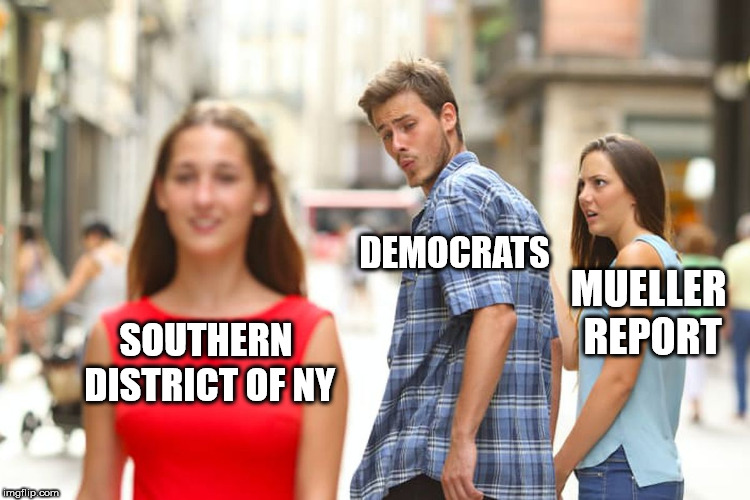
UPDATE: After the Mueller Report this seems appropriate:


I made this, BTW.

UPDATE: Yeah, that isn't happening any time soon. Tip to Instapundit.

Defeating Russia Requires the Defeat of Corrupt Ukrainians

In the last data dump I commented on the importance of Ukraine fighting corruption in order to be able to defend their country against Russian aggression:

Russia remains corrupt. Which offers Ukraine hope of being strong enough to deter Russia if it can be more than a smaller version of corrupt Russia. And thanks to Joe Biden, Ukraine was held back from that rule-of-law path to security. And we aren't exactly setting an example of caring about rule of law in our dealings with Ukraine in this matter, either. What's up with that?

As I noted in the second link in the above quote:

Only by becoming more like the West can Ukraine build the economic and military power to remain a free country, just as a free West built on rule of law defeated the USSR.

Remember, Russia is fine with a corrupt Ukraine. It allowed Russia to weaken and dominate Ukraine's government before 2014, and it will allow Russia to buy influence and control in Ukraine once again.

Stalemate, even tilted toward Ukraine as I noted in this post, in the Donbas won't matter if the real fight for Ukraine takes place in the secret bank accounts of Ukrainian officials and business people.

Ukraine seems to be taking care to avoid being just a smaller version of corrupt Russia:

Ukrainian President Petro Poroshenko on Thursday announced the launch of a special court to try corruption cases, part of a flurry of activity to shore up his reform credentials ahead of a presidential election run-off next week.

The court is being set up as part of Ukraine's $3.9 billion loan program with the International Monetary Fund, aimed at rooting out entrenched corruption and ring-fencing court decisions from political pressure or bribery.

It is distressing that it takes an election to push Poroshenko on this issue. But it is gratifying that Poroshenko realizes it is important to enough voters to push him to move on this issue.

Defeating Russia requires success in this war on corruption. We should fully support this effort.

UPDATE: It is not futile to think Ukraine could gain a quality edge over Russia:

The damage the one year conscript service did to the [Russian] military was never officially admitted until recently because senior officers were told that anyone speaking about this publicly would do serious damage to their careers. But as officers with knowledge of the extent of the damage retired or resigned from the military more of them spoke openly of the problem. Because of the growing demand for troops to serve in eastern Ukraine and Syria there was more discussion on the Internet of the negative impact one year conscripts have inflicted. Denials from the government were no longer working and active duty generals and admirals unofficially admitted it was all true, and that it was actually as bad as much of the Internet chatter implied. It was no secret that the presence of so many ill-trained conscripts in the military discouraged men from joining as volunteers (contract soldiers) and many existing officers and career enlisted men were leaving as well.

It is not futile for Ukraine to resist.

Friday, April 12, 2019

Crushtension

The European Union graciously granted Prime Minister May's request that the EU adjust its grip on Britain a little longer:

Following the decision early Thursday by the European Union to delay the U.K.'s departure for a second time, not much is clear about Brexit bar the certainty that the divisions in British society and in Parliament will remain.

The so-called "flextension" until Oct. 31 given to Britain to approve a Brexit withdrawal agreement will require the country to hold elections for the European Parliament on May 23 — provided the withdrawal agreement hasn't been passed by lawmakers.

Perhaps I'm a pessimist, but I think that an extension is just a way for the EU and British Remainers to ease Britain out of the pledge the British government made to its people that the Brexit referendum would settle the issue of EU membership finally, one way or the other.

Remainers and the EU assumed the issue would be settled the other way, and have obstructed the negotiations to create doubt and fear about exiting the EU, all to reach the point where a bare majority of British people will now accept the other way to settle the issue forever. With no more voting allowed.

And if another vote is held to confirm the original Brexit result, it will be for the sole purpose of reversing the original Leave vote. Are you so naive as to think that a second leave result will not result in more delay and obstruction and yet another vote in a couple years to verify that the British voters really want to leave the EU?

Only a vote to remain in the EU will be considered a final vote--no matter how many it takes.

And so with this delay the EU will renew the strength of its grip on Britain's throat. Rule of law and democracy will fail in the face of the proto-imperial EU's drive for ever closer union despite the wishes of all those warmongering peasants who don't know what is good for them anyway.

I hope I am wrong, but I think Britain will be crushed by this extension and absorbed into the EU for good.

Which will be a good lesson for any member state less powerful than advanced, prosperous, and nuclear-armed Britain that might wish to escape the imperial state being built in Brussels.

UPDATE: Remember that the only reason there is an Irish issue bedeviling Britain's exit is that the Irish were made to vote until they accepted the European Union.

It's business as usual for the EU.

Will Fear of China Be the Beginning of Russian Wisdom?

Is Russia willing to confront the problem of their accommodating policy toward China?

Barring a radical destabilization of Xinjiang or fundamental shifts in Central Asian countries and their relations with major power centers abroad, Beijing will “very likely” establish a network of its own military bases in the region over the next five years, according to Dmitry Zhelobov, a China specialist at Russia’s Urals Federal University. He recently argued, in a widely reposted interview with the Moscow-based Regnum news agency, that Chinese steps toward acquiring those bases are driven by a desire to expand its regional influence as well as to ensure that neither Russia nor the United States are able to limit China’s cross-continental trade with Europe.

I've said that China's Belt and Road Initiative to build up overland trade routes will eventually lead to Chinese military presence to protect the new economic assets.

Indeed, I've long wanted China to focus inland so China won't be likely to wage war on America and our allies at sea. Such an inland focus, complete with ground forces, will force Russia to confront the Chinese threat.

China and Russia are no allies, I think. Does the wide reposting of that interview highlighting China's threat mean that Russia is on the path to ending their policy of appeasing China (and concealing that appeasement by being counter-productively hostile to NATO)?

Zheloboy warns of China's threats to "post-Soviet" space in Central Asia. But the threat to "pre-Soviet" Far Eastern territorial gains at China's expense is just as real, if a little further in the future.

Of course, even if Russia is finally facing reality, they did a lot of damage to their relations with the West which will make it difficult to get help against China. Perhaps people in Russia will notice that Putin effed things up royally.

UPDATE: Will there be a big skedaddle by Russians from the former Soviet republic Kazakhstan?

Thursday, April 11, 2019

Dreaming of Armored Cavalry

I have been worried about the Army's lack of armored cavalry.

The armored cavalry regiments are gone in all but name and in the brigade combat teams we made light units that were essentially forward observers to call in firepower. Of course, divisional cavalry squadrons (battalions) died in that reorganization. Will our latest reorganization that is considering restoring division roles for major combat operations restore the divisional cavalry squadron?

Major Jennings discusses the divisional squadron. He highlights something I've mentioned before, after the experience of the Persian Gulf War:

Two years later, even as it downsized, the Army established robust L-series squadrons that included three ground troops containing Abrams and CFV [NOTE: Cavalry Fighting Vehicles, the cavalry version of the Bradley] platoons,along with two air troops with Apaches and Kiowa scouts. After decades of vacillation over whether division cavalry should optimize for stealthy or forceful reconnaissance, it had once again chosen maximal capability.

Yes! I've often mentioned that in peace the urge to lighten up recon elements, supposedly to make them more "agile," has proven to be unstoppable. But in war it is found that recon units need to be heavy enough to fight for information or to screen friendly forces to prevent the enemy from getting information.

Slowing down the enemy is a mission of our cavalry, too, and if cavalry units are strong enough to compel an enemy to deploy rather than overwhelm our cavalry screens from virtually a road march formation, we buy time and information.

Indeed, it frustrates me that the Army clearly misses the capabilities of an armored cavalry regiment because it is trying to build an ersatz armored cavalry regiment without just admitting what we need and building it.

I've mentioned Jennings' effort before. May he find a receptive audience in the Army to restore our damned armored cavalry formations. I don't think recon drones make their missions obsolete. Thin-skinned recon vehicles aren't "agile"--they're just smoking hulks.