

I don't think Multi-Domain Operations could affect the Army National Guard
as much as the Guard could be affected by a re-think on what is needed in the short term to fight a war. That has long been a point of debate.
A lot of what is in the Guard (and Army
Reserve) is part of the "tail" with more of the "tooth" in the active
component. The idea was that the country would have to debate the war
the Army was being sent to fight because the reserves would need to be
mobilized for any significant threat. Unless my memory is faulted, this was a reaction to the Vietnam War and sometimes called the "Abrams Doctrine."
Also, for people who didn't understand things, having a
higher active duty "tooth-to-tail" ratio looked
better.
Apparently, either the Army doesn't care about the national debate aspect
or thinks it will happen in the modern age regardless of the ability of
the Army to be moved overseas to fight a war, and so enabling the Army to
move faster with what it has on duty is the way to go.
Also, at least the Army understands that the other services will not be able to deploy the Army at will. The Army should face the reality that it has to plan on staging units when needed because the Navy and Air Force are a choke point in getting Army units mobilized in the United States to a battlefield around the world.
And yes, I fully worry
that the Army is too gripped by micromanagement (the way the French army
was in 1940) taking precedence over "mission command," which in theory enables lower level
initiative. We haven't faced a stronger conventional opponent in combat
(since 1950, I'd say) that could break apart the micromanagement
approach. Iraq's army in 1991 or 2003 simply wasn't strong enough to defeat the Army even if it was micromanaged.
A "zero mistakes" mentality on career advancement hinders
development of initiative, I fear. You'd think advances in computer
simulations would give ample opportunities for officers to just play
around with odd solutions--either to find a gem or disabuse them of bad
ideas--without harming careers even if the Army can't learn to embrace effing up in the chaos of properly understood exercises.
Anyway, the proper balance of active and reserve component units is a proper topic of debate. But I don't think Multi-Domain Operations is really having any effect on that debate.
Okay, this really isn't terribly focused. But it raises issues of reserve components, public support for war, officer leadership, and transportation shortfalls that worry me. But I can just vent here. So I did.
Wednesday, April 10, 2019
If You Have to Ask You Can't Afford It
China tells other countries that they are on double-secret probation in the South China Sea:
You have to admit that framing makes the negotiating process simple. China simply insists that other governments keep surrendering territory to China until China says that's enough.
Which fits with my past assessment of Chinese territorial claims:
Which is simple to remember.
China is withholding details on the boundaries of its vast claims to a resource-rich sea contested by five other governments because it distrusts international law and wants to ensure control over tracts of water that it considers crucial, maritime scholars say.
You have to admit that framing makes the negotiating process simple. China simply insists that other governments keep surrendering territory to China until China says that's enough.
Which fits with my past assessment of Chinese territorial claims:
I'm starting to think that an interest is "core" to China if China simply wants it.
Which is simple to remember.


Tuesday, April 09, 2019
Russia and China are Frenemies at Best
This author believes that the talk of a growing Russian-Chinese alliance is over-stated:
I tend to agree with that observation.
Even if the two are aligned a bit, it is more because China is focused on America and because Russia fears the power imbalance between Russia and China over control of Russia's Far East, which Russia took from China in the 19th century.
Which leads to Russia trying to point China out to sea in hopes that China will fight America instead of Russia.
And which leads Russia to hype a threat from NATO which serves to disguise Russian appeasement of the far more powerful China.
In the long run, China is far more dangerous to Russia if Russia wants to remain a Pacific power.
NATO is no military threat to Russian territorial integrity; and if Russians believe the example of free NATO states might "infect" Russian people, that problem is on Russia's treatment of their own people. If the Russians think NATO's "threat" to Russia can only be prevented by pushing Russia's boundaries west or by European states ceasing to be democratic beacons (hello proto-imperial and anti-democratic European Union), conflict between Russia and NATO is all on Russia's shoulders.
Indeed, China's Belt and Road Initiative (BRI, aka the New Silk Road, or One Belt One Road--OBOR) is a massive Chinese effort to move away from the sea and develop economic links to the west, including overland through Russia. If the flag follows trade, Russia will have problems in Central Asia where the USSR once ruled and in retaining their Far East.
But Nazi Germany and Soviet Russia caused a lot of damage to the world with a short-term Nazi-Soviet Nonaggression Pact despite their mutual hatred and fear. So even a short-term convergence of parallel interests could be a world-shattering problem.
It truly would be better if the Russians came to their senses and made peace with NATO (and their western neighbors, in general) and Japan to turn European Russia into a safe rear area while gaining the cooperation of America, Japan, and potentially South Korea to deter a Chinese attempt to recover their territories taken by Russia should that lost territory be raised to the level of a core Chinese interest.
We should definitely work to strengthen NATO while the Russians are fully in the grip of their delusions. But it would be nice if Democrats got over their sudden Russia obsession to allow America to have a little maneuvering room to pry at those natural Russian-Chinese divisions to help Russia come to its senses.
[Many] foreign-policy experts are convinced that an anti-U.S. alliance between the two countries is emerging. Yet even half a century on, such an assessment stretches the evidence beyond what it can bear. On closer inspection, Chinese-Russian economic, foreign policy, and military cooperation is less than impressive. The history of relations between the two countries is fraught, and they play vastly different roles in the world economy, making a divergence in their objectives all but unavoidable. In short, reports of a Russian-Chinese alliance have been greatly exaggerated.
I tend to agree with that observation.
Even if the two are aligned a bit, it is more because China is focused on America and because Russia fears the power imbalance between Russia and China over control of Russia's Far East, which Russia took from China in the 19th century.
Which leads to Russia trying to point China out to sea in hopes that China will fight America instead of Russia.
And which leads Russia to hype a threat from NATO which serves to disguise Russian appeasement of the far more powerful China.
In the long run, China is far more dangerous to Russia if Russia wants to remain a Pacific power.
NATO is no military threat to Russian territorial integrity; and if Russians believe the example of free NATO states might "infect" Russian people, that problem is on Russia's treatment of their own people. If the Russians think NATO's "threat" to Russia can only be prevented by pushing Russia's boundaries west or by European states ceasing to be democratic beacons (hello proto-imperial and anti-democratic European Union), conflict between Russia and NATO is all on Russia's shoulders.
Indeed, China's Belt and Road Initiative (BRI, aka the New Silk Road, or One Belt One Road--OBOR) is a massive Chinese effort to move away from the sea and develop economic links to the west, including overland through Russia. If the flag follows trade, Russia will have problems in Central Asia where the USSR once ruled and in retaining their Far East.
But Nazi Germany and Soviet Russia caused a lot of damage to the world with a short-term Nazi-Soviet Nonaggression Pact despite their mutual hatred and fear. So even a short-term convergence of parallel interests could be a world-shattering problem.
It truly would be better if the Russians came to their senses and made peace with NATO (and their western neighbors, in general) and Japan to turn European Russia into a safe rear area while gaining the cooperation of America, Japan, and potentially South Korea to deter a Chinese attempt to recover their territories taken by Russia should that lost territory be raised to the level of a core Chinese interest.
We should definitely work to strengthen NATO while the Russians are fully in the grip of their delusions. But it would be nice if Democrats got over their sudden Russia obsession to allow America to have a little maneuvering room to pry at those natural Russian-Chinese divisions to help Russia come to its senses.
A Marine Air Defense Swarm of Their Own
The Marines get the drone threat and the limits of ground-based air defenses:
For one thing, ground-based air defense is just one more thing that infantry have to lug around if they want to be protected. The weight issue is bad enough without forcing forward units on foot to be responsible for the defense of their local "brown sky" air space.
This is why I argued in Army magazine for Army air defense drones to battle enemy drone swarms.
On Thursday, during a hearing at the House Armed Service Committee, Marine leaders told lawmakers that they were also looking at drones that can kill other drones to bolster the Corps’ air defense capabilities.
Lt. Gen. Steven R. Rudder, the deputy commandant of the Marine Corps for aviation, told lawmakers that the miniaturization of tech was helping provide capabilities like “precision-guided munitions that can be launched and hover and loiter at great distances,” to “small UASs [unmanned aircraft system] that can counter other UASs, that we can certainly launch from a manportable system.”
Whether that system will employ kinetic or electronic attack to take down enemy drones was not clear during Thursday’s hearing, but the Corps has been experimenting with a range of loitering drone munitions capable of carrying different payloads.
The threat of swarming drones has become an ever-growing threat, which Rudder characterized Thursday as a “great concern,” especially as even small terror and militia groups have managed to weaponize small commercial drones.
For one thing, ground-based air defense is just one more thing that infantry have to lug around if they want to be protected. The weight issue is bad enough without forcing forward units on foot to be responsible for the defense of their local "brown sky" air space.
This is why I argued in Army magazine for Army air defense drones to battle enemy drone swarms.
Monday, April 08, 2019
Watch on the Tigris
The problem with sanctions imposed on an enemy being effective is that an enemy feels the effects (tip to Instapundit):
My first thought was "uh oh." In the Iran-Iraq War the Iranians knew that they were being starved of funds by the oil war against them, which consisted of Saudi-driven lower prices and Iraqi air attacks on oil exports. In time, this may have led the Iranians to lash out at sea contrary to their interests and spark combat with American forces in the Gulf.
I went to look for my long Iran-Iraq War post and discovered I'd apparently had the same "uh oh" reaction in December:
Don't think Iran won't wage war on us in Iraq. They've done it before:
This is an increase in the past estimate.
And the Iranians don't like it that we have troops in Iraq:
The one good thing about our departure in 2011 is that it proved we'd leave when asked. And then the Iraqis paid the price with the rise of ISIL.
We need to be careful with our ships and bases in the Gulf; our troops in Iraq need to be tight, with nobody going slack on base security; we need to keep a close eye on the pro-Iran Iraqi militias; and we must make sure CENTCOM air, ground, and naval forces are ready to counter any Iranian move.
Because the Iranians aren't finished trying to increase our body count.
UPDATE: I mentioned in the last data dump that we may designate Iran's Revolutionary Guards as a terrorist organization. An Iranian general threatened the lives of American troops if that designation should take place.
UPDATE: So what will Iran do now?
Let's not let down our guard out there.
UPDATE: Iran warned our fleet not to get close to their boats.
I'm fully on board the idea that nothing of theirs should get within a certain distance of our ships and be allowed to continue floating.
The American sanctions that kicked back in last November were designed well. They’ve hit Iran’s biggest industries, especially the oil sector, and have been slowly producing devastating effects. In January, Iranian President Hassan Rouhani said that Iran is facing its toughest economic situation in 40 years, and that the United States was squarely to blame.
My first thought was "uh oh." In the Iran-Iraq War the Iranians knew that they were being starved of funds by the oil war against them, which consisted of Saudi-driven lower prices and Iraqi air attacks on oil exports. In time, this may have led the Iranians to lash out at sea contrary to their interests and spark combat with American forces in the Gulf.
I went to look for my long Iran-Iraq War post and discovered I'd apparently had the same "uh oh" reaction in December:
As I've said, while economic sanctions are considered an alternative to war, if sanctions are really effective the target of the sanctions will see them as little different than kinetic attacks and may consider kinetics in response. ...
If our oil sanctions really do start to bite deep without Iran able to significantly evade the sanctions, Iran will consider military/terrorist options in response.
Does Iran know that they can't beat America any more or less than they knew in 1988?
I'd keep our capital ships out of the Persian Gulf for now and carefully investigate the death of our 5th Fleet commander in Bahrain.
UPDATE: Iran's chief nutball Rouhani repeats the longstanding Iranian threat:
"If one day they want to prevent the export of Iran's oil, then no oil will be exported from the Persian Gulf," he said.
Be careful out there.
Don't think Iran won't wage war on us in Iraq. They've done it before:
“During Operation Iraqi Freedom, DoD assessed that at least 603 U.S. personnel deaths in Iraq were the result of Iran-backed militants,” Navy Cmdr. Sean Robertson, a Pentagon spokesman, said in an email.
“These casualties were the result of explosively formed penetrators (EFP), other improvised explosive devices (IED), improvised rocket-assisted munitions (IRAM), rockets, mortars, rocket-propelled grenades (RPG), small-arms, sniper, and other attacks in Iraq," Robertson said.
This is an increase in the past estimate.
And the Iranians don't like it that we have troops in Iraq:
"You must make sure that the Americans withdraw their troops from Iraq as soon as possible because expelling them has become difficult whenever they have had a long military presence in a country," Khamenei was quoted as saying [in Iranian state media].
The one good thing about our departure in 2011 is that it proved we'd leave when asked. And then the Iraqis paid the price with the rise of ISIL.
We need to be careful with our ships and bases in the Gulf; our troops in Iraq need to be tight, with nobody going slack on base security; we need to keep a close eye on the pro-Iran Iraqi militias; and we must make sure CENTCOM air, ground, and naval forces are ready to counter any Iranian move.
Because the Iranians aren't finished trying to increase our body count.
UPDATE: I mentioned in the last data dump that we may designate Iran's Revolutionary Guards as a terrorist organization. An Iranian general threatened the lives of American troops if that designation should take place.
UPDATE: So what will Iran do now?
President Donald Trump announced Monday that the U.S. is designating Iran's Revolutionary Guard a "foreign terrorist organization," in an effort to increase pressure on the country that could have significant diplomatic implications in the Middle East.
Let's not let down our guard out there.
UPDATE: Iran warned our fleet not to get close to their boats.
I'm fully on board the idea that nothing of theirs should get within a certain distance of our ships and be allowed to continue floating.
Shield and Sword
America has deployed Reaper drones to Poland, where they will keep an eye on Russia's Kaliningrad exclave sandwiched between Poland, Lithuania, and the Baltic Sea.
That's good:
We need to keep a closer eye on Russian forces there to prevent the Russians from impeding reinforcements going to Poland.
Plus, I think NATO's first offensive operation in case Russia invades any of the Baltic states should be to capture Kaliningrad.
And you know my view on the importance of Belarus to NATO security. Belarus won't be an ally--and if they tried Russia would likely invade--but with Western support it can decline to be the launching point for a Russian invasion of Poland and Lithuania.
That's good:
The MQ-9s stationed in Poland will assist Poland in keeping an eye on Russian forces that often operate close to the 210 kilometer long border the two nations share (because of the Kaliningrad enclave on the Baltic). There is also the 418 kilometer border with Belarus, a close ally of Russia.
We need to keep a closer eye on Russian forces there to prevent the Russians from impeding reinforcements going to Poland.
Plus, I think NATO's first offensive operation in case Russia invades any of the Baltic states should be to capture Kaliningrad.
And you know my view on the importance of Belarus to NATO security. Belarus won't be an ally--and if they tried Russia would likely invade--but with Western support it can decline to be the launching point for a Russian invasion of Poland and Lithuania.
Sunday, April 07, 2019
Weekend Data Dump
One Congress cannot bind a future Congress' actions, but according to a judge one president can bind a future president if the first president issues an executive order intended to be permanent. Does the judge realize the kind of power she just granted Trump in her eagerness to defend Obama's legacy? Of course, it will be reversed. Unless Trump doesn't appeal and just pockets the new power. I don't know how that would work out. But it is a bad power to grant any president.
As President Trump seems to be gearing up for a reelection campaign I have to say my hunch that he'd decline to run for reelection in order to "leave on a high note" was wrong. And he could win all because Democrats couldn't pull off looking mostly sane at first glance.
Strategypage looks at the Littoral Combat Ship. It comes in two hull forms from two companies. It has promise if the flaws of the new designs can be worked out because the ships can be reconfigured for different missions with inserts. My problem with the class is the idea that it can operate close to shores and expect to survive. I think that issue is resolved. My other issue is that the ship needs those combat system inserts to be more than a weak surface combatant with enough open space to carry a company-sized ground unit or supplies, too. Work on the mission modules and the debugging of the new-class problems and it will be able to play a useful role even though it was designed for the post-Cold War era of power projection against weak powers lacking anti-ship weapons. Although it is no longer a cheap ship.
Resistance if futile. You will be absorbed into the Borg collective. 5G totalitarianism is a horror to behold in its expansive aims for control.
Wait a second, "Beto" O'Rourke spoke to an audience in his "native Spanish?" Did his cultural appropriation go so deep that a reporter doesn't notice Beto's a basic white guy (not that there's anything wrong with that, of course)?
We have halted the shipment of equipment to Turkey that will allow them to eventually get F-35s. We also say Turkey's role in the global supply chain can be replaced. Good. But remember that we don't have an S-400 problem--we have an Erdogan problem.
Fans of socialism in America have a sweet gig. When socialist states are shown to be an economic failure and/or police state sh*thole state like Venezuela, the USSR, Cuba, or North Korea, socialists say that particular failure didn't really implement socialism. And then the fans point to successful states like Sweden or Denmark and falsely claim they are socialist states. Face it, some people just like ordering other people about, and socialism is nothing if not that.
I won't say that Trump is responsible for strengthening NATO given that path was started under Obama in reaction to Russia's invasions of Ukraine. But I will say that Trump is certainly not wrecking NATO as the Germans like to say (to justify their failure to spend sufficient money on defense?)--and he is continuing to strengthen NATO's defenses--especially American power which weakened in regard to maintenance and ammunition stocks under Obama. And in the meantime, only the German government and Russia are happy with Germany's failure to maintain a military rather than a public works program with common dress codes. The Germans say they can't spend more because of World War II. But the Germans did have an effective military in the Cold War (both West Germany and East Germany, oddly enough) despite the same history being closer in time. And if that is their worry, I say bring out the clue bat one more time.
Hiftar (or Haftar) is gradually making the talks about a unity government moot. His forces are slowly expanding from their eastern base and just took Gharyan, 60 miles south of Tripoli in the west. But it's not all slow-motion shock and awe. And the militias that control Tripoli vow to fight. The recognized government seems to just control a narrow coastal strip in the west, so if Hiftar takes Tripoli, the formal capital, he might have the win.
"[On the Gaza border] Israeli troops found and destroyed several bombs demonstrators had thrown over the border fence during a recent demonstration." I know the authors know this, but in what sense do "demonstrators" throw bombs? This is an ongoing border assault with human shields.
You'd think that if global warming is a crisis that we'd start ramping up nuclear power before we insist on settling the question of how we should react to climate change. Nuclear energy can satisfy goals of both sides without settling the question of planetary doom, no?
For no particular reason to share this, but I always assumed that anonymous work surveys will always provide superiors with enough information to exactly figure out who said what.
Yeah, it sucks when you run afoul of your own rules.
I wonder how many times Fairfax took the test before he passed it.
There is no reason for America to denounce the Montreux Convention given that Turkey is the ultimate decider on access to the Black Sea based on physical control of the Turkish Straits. So Russian suggestions we could do this are likely just propaganda to drive the wedge in US-Erdogan relations deeper, in my opinion. Given NATO decisions to bolster its position around the Black Sea, this is perhaps expected. Although Turkey remains a shaky pillar of that NATO effort.
What are the odds that Iran didn't thoroughly scrub the warehouse in the large amount of time that passed between Israel's operation to pull information out of the nuclear program information storage site and the IAEA inspection? And for God's sake people, of course Iran abides by the horrible Iran nuclear deal! It is effectively toothless.
KATUSA's and how America's Army humanized the South Korean military.
Tora! Tora! Tora! Sorry, I couldn't resist.
China is apparently studying the naval battles for Guadalcanal. That's good. But I think a study of how the synergy of all the domain battles in that long World War II campaign provided America victory is a better focus--as I sketched in this AUSA Land Warfare Paper. But yeah, the point of being able to endure losses and win while maintaining logistics is important alone.
I don't think Biden has done anything that damning (while making clear I would not behave in such a manner). But I do take comfort that after decades of Republicans being horribly accused of "waging war on women," it is clear the Democrats had their own p***y-grabbing brigade in their own ranks of men. Enjoy the deserved purge.
Given the importance of holding the Suwalki Gap, a special agreement on defense cooperation with Lithuania on top of NATO membershipis a good idea.
As long as we are talking presidential obstruction.
I'm not comfortable with Afghanistan not being at the table for negotiations with the Taliban. It accepts Taliban claims that that the Afghan government isn't legitimate. How can be trust a deal with the Taliban to protect the Afghanistan government when the Taliban don't accept the Afghan government? Negotiating a "decent interval" between our departure and a Taliban victory is no way to discuss peace.
If robotic logistics vehicles can be misdirected by putting stickers on pavement, the leader-follower concept faces another vulnerability.
Just call them "high-capacity legal tender." There are people who will use this information to ban paper currency because "only criminals need it." Why does everything I buy need to be recorded by somebody?
More Russians too poor to buy new shoes. I wonder what happens when the Russian people figure out Putin is at fault?
Effing Russians.
Taiwan declared a rather specific red line against Chinese fighter planes crossing a long-observed line in the Taiwan Strait. Will Taiwan enforce that by shooting at Chinese fighters? Will China attempt to ambush a Taiwanese effort to enforce that line? In related news, the Chinese don't want Taiwan to be better able to enforce such a red line by buying new late-model F-16s from America.
If Britain doesn't exit the European Union despite lack of a deal, rule of law is dead in Britain and the European Union has learned that obstructing national democracy by refusing to negotiate in good faith is the best way to defeat democratic efforts to resist "ever closer union" until the proto-imperial project can shed the prefix.
If American military intervention to overthrow Maduro is on the table, watch the Atlantic Marine Expeditionary Force, the 82nd Airborne Division, related air and naval units, and SOUTHCOM for signs of more intense activity. While it would be morally right to overthrow Maduro, I'd rather not count on a quick victory. And I don't want to do it to save Brazil the job of leading an intervention of Latin American states, which Brazil's military is opposed to doing. I continue to think intervention is more likely for purely humanitarian reasons to enable the flow of aid. Although we should keep in mind how humanitarian missions can become combat missions--see Somalia from Bush 41 to Clinton. But given the sudden Democratic hatred of all things Russia, how could Democrats credibly oppose intervention given that Russia has sent actual troops to assist Maduro. Not many, mind you. But still, RUSSIANS.
Captain Obvious arrives in WDC to declare Iran's Revolutionary Guards a terrorist organization. The story makes a point of saying that this is "the first time Washington has formally labeled another country's military a terrorist group." But how many times have people friendly to Iran said we can't hold the government responsible for what the Revolutionary Guards do because they aren't fully under control of the government?
That's pretty cool.
The Army wants to help improve marksmanship by removing an alternate test that reduces the "drop" and wind problems for long-range targets. That's a good thing to do until the Army issues marksmanship to each soldier (membership required).
French weekend protests continue.
Russia remains corrupt. Which offers Ukraine hope of being strong enough to deter Russia if it can be more than a smaller version of corrupt Russia. And thanks to Joe Biden, Ukraine was held back from that rule-of-law path to security. And we aren't exactly setting an example of caring about rule of law in our dealings with Ukraine in this matter, either. What's up with that?
If the Arab Spring is re-blooming in Sudan, the Islamist dictator in question isn't planning to go quietly without trying to kill his way to victory, it seems.
The Saudis are expanding their diplomatic presence in Iraq. Good. It's about effing time. If the Saudis will finally bring Iraqi back into the Arab fold despite the Sunni-Shia divide, Iraqi prime minister visits to Iran will more and more take the form of "you guys had best back off, or else" agendas.
An American aircraft carrier visit to Vietnam is a nice peacetime symbol of support against Chinese territorial claims. But I still don't like dangling those ships too near threats in case we suddenly aren't in peacetime.
It is not being "worshipped." That said, I've never been keen on that relic "veneration" stuff. A nice statue should be sufficient.
Oh FFS, it wasn't a "doctored" video of Biden! It was an obvious spoof video mocking Biden. How many people just saw the biased headline?
A Venezuelan legislator says 20 tons of gold is being readied for loading on a Russian plane. If true, is this for Maduro's exile or is Maduro paying Russia to save his inept and cruel regime?
Well, our new helmet (ECH) certainly works. It's nice to see things made by the lowest bidder working.
Worst. Tyrant. Ever. But he tweets! It still boggles my mind that so many on the left sincerely believed the election of Trump would lead to a dictatorship here.
Huh.
A Milestone in Iran's Propaganda War
Congress voted to hand Iran a victory in Yemen:
Which is good for Iran given that they are slowly losing and only getting the West to fall for their propaganda charges can save them there at this point.
But hey, the whole Khashoggi martyr campaign went well for Iran by getting Congress to turn against the Saudis. Why not extend that to Yemen, too?
UPDATE: I should note an old post on war powers. It's complicated. And a bonus in that I discovered an older post of mine that clarified an issue I was long puzzled about. Amazingly that discovery of mine exited my brain since I found it and posted about it.
Rejecting a plank of President Donald Trump's foreign policy, the House on Thursday invoked never-before-used powers to demand that his administration withdraw support from the Saudi-led war in Yemen . The Senate passed the same resolution in March with bipartisan support.
Trump is expected to issue a veto of the measure , his second as president, and Congress does not have the votes to override him. But the action was nonetheless a milestone for lawmakers, who have shown a renewed willingness to assert their war-making powers after letting them atrophy for decades under presidents from both parties.
Which is good for Iran given that they are slowly losing and only getting the West to fall for their propaganda charges can save them there at this point.
But hey, the whole Khashoggi martyr campaign went well for Iran by getting Congress to turn against the Saudis. Why not extend that to Yemen, too?
UPDATE: I should note an old post on war powers. It's complicated. And a bonus in that I discovered an older post of mine that clarified an issue I was long puzzled about. Amazingly that discovery of mine exited my brain since I found it and posted about it.
Saturday, April 06, 2019
We Still Have a German Question in 2019?
Just ... stop:
Are the Germans seriously arguing that they can't be trusted with a real military after so many decades in NATO and as a democracy?
If so, allow me to apply the clue bat:
If the Germans are convinced that they are that prone to going full Aryan on Europe, maybe we just need to pull out and nuke the site from orbit as the only way to make sure.
What is wrong with these people?
German efforts to meet defense obligations as part of NATO are sparking heated discussions within the country about its military because of the nation's Nazi history, according to a top diplomat.
“These debates are necessary in view of Germany’s history,” German Foreign Minister Heiko Maas said Wednesday at a forum on the sidelines of the NATO summit in Washington. “Instead of only talking about ability or willingness to honor commitments with the alliance, we should also make one thing clear: NATO may be a security alliance but above all it's an alliance of values and it has a political function.”
Maas’ implicit reference to Germany’s role in the Second World War came just a couple hours after Vice President Mike Pence lashed Berlin for failing to honor a 2014 pledge to increase defense spending.
Are the Germans seriously arguing that they can't be trusted with a real military after so many decades in NATO and as a democracy?
If so, allow me to apply the clue bat:
I keep reading that the Germans hate their militaristic past so much that they don't want to fight.
Let's try applying the clue bat to Germany's collective skull on this issue.
Conquering and setting up death camps under the shield of a powerful military? That's bad. By all means, don't do that.
Having a military capable of fighting death cult enemies or stopping the Russians from moving west? Well, that's a good thing. Try doing that.
If the Germans are convinced that they are that prone to going full Aryan on Europe, maybe we just need to pull out and nuke the site from orbit as the only way to make sure.
What is wrong with these people?
Their Foes By Any Other Name
The Russians simply move into vacuums to spite America, it seems. I credit that to poor self esteem. Wherever the Russians annoy America, they proudly exclaim "See? We matter!" Sad, really.
Seriously, what is their major malfunction (tip to the PJ Media Live Blog)?
Not that this is something new for Russia. Even in the Era of Glorious Reset, the Russians saw America as their main enemy. And NATO is along for the ride of hate, of course, as our security institution in Europe.
Seriously, the Russians should look in the mirror if they want to see their main enemy.
#WhyRussiaCan'tHaveNiceThings
UPDATE: Am I right, or what?
We really matter! We're somebody!
If the Russians didn't have nukes it would be pathetic.
UPDATE: Will Russia take the risk of supporting Maduro just to be "significant?"
America will impose more sanctions on Russia if Russia backs Maduro too much.
Will Russia's people think trading their economic well being for the warm fuzzy feeling that Putin gets from being seen as "significant" in world affairs is a good deal?
Seriously, what is their major malfunction (tip to the PJ Media Live Blog)?
In case anyone harbored any doubts, Moscow’s top military leader has reaffirmed that Russia is engaged in a permanent war with the United States.
In a recent speech at Moscow’s Academy of Military Science, Gen. Valery Gerasimov, chief of the Russian general staff, issued a three-pronged warning to the United States. He broadened Moscow’s definition of war, threatened the nuclear option and invented a U.S.-sponsored “fifth column” that allegedly plans to destabilize Russia.
Gerasimov followed in Soviet footsteps by describing America as Russia's main enemy and declared that there are no essential differences between open war and an opaque peace. [emphasis added]
Not that this is something new for Russia. Even in the Era of Glorious Reset, the Russians saw America as their main enemy. And NATO is along for the ride of hate, of course, as our security institution in Europe.
Seriously, the Russians should look in the mirror if they want to see their main enemy.
#WhyRussiaCan'tHaveNiceThings
UPDATE: Am I right, or what?
"Harsh confrontation with Washington over Venezuela, according to the Kremlin's logic, boosts Russia's significance in the eyes of the U.S.," foreign affairs analyst Vladimir Frolov told CBS News. "It's political theater, and theater needs proper decorations."
We really matter! We're somebody!
If the Russians didn't have nukes it would be pathetic.
UPDATE: Will Russia take the risk of supporting Maduro just to be "significant?"
It has become increasingly clear that Vladimir Putin is not going to let the U.S. take its Middle East regime-change policy to Venezuela.
Outside of a loyal Venezuelan military, the Socialists United leader and the country’s president, Nicolas Maduro, is protected by criminal gangs called Coletivos and by the Russians. ...
If Maduro sticks around longer than most people hope, and if the Russian government is seen as aiding that, investors should look for another round of sanctions designed to punish Russia for its role in Venezuela.
America will impose more sanctions on Russia if Russia backs Maduro too much.
Will Russia's people think trading their economic well being for the warm fuzzy feeling that Putin gets from being seen as "significant" in world affairs is a good deal?
Friday, April 05, 2019
Send in The AFRICOM Queen
The general selected to lead AFRICOM is worried about Russian activities in Africa.
Why Russia is wasting time doing this other than to be a big fat jerk is beyond me:
We have limits on responding. Our footprint in Africa is small away from the Horn of Africa and our power projection capabilities are limited to that area and the Mediterranean littorals with Marine reaction forces ashore in Spain and Italy.
Although we are building up capabilities to go after jihadis in the areas around Niger.
Still, local sensitivities generally provide a brake on our ambitions. And higher priorities in Europe and Asia mean resources to AFRICOM are scarce. I sometimes figure AFRICOM's unofficial motto must be "Thank God for SOUTHCOM!"
But if we equip one or more modularized auxiliary cruisers as power projection platforms capable os military or humanitarian missions, as I described in "The AFRICOM Queen" in Military Review, we could have a mobile at-sea force capable of reaching areas in sub-Sahara Africa beyond the range of existing power concentrations.
UPDATE: Fighting in Libya is getting too close for comfort:
Libya--especially after the failure to rapidly respond to the September 11, 2012 jihadi attacks in Benghazi--is well within our military range of action from bases in Europe now.
But away from that, The AFRICOM Queen would be useful for similar evacuations--or even basing such missions aboard the ship itself offshore.
Why Russia is wasting time doing this other than to be a big fat jerk is beyond me:
Army Gen. Stephen Townsend, the nominee to head U.S. Africa Command, said Tuesday that the presence of Russian mercenaries in the Central African Republic is part of the effort by President Vladimir Putin to regain influence for Moscow in the Sub-Sahara.
We have limits on responding. Our footprint in Africa is small away from the Horn of Africa and our power projection capabilities are limited to that area and the Mediterranean littorals with Marine reaction forces ashore in Spain and Italy.
Although we are building up capabilities to go after jihadis in the areas around Niger.
Still, local sensitivities generally provide a brake on our ambitions. And higher priorities in Europe and Asia mean resources to AFRICOM are scarce. I sometimes figure AFRICOM's unofficial motto must be "Thank God for SOUTHCOM!"
But if we equip one or more modularized auxiliary cruisers as power projection platforms capable os military or humanitarian missions, as I described in "The AFRICOM Queen" in Military Review, we could have a mobile at-sea force capable of reaching areas in sub-Sahara Africa beyond the range of existing power concentrations.
UPDATE: Fighting in Libya is getting too close for comfort:
The U.S. military has withdrawn its troops from Libya as a local military commander’s forces advanced on the capital for a showdown with militias holding the city.
“Due to increased unrest in Libya, a contingent of U.S. forces supporting U.S. Africa Command temporarily relocated in response to security conditions on the ground,” AFRICOM said in a statement.
Libya--especially after the failure to rapidly respond to the September 11, 2012 jihadi attacks in Benghazi--is well within our military range of action from bases in Europe now.
But away from that, The AFRICOM Queen would be useful for similar evacuations--or even basing such missions aboard the ship itself offshore.
Blitz or Attrition?
Strategypage notes that Iran's strategy for threatening Israel centers on adapting 10,000 longer-ranged rockets GPS guidance. That will require Israel to invade Lebanon to root out Hezbollah. Unless Israel thinks it can win an air war against Hezbollah this time.
Iran has been unable to exploit their position in Syria to establish forward positions on the Israeli border, but they still have southern Lebanon (and a bit of influence in Gaza, too):
With much less money to play around with under renewed sanctions and lower oil prices (on top of corruption), Iran's Syria expedition doesn't have the resources it once had.
Still, a precision rocket arsenal would change the situation dramatically for Israel. Israel could very well launch a multi-division ground raid into Lebanon to really dig out Hezbollah before Hezbollah can recover from and redeploy from the heavy casualties in their expeditionary force sent to Syria to fight for Assad.
Just mass rockets alone would in time overwhelm Israel's rocket defenses which rely on the fact that only a small fraction of dumb rockets will actually hit a target, and so have to be intercepted with an Iron Dome rocket. The vast majority could be allowed to hit harmlessly.
But with 10,000 GPS-guided rockets, Israel will quickly run out of defensive missiles. Which means that Israeli ground troops need to go in and clear out the rocket-launching sites and arsenals. And as long as they are in southern Lebanon I figure the Israelis could exploit Hezbollah's Syria diversion to go further north and really tear up Hezbollah's rear area infrastructure.
Or perhaps the Israelis think that their air and missile power has got so much better than it was in 2006 that Israel can do from the air what they failed to do in 2006 the last time Israel faced a Hezbollah rocket campaign--destroy it all from the air.
But on the other hand, I've been connecting dots pointing to an Israeli ground raid for many years now. Which at least may indicate the logic is sound even if the decision to act on the logic has not been made in Israel.
Iran has been unable to exploit their position in Syria to establish forward positions on the Israeli border, but they still have southern Lebanon (and a bit of influence in Gaza, too):
While Iran has backed off from the Israeli border and spent more time and effort concealing its operations and personnel in Syria, there are still plans to “destroy Israel.” These apparently revolve around upgrading over 10,000 of the longer (50 kilometers or more) range rockets Iran has provided Hezbollah. The upgrade is mainly about adding GPS guidance systems that will allow for precision attacks on Israeli targets (especially populated areas). A mass use of these rockets could overwhelm Israeli anti-missile defenses.
With much less money to play around with under renewed sanctions and lower oil prices (on top of corruption), Iran's Syria expedition doesn't have the resources it once had.
Still, a precision rocket arsenal would change the situation dramatically for Israel. Israel could very well launch a multi-division ground raid into Lebanon to really dig out Hezbollah before Hezbollah can recover from and redeploy from the heavy casualties in their expeditionary force sent to Syria to fight for Assad.
Just mass rockets alone would in time overwhelm Israel's rocket defenses which rely on the fact that only a small fraction of dumb rockets will actually hit a target, and so have to be intercepted with an Iron Dome rocket. The vast majority could be allowed to hit harmlessly.
But with 10,000 GPS-guided rockets, Israel will quickly run out of defensive missiles. Which means that Israeli ground troops need to go in and clear out the rocket-launching sites and arsenals. And as long as they are in southern Lebanon I figure the Israelis could exploit Hezbollah's Syria diversion to go further north and really tear up Hezbollah's rear area infrastructure.
Or perhaps the Israelis think that their air and missile power has got so much better than it was in 2006 that Israel can do from the air what they failed to do in 2006 the last time Israel faced a Hezbollah rocket campaign--destroy it all from the air.
But on the other hand, I've been connecting dots pointing to an Israeli ground raid for many years now. Which at least may indicate the logic is sound even if the decision to act on the logic has not been made in Israel.
Thursday, April 04, 2019
So What About Syria?
The United States lacks a strategy for even what we want in Syria. Other than that narrow point, I don't think too much of the article. But that point is spot on. What do we want in Syria? And what price will we pay to get what we want?
I mentioned some time ago that we needed to decide what our objective in Syria is after defeating ISIL:
The question could be avoided as long as ISIL still held ground in Syria. We had to defeat ISIL in Iraq, build up friendly forces in Syria, and then defeat ISIL in Syria. But after that, what?
And I suspect avoiding the question is why the final defeat of the ISIL caliphate last month took so long after the effective defeat of ISIL over a year ago.
And FFS, no we aren't refusing to accept victory in Syria over ISIL. Like every victory, it is not the end of history but the entry ticket to the next problem or problems.
Now, post caliphate, we don't want Iran to entrench in Syria. We don't want Iran to have an overland supply route to Syria and Lebanon (where Iran's ally and creation Hezbollah is a power within that formal state). And we don't want to look like we are abandoning local allies in the SDF (mostly Kurds).
Those objectives are difficult as long as Assad is in power. But when we wanted Assad to step down, we did nothing effective to make that happen. And now that Assad seems secure, the fact that we don't have high interests in western Syria means we won't exert a larger amount of power to get rid of Assad to prevent those bad things.
Now we need to get "lucky" for that to happen. And if we get lucky until that is sorted out the chaos will deepen.
Will we stay in eastern Syria to prevent those bad things, hoping we don't suffer casualties to achieve them? But if we have a Beirut barracks bombing or Battle of Mogadishu that forces us to confront our unwillingness to suffer casualties for those objectives, we will retreat and look bad.
I'd like alternative to staying in Syria for preventing bad things. Could we strengthen Iraq to cut off the land route right there? Could we work with Russia and Israel to get Iran out of Syria and to get the Syrian Kurds a level of autonomy that protects them?
I mentioned some time ago that we needed to decide what our objective in Syria is after defeating ISIL:
The Obama administration ignored the logical consequences of saying Assad had to step down by waging a parallel war as a de facto ally of Assad against the common enemy of ISIL that put off enforcing that declaration. The defeat of the ISIL caliphate has exposed the wide gap between the stated preference for Assad to leave and the focus of military action on ISIL only. So what do we do now?
The question could be avoided as long as ISIL still held ground in Syria. We had to defeat ISIL in Iraq, build up friendly forces in Syria, and then defeat ISIL in Syria. But after that, what?
America avoided facing that question while in the first three steps (and I suspect avoiding that question is why Iraq War 2.0 has taken so long). We've finally finished the first three steps.
America now has to face the fourth step and either finish the job by targeting Assad and defeating Russia, Iran, and Hezbollah in the process; or by pulling out and accepting the consequences of Assad's continued rule, Russian and Iranian bases in Syria, Hezbollah's role on the winning side, and the loss of reputation by watching the Syrian Kurds and Syrian rebels we once supported get crushed by Assad and his allies.
And I suspect avoiding the question is why the final defeat of the ISIL caliphate last month took so long after the effective defeat of ISIL over a year ago.
And FFS, no we aren't refusing to accept victory in Syria over ISIL. Like every victory, it is not the end of history but the entry ticket to the next problem or problems.
Now, post caliphate, we don't want Iran to entrench in Syria. We don't want Iran to have an overland supply route to Syria and Lebanon (where Iran's ally and creation Hezbollah is a power within that formal state). And we don't want to look like we are abandoning local allies in the SDF (mostly Kurds).
Those objectives are difficult as long as Assad is in power. But when we wanted Assad to step down, we did nothing effective to make that happen. And now that Assad seems secure, the fact that we don't have high interests in western Syria means we won't exert a larger amount of power to get rid of Assad to prevent those bad things.
Now we need to get "lucky" for that to happen. And if we get lucky until that is sorted out the chaos will deepen.
Will we stay in eastern Syria to prevent those bad things, hoping we don't suffer casualties to achieve them? But if we have a Beirut barracks bombing or Battle of Mogadishu that forces us to confront our unwillingness to suffer casualties for those objectives, we will retreat and look bad.
I'd like alternative to staying in Syria for preventing bad things. Could we strengthen Iraq to cut off the land route right there? Could we work with Russia and Israel to get Iran out of Syria and to get the Syrian Kurds a level of autonomy that protects them?
"Defender Pacific" is a Good Start
The Army is looking at a South China Sea scenario, using a fairly substantial force in the exercise. This is a start to really thinking about an Army role in its core competencies across the Indo-Pacific region.
Good:
This is excellent both in raising the Army's sights from the narrow focus on South Korea and recovering the ability to move large ground forces into other areas of INDOPACOM (and let me vent my continued disappointment that the command wasn't renamed PAINCOM). Gaining familiarization with the host countries' militaries and terrain will be useful.
Even India is a possibility.
The practice moving troops like this will eventually be useful for moving a major Army force of 5 divisions to assist allies around the periphery of China, as I argued for in Military Review fairly recently.
And really, as I wrote for the Institute of Land Warfare, even some islands can require a sizable Army effort to secure.
Good:
While the U.S. Army has 85,000 permanently stationed troops in the Indo-Pacific region and is already conducting exercises such as Pacific Pathways with allies and partners, the service is aiming to practice rapid deployment from the continental United States to the Pacific.
The plan is to bring over a division headquarters and several brigades over the course of a 30- to 45-day period along with their enablers, Brown said.
“They will get the challenge of coming to the Pacific with the Pacific-assigned forces already there,” he said, “and we won’t go to Korea, we will actually go to a South China Sea scenario where we will be around the South China Sea; and another scenario we can do that is the East China Sea.”
The exercise will consist of many things the Army has not practiced at such a large scale, Brown said. Forces will be in countries like the Philippines and Thailand, and they will likely work with other countries like Malaysia, Indonesia and Brunei.
This is excellent both in raising the Army's sights from the narrow focus on South Korea and recovering the ability to move large ground forces into other areas of INDOPACOM (and let me vent my continued disappointment that the command wasn't renamed PAINCOM). Gaining familiarization with the host countries' militaries and terrain will be useful.
Even India is a possibility.
The practice moving troops like this will eventually be useful for moving a major Army force of 5 divisions to assist allies around the periphery of China, as I argued for in Military Review fairly recently.
And really, as I wrote for the Institute of Land Warfare, even some islands can require a sizable Army effort to secure.
Wednesday, April 03, 2019
Wasp is Not an Aircraft Carrier
A Navy amphibious warfare ship embarked a complement of 10 F-35Bs, larger than a usual half dozen. But the ship is not an aircraft carrier. We should never build such ships instead of big-deck carriers for the aviation mission, but be grateful that have a useful secondary role as a light carrier.
Yes, this is a good thing given the great improvement the F-35B provides over the ancient Harrier that used to be carried:
Such small carriers are not a cost effective replacement for big deck carriers. The math doesn't work out for such a replacement. Seriously, Wasp is not a carrier. The Navy understands this, fortunately.
Even if you replaced each large carrier with four light carriers to match sortie rates, the smaller carrier can't carry the breadth of naval aviation that the big carriers can embark. Nor do the small carriers have the endurance of the nuclear-powered ships, which eases the strain of refueling surface escorts.
Perhaps drone aircraft in many of those roles could fit on the small carriers but I'm skeptical light carriers can do the job. Especially if you still want amphibious warfare.
But the small amphibious ship provide a useful sea-based aviation capability in their light carrier role.
I think the true replacement for aircraft carriers in the sea control role is--as I projected in 2000--a networked force of surface warships (with rail guns!), submarines, sea- and land-based air power, and land-based anti-ship artillery (including rockets and missiles).
Add in auxiliary cruisers and we're all set for whatever you want to call it, whether "network-centric warfare," "cooperative engagement," the "tactical cloud," "distributed lethality," or a "kill net."
Abut remember that power projection and sea control are different missions when you assess the role of sea-based aviation. I think we need fewer big-deck super carriers for the former mission and should not rely on them in the face of enemy kill nets for the latter.
UPDATE: Wasp in the South China Sea this month, from Strategypage:
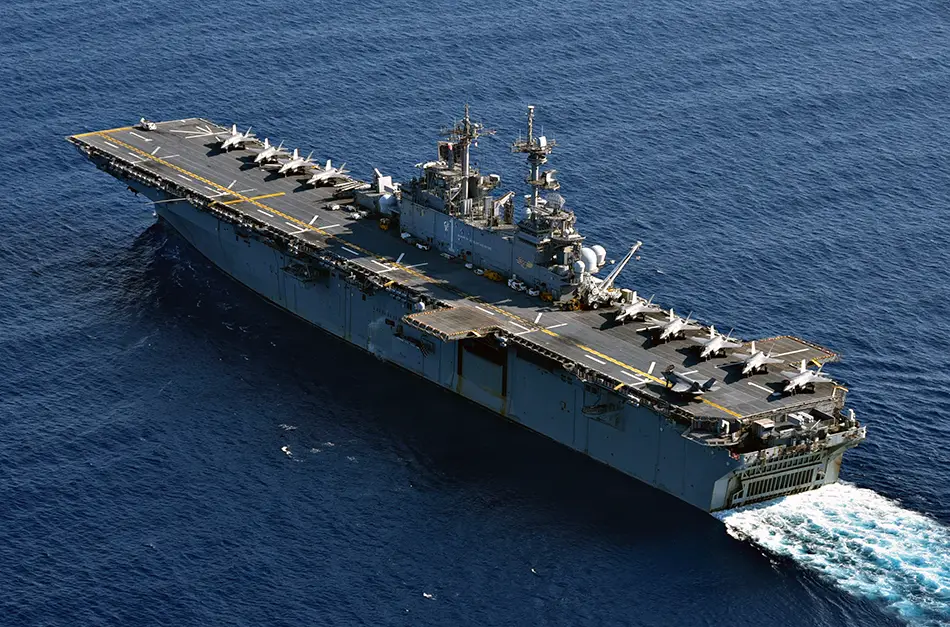
Yes, this is a good thing given the great improvement the F-35B provides over the ancient Harrier that used to be carried:
In sailing with nearly twice as many vertical-landing fighters than is normal for an assault ship, Wasp is helping to prove a concept the Marine Corps seriously has been mulling over for years now -- transforming amphibious ships into light aircraft carriers.
It's an idea that's gaining credibility as the Navy considers cutting the number of large carriers in the fleet.
Such small carriers are not a cost effective replacement for big deck carriers. The math doesn't work out for such a replacement. Seriously, Wasp is not a carrier. The Navy understands this, fortunately.
Even if you replaced each large carrier with four light carriers to match sortie rates, the smaller carrier can't carry the breadth of naval aviation that the big carriers can embark. Nor do the small carriers have the endurance of the nuclear-powered ships, which eases the strain of refueling surface escorts.
Perhaps drone aircraft in many of those roles could fit on the small carriers but I'm skeptical light carriers can do the job. Especially if you still want amphibious warfare.
But the small amphibious ship provide a useful sea-based aviation capability in their light carrier role.
I think the true replacement for aircraft carriers in the sea control role is--as I projected in 2000--a networked force of surface warships (with rail guns!), submarines, sea- and land-based air power, and land-based anti-ship artillery (including rockets and missiles).
Add in auxiliary cruisers and we're all set for whatever you want to call it, whether "network-centric warfare," "cooperative engagement," the "tactical cloud," "distributed lethality," or a "kill net."
Abut remember that power projection and sea control are different missions when you assess the role of sea-based aviation. I think we need fewer big-deck super carriers for the former mission and should not rely on them in the face of enemy kill nets for the latter.
UPDATE: Wasp in the South China Sea this month, from Strategypage:
Praise the Horde and Pass the Ammunition
Naval quantity has a quality all its own. This is good to pursue. The Navy needs more but smaller warships that can fight as a dispersed network massing effort rather than platforms. But this causes a logistics problem. I have a solution.
The Navy wants more logistics ships for a future dispersed and larger fleet:
One of my earlier posts on modularized ships that evolved to auxiliary cruisers for the Navy and then to power projection platforms for ground forces in AFRICOM (in Military Review) was this post on creating logistics ships:
The goal was to support allies--in that case the Netherlands in a conflict with Hugo Chavez over Dutch islands near Venezuela--without stretching our already inadequate logistics assets. It obviously applies to our own Navy if it is larger and operating across a wider area.
The Navy wants more logistics ships for a future dispersed and larger fleet:
Another key area set for increases in the next FSA is support ships such as oilers, dry cargo ships, medical ships and other assets used to support sailors and Marines operating forward. If the fleet relies on more smaller ships operating independently instead of sailors massed on fewer larger ships operating in strike groups, the Navy will have to rethink how it sustains that force – and the answer almost certainly involves a requirement for more supply ships.
One of my earlier posts on modularized ships that evolved to auxiliary cruisers for the Navy and then to power projection platforms for ground forces in AFRICOM (in Military Review) was this post on creating logistics ships:
Perhaps we could design modules that fit in standard shipping containers that would be available to be secured to civilian ships that could link the ship to our network, add command-and-control facilities and air defense capabilities, support helicopter operations from the deck, and provide for transferring supplies to another ship. The goal would be to basically turn a civilian ship into an instant logistical support ship.
The goal was to support allies--in that case the Netherlands in a conflict with Hugo Chavez over Dutch islands near Venezuela--without stretching our already inadequate logistics assets. It obviously applies to our own Navy if it is larger and operating across a wider area.
Tuesday, April 02, 2019
Saddam's Boys
Were former Baathist officers who lost the Iraq War, lost the Persian Gulf War, and emerged with a win on points in the long war of attrition in the Iran-Iraq War really a squandered source of army leadership in the new post-Saddam Iraq?
This writer thinks that the effect of former Saddam officers on making ISIL an effective fighting force is overstated:
That is, the former Saddam officers eventually got good, but their service in Saddam's army wasn't the reason they could materially help ISIL. Further, ISIL allowed them to succeed rather than crushing their abilities in a machine of mediocrity. So it may have been more important that ISIL made them better.
This take on the effect of Saddam's boys Also partly rebuts the notion that de-Baathification critically harmed the new Iraq army because those purged officers at the time weren't actually that good.
He has a point on that. I'd figure that the best think former Baathists could provide is technical expertise in administration and technical aspects of fighting rather than combat planning and leadership--which the American forces provided, really, while training Iraqis to take over.
In addition to questions of their loyalty to a new Shia-dominated and Kurdish-tolerant government, you have to wonder just how good the Sunni Arab "ex-Baathists" would have been--even if we had recalled them after the Iraqi army self-disbanded.
This writer thinks that the effect of former Saddam officers on making ISIL an effective fighting force is overstated:
Please understand that I am not denying that these men exist or that they did not make important contributions to Da’ish’s military fortunes, only that their role has been exaggerated and the reason that they have contributed has little to do with their service in Saddam’s army. There are tens of thousands of former Iraqi soldiers who fought with Da’ish, and before that with AQI. What is important about those who have become key leaders of Da’ish is that they were the ones who survived and thrived through the American occupation, the 2005–2008 Iraqi Civil War, the Surge, and then the Syrian Civil War. The vast majority didn’t. They got killed. They got injured. They got tired. They got sidelined. Unlike all of the rest, these 100–150 men figured out how to fight, how to stay alive, and how to succeed in this kind of warfare. That is why they advanced through Da’ish’s ranks and why they became important members of Da’ish’s command staff.
That is, the former Saddam officers eventually got good, but their service in Saddam's army wasn't the reason they could materially help ISIL. Further, ISIL allowed them to succeed rather than crushing their abilities in a machine of mediocrity. So it may have been more important that ISIL made them better.
This take on the effect of Saddam's boys Also partly rebuts the notion that de-Baathification critically harmed the new Iraq army because those purged officers at the time weren't actually that good.
He has a point on that. I'd figure that the best think former Baathists could provide is technical expertise in administration and technical aspects of fighting rather than combat planning and leadership--which the American forces provided, really, while training Iraqis to take over.
In addition to questions of their loyalty to a new Shia-dominated and Kurdish-tolerant government, you have to wonder just how good the Sunni Arab "ex-Baathists" would have been--even if we had recalled them after the Iraqi army self-disbanded.
To the Shores of Networked Kill Zones
The Navy and Marines practiced dispersed operations:
I discussed a method of deploying Marines for those dispersed operations in this article (sorry, membership required to read it; but libraries may have paper copies).
Basically I called for experimenting with armed fast transports using decommissioned Perry frigates as the building block along the lines of the converted destroyers used heavily as transports (APD) in the Pacific in World War II.
Based on that experimentation the Navy could then try purpose-built armed transports--or discard the concept, of course.
The exercise, which began March 12 off Southern California, is the result of combining the logistics exercise Pacific Horizon and amphibious exercise Dawn Blitz “to try to start getting at this complicated concept,” Vice Adm. John Alexander, the U.S. 3rd Fleet commander in San Diego, said of the Marine Corps’ Littoral Operations in a Contested Environment (LOCE) concept that involves moving small groups of Marines around on shore or between islands. “It’s a different way of doing business.”
I discussed a method of deploying Marines for those dispersed operations in this article (sorry, membership required to read it; but libraries may have paper copies).
Basically I called for experimenting with armed fast transports using decommissioned Perry frigates as the building block along the lines of the converted destroyers used heavily as transports (APD) in the Pacific in World War II.
Based on that experimentation the Navy could then try purpose-built armed transports--or discard the concept, of course.
Monday, April 01, 2019
The Major Causes of Iraq's Insurgency and Civil War?
The Army study of the Iraq War (volumes one and two) blames American mistakes for the gradual descent into full insurgency and civil war. Really?
The Army study writes that "deep" de-Baathification of the state apparatus and military formations was a mistake. And that combined with "abortive reconstruction efforts" and "unmet popular expectations" were "major contributors to gradual descent into full insurgency and civil war." [my emphasis]
I don't think the history of the war through its phases justifies the conclusion that those failures were major contributors of subsequent violence.
And I'll avoid debating whether the sectarian killing that developed over time should be called a "civil war" or not. I don't feel on firm ground for that, perhaps overly influenced by the form of America's civil war in this issue, but still resist elevating it to civil war (in 2014 it was arguably more of a civil war as ISIL built a state on their territory).
So the study description of the issues bothers me. Define "major contributors" and what of helpful effects of de-Baathification?
I find it hard to believe that the Sunni Arab Baathists, who mostly believed they deserved to run Iraq despite its Shia majority--and had done so for centuries whether under independent Iraq or past imperial control--and even believed they were a majority of the population rather than 20%, would have accepted their smaller role in Iraq if reconstruction was done better.
How fast could reconstruction go when Saddam's regime was responsible for the sad state of the infrastructure rather than American-led coalition actions. As I understand it, our efforts to avoid harming the infrastructure as we advanced into Iraq in 2003 to preclude the need to rebuild foundered on the fact that the infrastructure was in bad shape because little was done since 1991 to keep it in repair. Surely that was known in Iraq, giving expectations a healthy dose of reality. And if it did not, how is failure to apply magical solutions our fault?
And insurgents destroyed as we rebuilt. Where do we draw the line between failure to rebuild and the ability of enemies to destroy or prevent rebuilding?
Further, what level of rebuilding to meet expectations would have prevented al Qaeda from invading Iraq?
And what level of rebuilding would have prevented Iran from undermining Iraq by supporting Shia fanatics?
Remember that the Army speaks of a gradual descent into full insurgency and civil war. My memory of the situation is that the fight against Baathist resistance lasting from May 2003 to February 2004 was largely successful, including the capture of Saddam and killing of his psycho lads. Lack of reconstruction progress/perceptions of unmet expectations and de-Baathification didn't prevent that.
But in March 2004 a new problem of al Qaeda and the Iran-backed Shia gunmen arose. In that dual uprising, half of the Iraqi security forces collapsed. Am I to believe that shallow de-Baathification would have prevented that collapse? Or would Baathist leadership in the army and government taken their units and government entities over to the enemies to become enemy assets rather than simply being ineffective?
Would Baathist domination of the state and military even after the destruction of the Saddam regime just made Iran's job of gaining the allegiance of the Shia majority easier?
The study seems to forget that there were worse options than weak Iraqi government and security institutions working with us.
We met that challenge in 2004. By 2005 it seemed like elections and holding the line against enemies really would allow us to withdraw a lot of troops by the end of the year. I thought it possible. Again, the problems the study indicates contributed to insurgency and civil war didn't seem to stop this progress.
It was only in 2006 after the February bombing of the Samarra Shia Golden Mosque that Shia-Sunni Arab killings really took off as the Shias began to respond in kind to the Sunni Arab attacks on Shias. Even that was gradual, not really taking off until the summer.
So the gradual rise in sectarian violence didn't fully take off until 2006, three years after the invasion. Was that really the fault of initial reconstruction errors, unmet expectations, and deep de-Baathification?
Of course, the surge offensive (and Awakening don't forget, plus the contribution of more Iraqi forces trained to fight) beginning in 2007 finally broke al Qaeda and by spring 2008 the Shia gunmen were knocked back. Was reconstruction really better by then? Were Iraqi expectations of reconstruction being met?
Maybe I'm being picky about word choice.
Yes, de-Baathification harmed the ability to staff government and security institutions. But what problems would we have had with the majorities if the tormentors of the majority had been retained to run the government and security forces?
Yes, poor infrastructure harmed people but Saddam let it rot and enemies attacked what we rebuilt, even if our efforts failed to appreciate the scale of requirements when we invaded.
But how are unrealistic expectations something we could have dealt with?
And wasn't the decision of Iran to support Shia death squads more of a problem?
Wasn't Syria's decision to funnel Sunni terrorists into Iraq more of a problem?
Wasn't al Qaeda's decision to make Iraq the major battlefield in their war on America (and al Qaeda's hatred of democracy as un-Islamic that we worked to build) rather than remaining in Afghanistan more of a problem?
Wasn't the Baathist/Sunni Arab decision to resist losing their sweet gig as a minority exploiting the majority more of a problem?
And recall that all those factors the Army cited as causing insurgency didn't stop the Sunni Arabs in Anbar province from flipping against al Qaeda in the Awakening finally engineered at the end of 2006.
I don't dispute that the 3 factors the study cites played a role--perhaps even "major" depending on how you define that--in extending the fighting. But other factors seem to swamp them in importance.
Our military usefully notes that the enemy gets a vote, too. Sometimes the enemy "votes" outweigh anything we could do to "vote" on the outcome. And many enemies voted to fight the new Iraqi government and the coalition forces defending that government.
Mind you, I'm glad the Army is willing to take a critical look at its practices to improve on performance. But so far the lengthy Army study seems overly critical, missing the important point that we won the war. Is the basic problem that any war studied in enough detail is indistinguishable from defeat?
I am suspending final judgments on this study until I make it through the lengthy two volumes. I'm kind of taking notes by commenting on portions as I read it that jump out at me. And so far some of the takes run counter to my impression from watching the war unfold. Yet I don't want to be incapable of changing my views on new information.
But online reading sucks and I'm going slowly.
Crouching Tiger, Hidden Dragging
China may never pass America by in economic power. Which is what I've been saying.
Interesting (and thanks AEI for disabling copy and paste!):
This fits well with my understanding. China may pass us by--or not.
And if China does pass us by they might not hold it.
The AEI paper discusses problems with purchasing power parity, which I have problems with as a general replacement for GDP as a measure of national economic strength. Needless to say the paper has a much more informed discussion than my generalist issues with it.
Also, the paper discusses "bad GDP" as one-time additions to GDP that don't actually have longer-term benefits--like building a power plant never connected to the electrical grid (which is something I touched on in what was going to be in the next data dump but which I moved below in two paragraphs, given that it is related to my "sugar rush" comment).
China's Belt and Road Initiative (BRI) is a massive infrastructure project that will no doubt have great effects on China and the places it is built. But I don't know why we assume this centrally planned mega-project will work any better than any other socialist state-driven projects that pretend that state managers can plan ahead with that much knowledge, merely because of its fantastic scale.
I have no confidence that China's rulers know what the effects BRI will have on Asia where the BRI is being built or on China itself. The track record says that despite a short-term sugar rush during the construction phase that China blows the money without a good return on investment. It will take time, but that's my prediction.
And seriously, does this sound like deep long-range Chinese planning abilities?
I can't see much more than that without subscribing, but that's the gist, eh?
I certainly have not been impressed with claims China plans decades ahead.
Practically speaking, I don't know what is more dangerous. A China convinced it will dominate the global economy. Or a China that knows it will fall short of or fail to hold the crown.
UPDATE: Related thoughts on over-estimating China, including my often repeated caution that it is easy to see our problems while it is tough to reall absorb their problems from afar.
On the other hand, in 1941 Japan gave us a lot of problems with just 1/8 to 1/10 of our GDP. So don't dismiss China.
Interesting (and thanks AEI for disabling copy and paste!):
When will China pass the US in economic size? The near universal belief that the People's Republic of China (PRC) has already passed or is soon to pass the US in size has multiple distinct flaws. These range from the gross--Chinese government statistics are unreliable--to the subtle--none of the ways economic size is measured are especially reliable.
Obviously, the policies of the two countries matter, especially whether China ever returns tothe pro-market reform path. While evaluating the competing development models is contentious and complex, growth arithmetic is simple. Putting policy aside, "the year 2030" turns out not to be a bad call for when China will pass the US in economic size, but so is "never."
This fits well with my understanding. China may pass us by--or not.
And if China does pass us by they might not hold it.
The AEI paper discusses problems with purchasing power parity, which I have problems with as a general replacement for GDP as a measure of national economic strength. Needless to say the paper has a much more informed discussion than my generalist issues with it.
Also, the paper discusses "bad GDP" as one-time additions to GDP that don't actually have longer-term benefits--like building a power plant never connected to the electrical grid (which is something I touched on in what was going to be in the next data dump but which I moved below in two paragraphs, given that it is related to my "sugar rush" comment).
China's Belt and Road Initiative (BRI) is a massive infrastructure project that will no doubt have great effects on China and the places it is built. But I don't know why we assume this centrally planned mega-project will work any better than any other socialist state-driven projects that pretend that state managers can plan ahead with that much knowledge, merely because of its fantastic scale.
I have no confidence that China's rulers know what the effects BRI will have on Asia where the BRI is being built or on China itself. The track record says that despite a short-term sugar rush during the construction phase that China blows the money without a good return on investment. It will take time, but that's my prediction.
And seriously, does this sound like deep long-range Chinese planning abilities?
Beijing is hurtling from one economic reform attempt to the next, but it’s creating ever more problems in its wake. At the plenary meeting of China’s rubber-stamp legislature, Beijing rolled out yet another slate of adjustments to its economic reforms. The steps taken at the National People’s Congress are the latest in China’s ambitious plans to micromanage its way through its slowdown without sparking a financial crisis. This round is aimed primarily at the private sector, which is suffering from a major credit crunch. The quick fix: some 2 trillion yuan (nearly $300 billion) worth of cuts to corporate taxes, fees and pension contributions – which combined are worth as much as 2 percent of China’s gross domestic product – plus pledges to get lending to those who need it. The reality is that the problems Beijing is trying to address now are the direct result of prior attempts to fix other problems.
I can't see much more than that without subscribing, but that's the gist, eh?
I certainly have not been impressed with claims China plans decades ahead.
Practically speaking, I don't know what is more dangerous. A China convinced it will dominate the global economy. Or a China that knows it will fall short of or fail to hold the crown.
UPDATE: Related thoughts on over-estimating China, including my often repeated caution that it is easy to see our problems while it is tough to reall absorb their problems from afar.
On the other hand, in 1941 Japan gave us a lot of problems with just 1/8 to 1/10 of our GDP. So don't dismiss China.
Subscribe to:
Posts (Atom)
